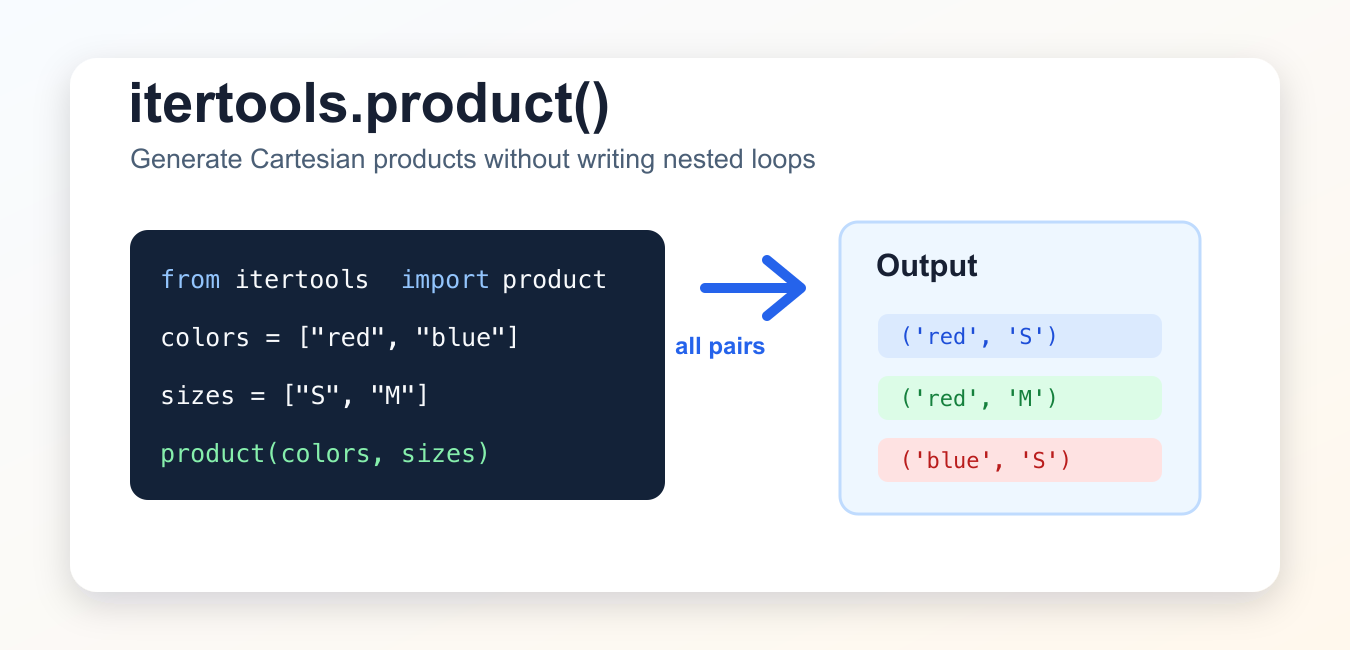
itertools.product() returns the Cartesian product of input iterables. In practical Python code, it is a compact way to replace nested loops when you need every ordered combination of values. The result is an iterator of tuples, so it can be consumed one combination at a time.
Quick Answer
Import product, pass finite iterables, and iterate over the returned tuples. Use repeat=n when combining an iterable with itself. Avoid converting a large product to a list unless you have enough memory and genuinely need every result at once.
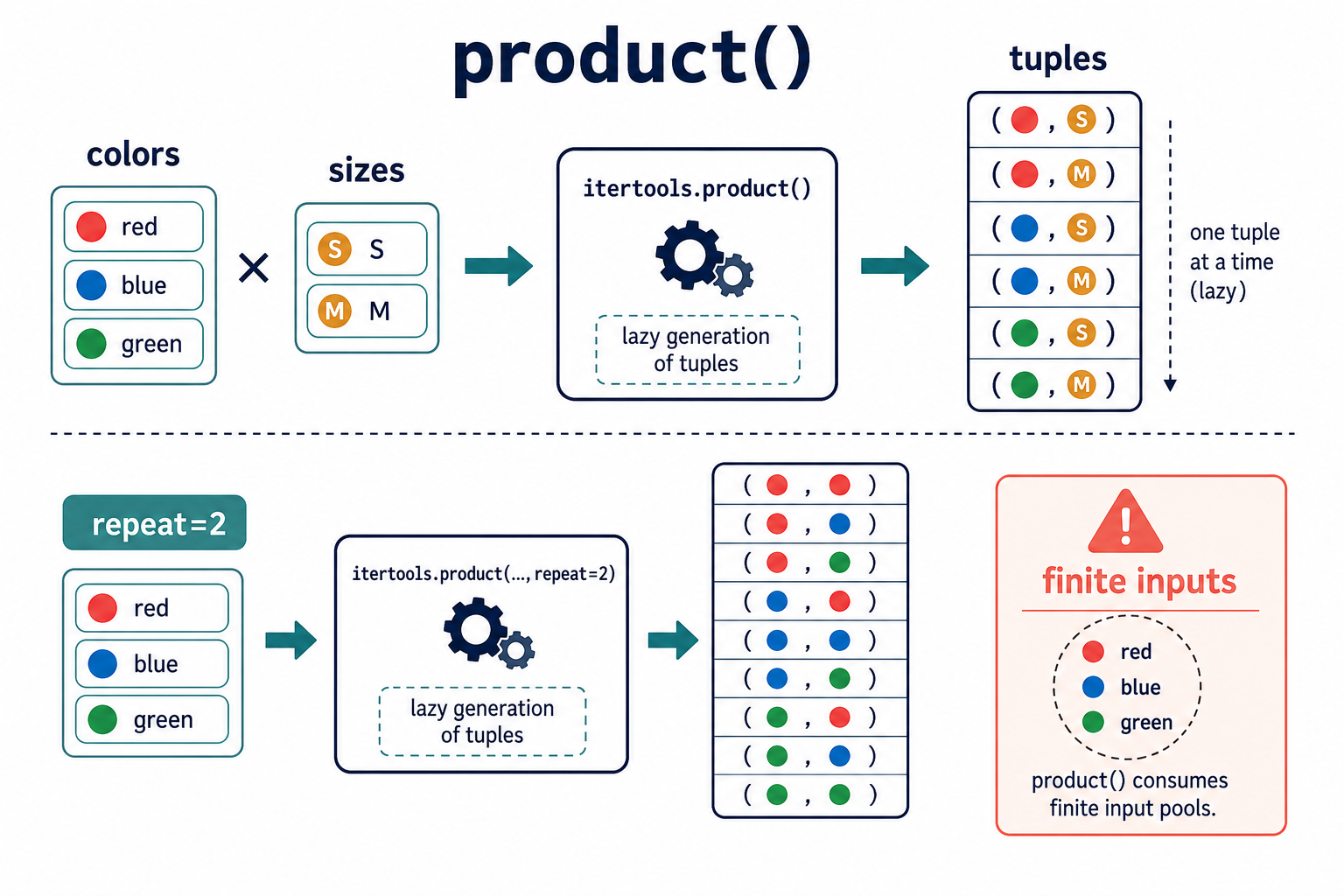
The official itertools.product documentation describes the function as the Cartesian product of the input iterables. It also notes that the input iterables are consumed into pools before results are generated, so the inputs must be finite.
Basic itertools.product() Example
Pass two or more iterables to generate every ordered pair.
from itertools import product

colors = ['red', 'blue']
sizes = ['S', 'M', 'L']

for color, size in product(colors, sizes):
    print(color, size)
The rightmost iterable changes fastest. With the lists above, red is paired with every size before blue is processed. This ordering is useful when the inputs are already sorted and you need predictable output.
Understand The Number Of Combinations
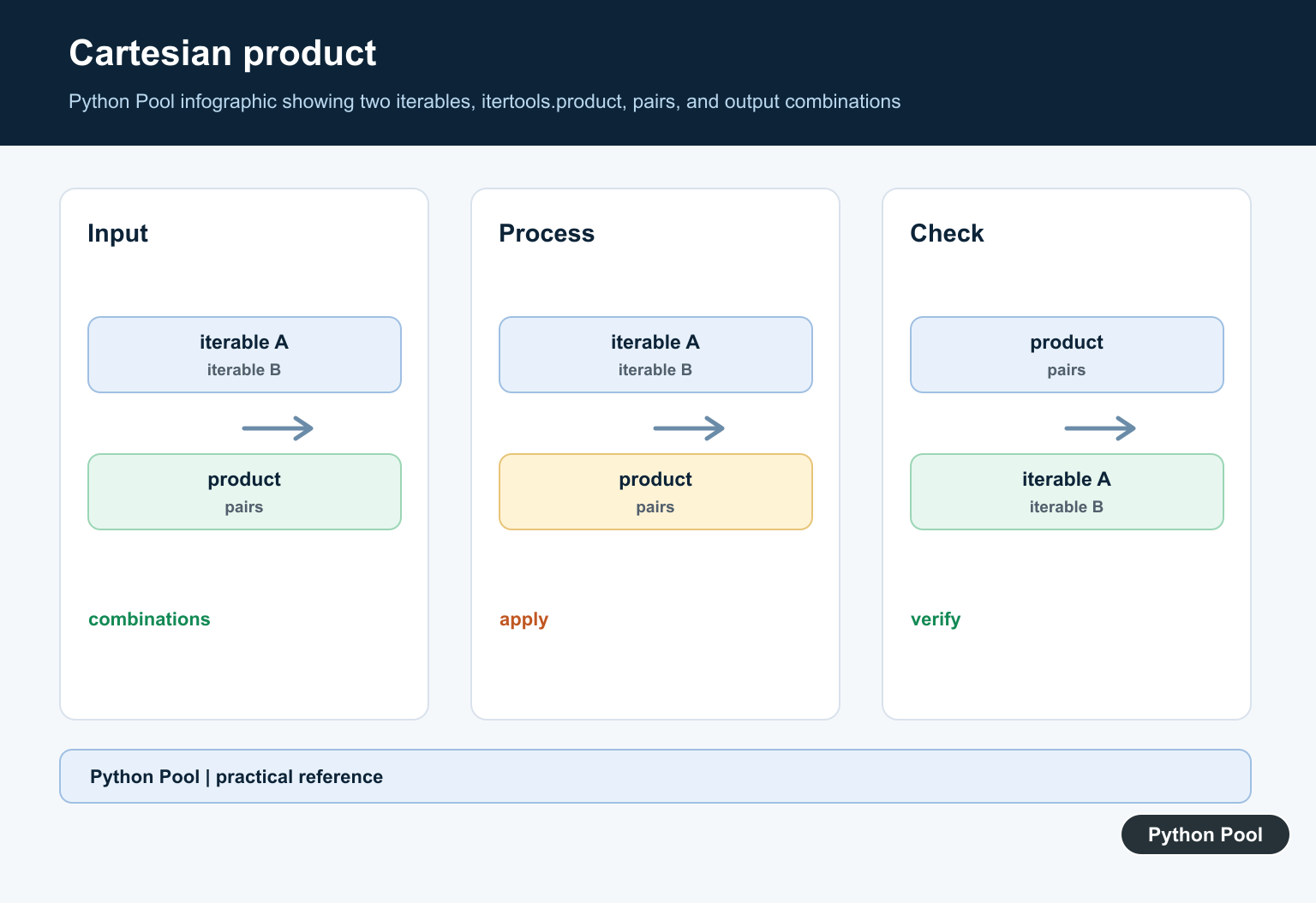
If the input lengths are 2 and 3, the product contains 2 times 3, or 6, tuples. With three inputs of lengths 10, 20, and 30, there are 6,000 combinations. The count grows multiplicatively, so estimate it before doing expensive work.
from itertools import product

colors = ['red', 'blue']
sizes = ['S', 'M', 'L']

combinations = list(product(colors, sizes))
print(combinations)
print(len(combinations))
Converting to a list is fine for a small example. For a large search space, keep the iterator and process each tuple as it arrives.
Use repeat For An Iterable With Itself
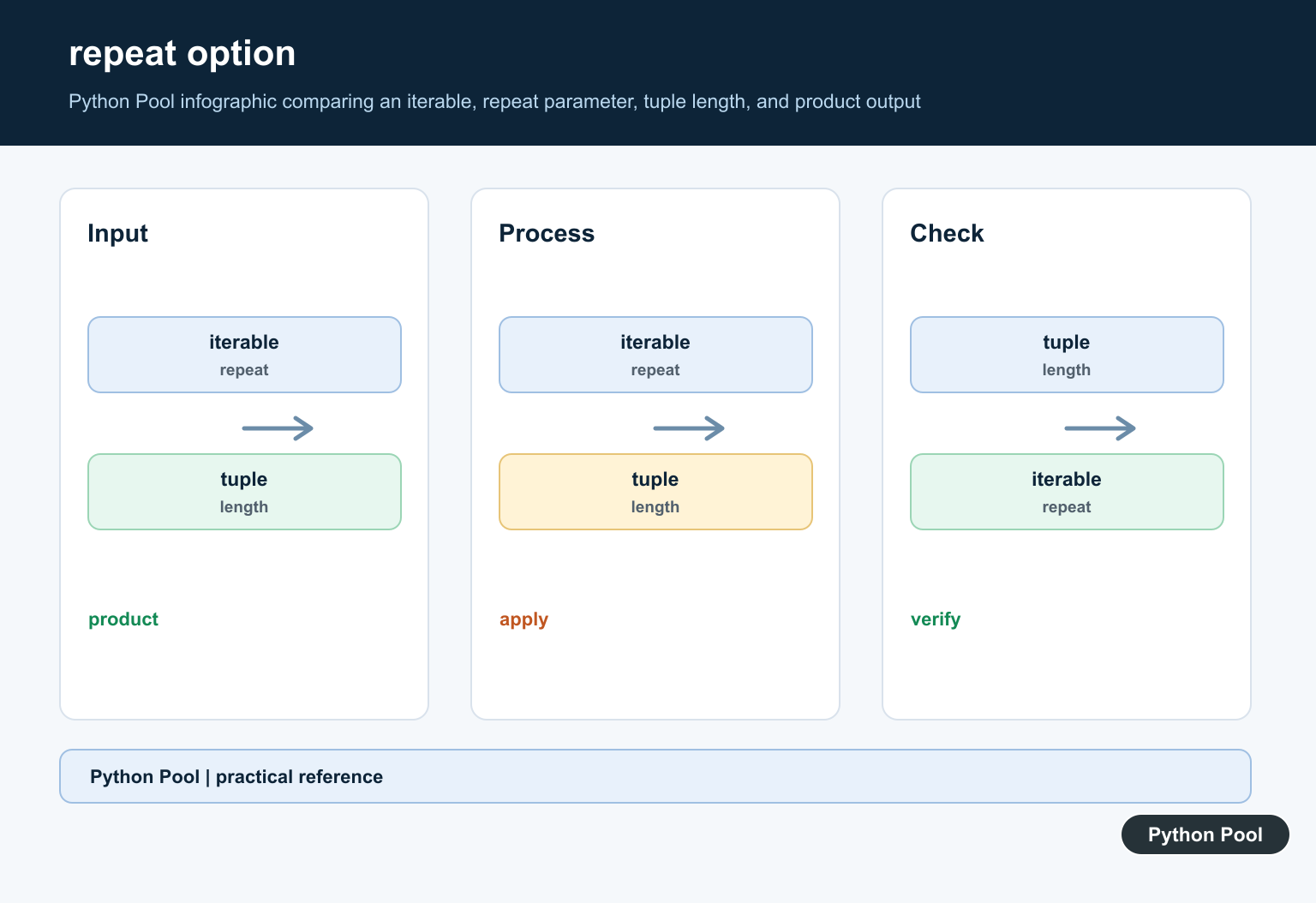
product(values, repeat=2) is equivalent to passing the same iterable twice. It is useful for pairs, grids, and small parameter spaces.
from itertools import product

values = ['A', 'B', 'C']

for pair in product(values, repeat=2):
    print(pair)
repeat=3 produces triples, and so on. A negative repeat raises ValueError. Treat the repeat value as part of the search-space size: a set of 10 values repeated four times has 10,000 combinations.
Product Is Lazy, But Inputs Are Consumed
The output is generated as an iterator, which means you do not need to allocate the entire result list. However, the documentation notes that product first consumes each input iterable into a pool. An infinite generator is therefore not a suitable input.
from itertools import product

def bounded_values():
    for value in range(3):
        yield value

for pair in product(bounded_values(), 'ab'):
    print(pair)
The generator above is finite. If a source is expensive or one-shot, remember that product stores the consumed values for later cycles.
Replace Nested Loops Carefully
Product is roughly equivalent to nested loops and often makes the combination intent easier to see.
from itertools import product

environments = ['dev', 'prod']
regions = ['us', 'eu']

for environment, region in product(environments, regions):
    print(environment, region)
Do not replace nested loops automatically when the inner loop has early exits, depends on mutable state, or should skip combinations. In those cases explicit control flow may communicate the algorithm better.
Filter Products Without Building Huge Lists
Keep the result lazy and filter during iteration when only some combinations are valid.
from itertools import product

numbers = range(5)

valid = (
    (left, right)
    for left, right in product(numbers, repeat=2)
    if left < right
)

for pair in valid:
    print(pair)
This still visits the product combinations, but it avoids storing rejected tuples. If the search space is too large to visit at all, use a more targeted algorithm rather than relying on a filter after product.
Product And Other itertools Tools
Use combinations() when order should not matter, permutations() when order matters without reuse, and combinations_with_replacement() when repeated values are allowed without treating order as distinct. Choosing the right function prevents duplicate work.
Use islice() when you need only the first part of a product iterator. This is helpful for previews, bounded tests, and user interfaces that should not compute every result before displaying the first few.
Common itertools.product() Mistakes
- Converting a huge product to a list without estimating its size.
- Passing an infinite iterator as an input.
- Using product when combinations or permutations express the real rule.
- Forgetting that tuple order follows the input order.
- Mutating source data while expecting the already-created product to change.
The practical rule is to use product for finite Cartesian combinations, keep the result lazy when possible, and make the multiplication of input sizes visible in code review. That keeps a concise expression from becoming an accidental memory or runtime problem.
Estimate Work Before Calling Product
For inputs with lengths n1, n2, and n3, the result count is n1 times n2 times n3. With repeat, the input length is raised to the repeat value. A quick estimate helps you decide whether to stream results, cap the search, or choose a different algorithm.
Time and memory are separate concerns. Keeping the iterator lazy avoids a result list, but downstream code can still perform expensive work for every tuple. Put a bound or early stopping rule near the consumer when the search is exploratory.
Preserve Input Order
Product emits tuples in an odometer-like order: the rightmost input advances fastest. If your input sequences are sorted, the emitted tuples follow a predictable lexicographic order. If the input came from a set or an unordered source, do not promise a stable order without sorting it first.
Stable ordering makes tests and reproducible reports easier. It also makes a first-page preview more useful because readers know why one combination appears before another.
Stop Early With islice
Use itertools.islice() when a caller needs only a bounded preview. This keeps the product expression lazy and avoids building a list just to take its first few entries.
A preview limit should be explicit in the interface. Returning only a prefix of a search can be correct for exploration but incorrect for a validation job that must inspect every combination.
For related itertools choices, compare product with combinations and islice. Read itertools combinations and pythons itertools islice for the related workflow.
Frequently Asked Questions
What does itertools.product() do?
itertools.product() returns the Cartesian product of input iterables as an iterator of tuples, equivalent in spirit to nested loops.
What does repeat mean in itertools.product()?
repeat=n combines one iterable with itself n times. The output tuple has n positions and the number of results grows as the input length raised to n.
Is itertools.product() lazy?
Its results are yielded as an iterator, but product consumes each input iterable into a pool first. The inputs therefore need to be finite.
Should I convert product() to a list?
Only when the result is small and you need random access or repeated traversal. For large products, iterate directly or use islice() to limit the work.