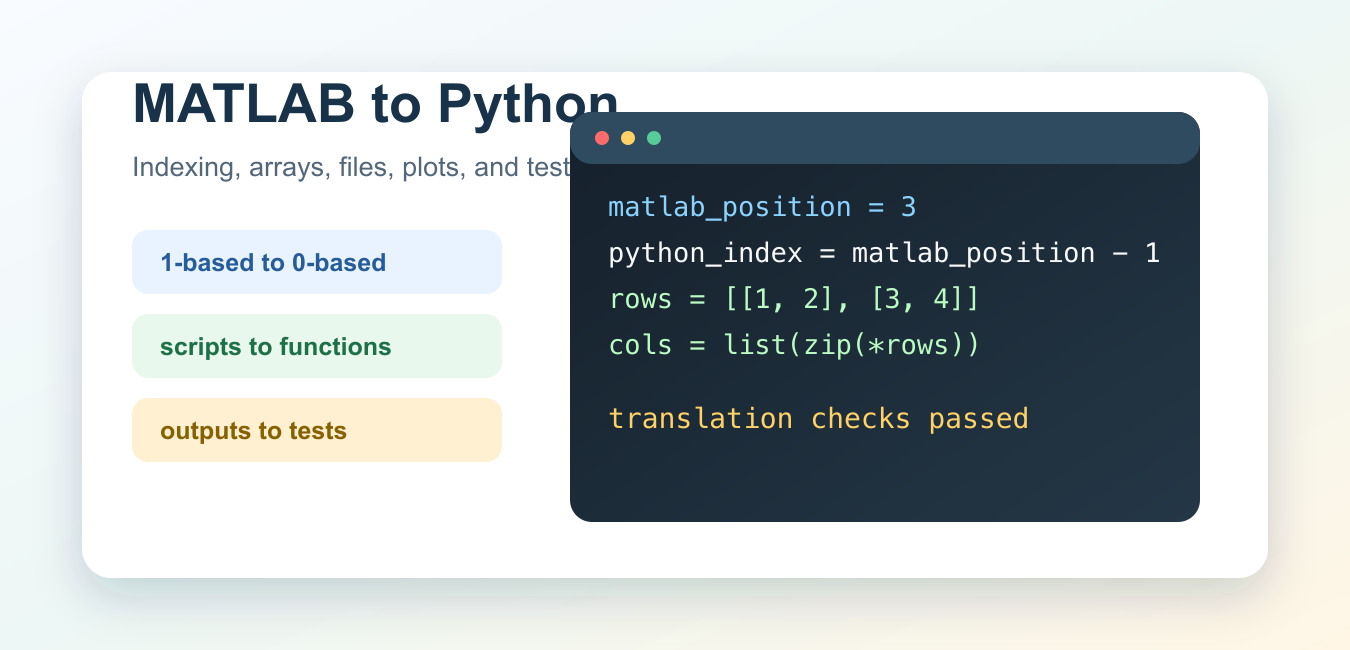
Quick answer: A MATLAB migration is a concept-by-concept translation, not a punctuation replacement. Map arrays and vectorization to NumPy, numerical routines to SciPy, and plots to Matplotlib, while checking one-based versus zero-based indexing, shape, broadcasting, and slicing at every step.
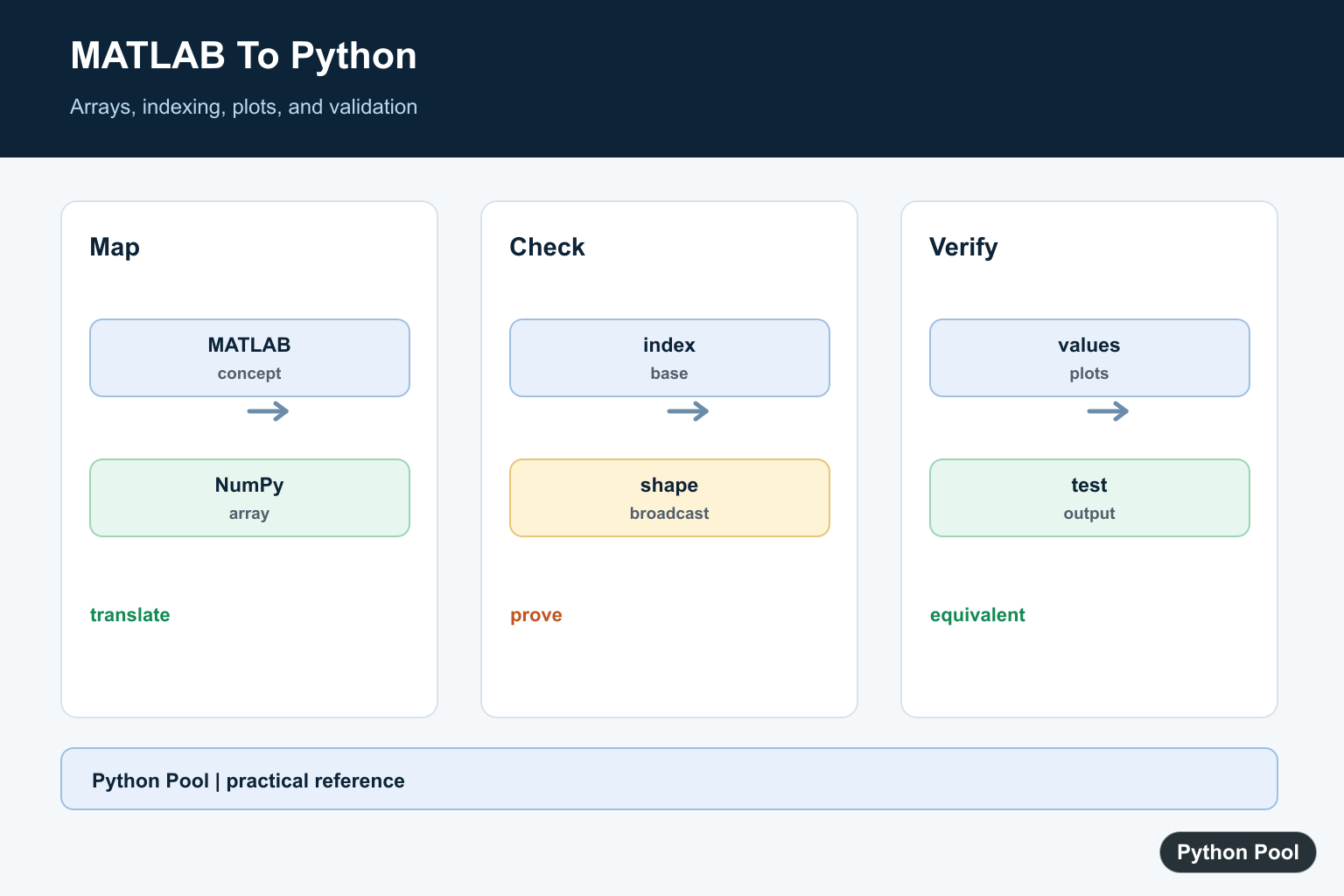
Converting MATLAB code to Python is less about changing syntax one line at a time and more about translating habits. MATLAB starts from matrices, 1-based indexing, scripts, and built-in numeric workflows. Python gives you a smaller core language, then expects you to choose libraries such as NumPy, SciPy, pandas, matplotlib, or pathlib for the job.
A good migration starts with behavior. Identify the inputs, expected outputs, array shapes, edge cases, and plots before rewriting a large script. Then translate a small section, run it, compare results, and move to the next section. This keeps the rewrite testable and prevents subtle indexing mistakes from spreading through the whole program.
The official references for common migration work are NumPy for MATLAB users, scipy.io.loadmat, matplotlib pyplot, csv, and pathlib.
Do not rely on automatic conversion alone for production code. Conversion tools may help with a first draft, but they cannot know your numerical tolerances, data format contracts, plotting requirements, or performance target. A reviewed rewrite with small tests is usually safer.
The examples below use only Python’s standard library so they run anywhere. In real scientific code, replace manual loops with NumPy arrays where that improves clarity and speed.
Translate 1-Based Indexing
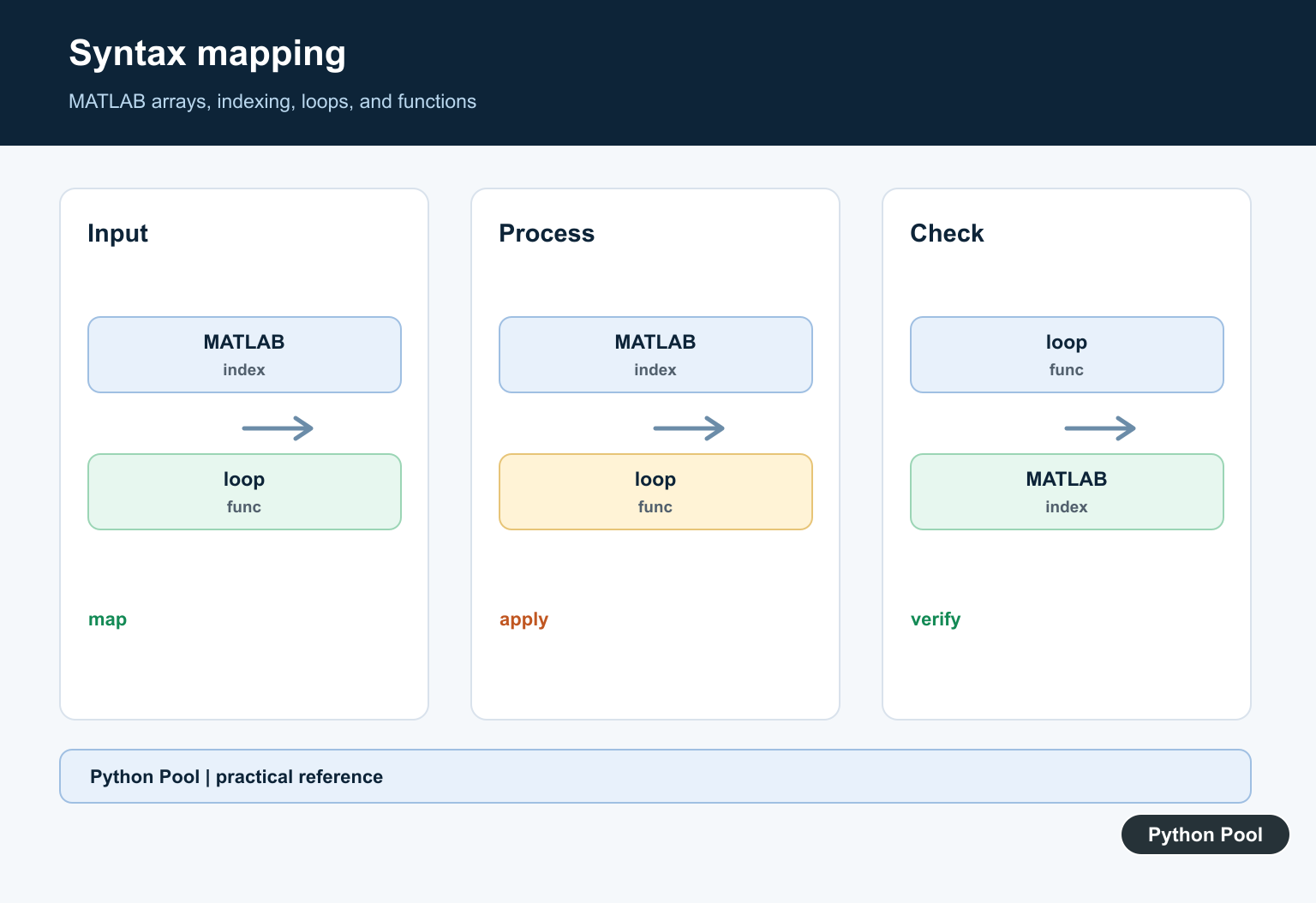
MATLAB indexing starts at 1. Python indexing starts at 0. This is the first thing to check when porting loops, slices, and table columns.
matlab_position = 3
items = ["red", "green", "blue", "gold"]

python_index = matlab_position - 1

print(items[python_index])
print(items[1:3])
The slice items[1:3] returns positions 2 and 3 from a MATLAB point of view. Python’s stop index is excluded, so translated slices often need careful review.
When a MATLAB loop starts with for i = 1:n, the Python form is usually for i in range(n) if i is used as an index. If the loop is reading elements, iterate over the elements directly instead.
Rewrite Matrix Shaping Carefully
MATLAB makes matrix operations feel native. In Python, plain lists can show the idea, while NumPy is the usual production tool for numeric arrays.
rows = [
    [1, 2, 3],
    [4, 5, 6],
]

transposed = [list(column) for column in zip(*rows)]
column_totals = [sum(column) for column in zip(*rows)]

print(transposed)
print(column_totals)
This example uses zip(*rows) to read columns from row-oriented data. In NumPy, the same intent would normally use arrays and the .T transpose property.
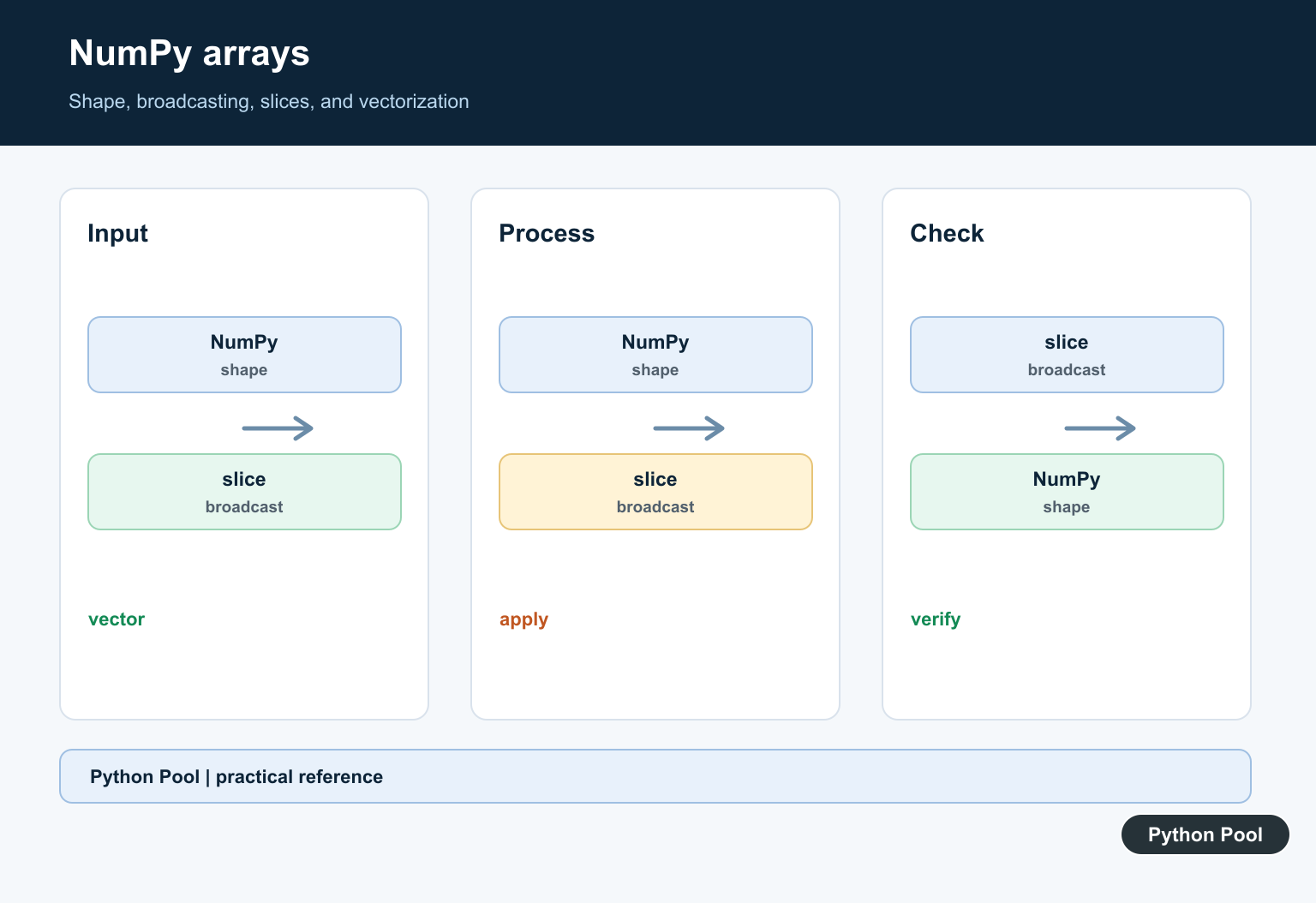
During migration, write down the shape at each step. Many bugs come from confusing row vectors, column vectors, and one-dimensional arrays.
Turn Scripts Into Functions
MATLAB scripts often depend on a shared workspace. Python code is easier to test when each calculation is placed in a function with explicit inputs and outputs.
def normalize_scores(scores):
    low = min(scores)
    high = max(scores)
    span = high - low
    if span == 0:
        return [0 for _ in scores]
    return [(score - low) / span for score in scores]

print(normalize_scores([8, 10, 14, 20]))
This style makes the rewrite easier to compare against MATLAB output. You can call one function with known input and check the result before translating the next block.
It also removes hidden dependencies. A function that receives its data as arguments is easier to reuse in notebooks, scripts, web jobs, and tests.
Replace Vector Habits With Clear Python
Small data processing steps can be written with comprehensions. For large numeric workloads, NumPy is the better target, but a clear pure-Python version is often useful while testing the translation.
readings = [12.5, 13.0, 12.0, 14.5]
average = sum(readings) / len(readings)

centered = [round(item - average, 2) for item in readings]
above_average = [item for item in readings if item > average]

print(round(average, 2))
print(centered)
print(above_average)
After this behavior is correct, you can move the same calculation to NumPy if performance or array operations matter. Keep the pure-Python version as a small reference test when useful.
Do not translate every MATLAB vector expression into clever Python. Readability matters more than preserving the original shape of every line.
Move Data Through Files Deliberately
MATLAB projects often use .mat files. Python can read many of them through SciPy, but CSV or another open tabular format is easier when you control the export.
import csv
from pathlib import Path
from tempfile import TemporaryDirectory

rows = [{"name": "alpha", "score": 10}, {"name": "beta", "score": 14}]

with TemporaryDirectory() as folder:
    path = Path(folder) / "scores.csv"
    with path.open("w", newline="", encoding="utf-8") as handle:
        writer = csv.DictWriter(handle, fieldnames=["name", "score"])
        writer.writeheader()
        writer.writerows(rows)

    print(path.read_text(encoding="utf-8").splitlines()[0])
If old MATLAB data must stay in .mat files, use SciPy’s loader and inspect the resulting keys and shapes. If the pipeline is new, choose CSV, Parquet, SQLite, or a documented API format based on the data shape.
Add Tests Around The Port
The safest migration plan compares the old result and the new result with a known tolerance. Start with small deterministic cases, then add representative real files.
def moving_average(items, width):
    results = []
    for start in range(0, len(items) - width + 1):
        window = items[start : start + width]
        results.append(sum(window) / width)
    return results

expected = [2.0, 3.0, 4.0]
actual = moving_average([1, 2, 3, 4, 5], 3)

assert actual == expected
print("translation checks passed")
For floating-point code, compare with a tolerance instead of exact equality. NumPy’s isclose and testing helpers are useful once the rewrite uses NumPy arrays.
In short, convert MATLAB to Python by translating behavior in small pieces. Fix indexing first, make shapes explicit, move scripts into functions, choose the right data format, and keep tests next to the migrated code. Use NumPy, SciPy, pandas, and matplotlib where they fit, but let readable Python structure guide the rewrite.
Translate Indexing And Shapes
MATLAB starts indices at one and includes different slice endpoints. Python starts at zero, and a row or column shape can change how broadcasting behaves, so write small shape assertions around the conversion.
import numpy as np

matrix = np.arange(12).reshape(3, 4)
first_column = matrix[:, 0]
assert first_column.shape == (3,)
print(first_column)
Map Vectorized Operations
NumPy replaces many MATLAB array operations, but operators act element by element unless a matrix operation is requested. Make the intended dimension and operation explicit.
import numpy as np

x = np.array([1., 2., 3.])
y = x ** 2
dot_product = x @ y
print(y, dot_product)
Replace Plots Deliberately
Matplotlib can reproduce common MATLAB plots, but figure, axes, labels, legends, and export settings should be expressed in a testable object-oriented form.
import matplotlib.pyplot as plt

fig, ax = plt.subplots()
ax.plot([0, 1, 2], [0, 1, 4], label="quadratic")
ax.set_xlabel("x")
ax.set_ylabel("y")
ax.legend()
fig.savefig("converted-plot.png", bbox_inches="tight")
Validate Numerical Equivalence
Compare representative values, array shapes, boundary cases, and visual output. A script that executes successfully can still be wrong because of indexing or implicit type conversion.
import numpy as np

expected = np.array([1., 4., 9.])
actual = np.array([1., 4., 9.])
np.testing.assert_allclose(actual, expected)
print("conversion check passed")
NumPy’s For MATLAB Users guide is a useful primary mapping reference. Related references include NumPy statistics, Matplotlib annotations, and axis behavior.
For related migration checks, compare NumPy statistics, Matplotlib annotations, and axis behavior when translating numerical code.
Frequently Asked Questions
What is the Python equivalent of MATLAB arrays?
NumPy arrays provide vectorized numerical arrays, but indexing and shape conventions must be checked explicitly during migration.
Is MATLAB indexing the same as Python indexing?
No. MATLAB is one-based while Python uses zero-based indexing, and slicing endpoints have different rules.
What replaces MATLAB plots?
Matplotlib covers common plotting workflows, while pandas or Seaborn can help with tabular and statistical visualization.
How should I validate a MATLAB conversion?
Compare representative numerical outputs, shapes, edge cases, and plots instead of relying only on code that runs without errors.