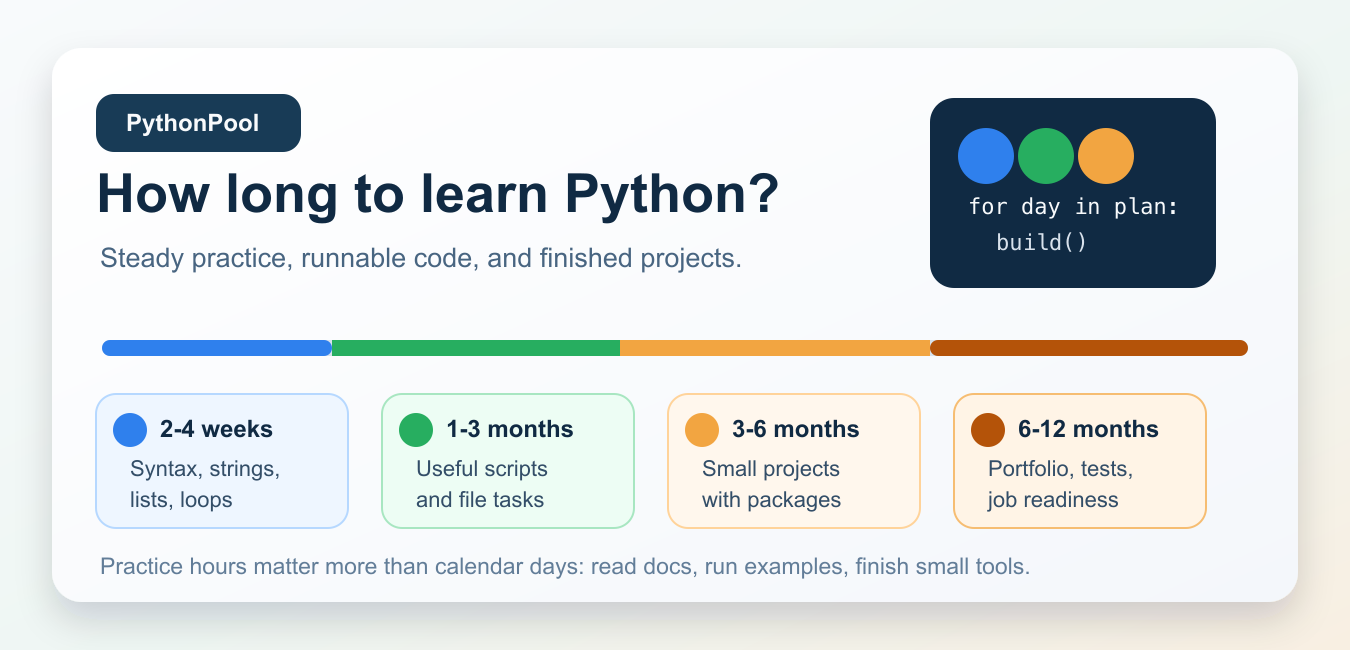
Quick answer: There is no universal number of days to learn Python. A learner can often build small scripts after consistent beginner practice, while job readiness or production expertise requires projects, debugging, testing, domain knowledge, and sustained feedback over a longer period.
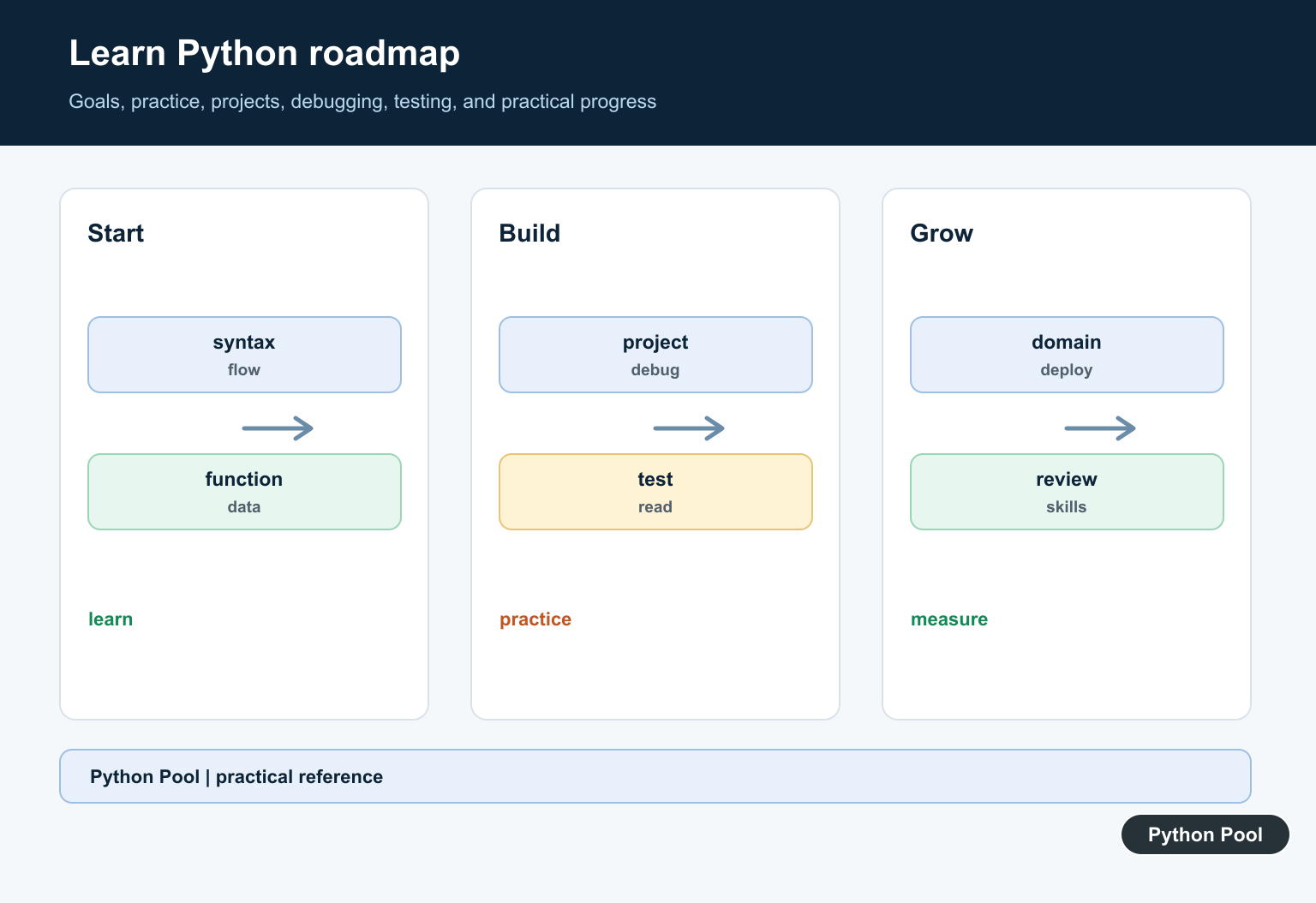
How long does it take to learn Python? For most new learners, the honest answer is a range: a few weeks for basic syntax, a few months for useful scripts, and several more months of steady project work before Python feels dependable in real tasks. Prior programming experience, weekly practice time, feedback, and project choice matter more than the calendar.
The official Python beginner page describes Python as easy for beginners to use and learn, while the Python tutorial is written for people who are new to the language and want hands-on examples. That gives a useful benchmark: learning Python is not just watching lessons. It means typing code, reading errors, using the interpreter, and building small programs often enough that the basics become familiar.
Short Answer: A Realistic Timeline
If you can practice five to eight focused hours per week, a practical timeline looks like this. In the first two to four weeks, aim to understand numbers, strings, lists, dictionaries, conditions, loops, and functions well enough to edit small examples. In one to three months, you can usually write simple scripts for text, files, calculations, and command-line tasks. In three to six months, you can start building small apps, automation tools, data cleaning scripts, or web-adjacent projects with outside packages. In six to twelve months, you can develop a portfolio, read documentation with less friction, and prepare for entry-level work or deeper study.
No timeline is a promise. A learner who has used JavaScript, Java, or C++ may move quickly through syntax. A complete beginner may need more time with problem solving, debugging, and editor workflow. A learner studying for data analysis, web development, testing, or automation also needs different practice after the core language.
hours_per_week = 8
milestones = [
    ("syntax and small exercises", 18),
    ("functions, files, and errors", 35),
    ("small automation projects", 70),
    ("portfolio-ready practice", 140),
]

total_hours = 0
for label, hours in milestones:
    total_hours += hours
    week = round(total_hours / hours_per_week, 1)
    print(f"{label}: around week {week}")
Weeks 1-4: Learn The Core Syntax
Start with the parts Python uses everywhere: expressions, assignment, strings, lists, dictionaries, if statements, for loops, and function definitions. The informal introduction in the official tutorial is a good source for numbers, text, lists, and first programs. During this stage, keep examples small and type them yourself. Copying once is fine, but changing the input and predicting the output is where learning starts.
name = "Maya"
hours_done = 6
weekly_goal = 8

hours_left = max(weekly_goal - hours_done, 0)
message = f"{name} has {hours_left} practice hours left this week."

print(message)
print(type(hours_done).__name__)
Do not rush past errors. A beginner who can read a NameError, a TypeError, and an indentation problem is already building the skill that makes later projects possible. Spend short daily sessions in the interpreter or a notebook, then move code into files once it has more than a few lines.
Months 1-3: Write Useful Small Programs
After syntax, focus on control flow and functions. The official tutorial section on control flow tools covers if, for, range(), loop control, match, and function definitions. This is the point where Python should stop feeling like isolated commands and start feeling like a way to describe a small process from input to output.
def practice_label(minutes):
    if minutes < 25:
        return "warmup"
    if minutes < 60:
        return "focused"
    return "deep practice"


sessions = [15, 45, 80]
for minutes in sessions:
    print(minutes, practice_label(minutes))
Good month-two projects are deliberately modest: rename a group of files, summarize a text log, calculate a budget, clean rows from a CSV string, or make a quiz. These projects are valuable because they force you to connect functions, branches, loops, and data structures. A polished tiny tool teaches more than a half-finished large app.
Months 3-6: Build Projects With Data Structures And Files
Python becomes much more useful once lists, dictionaries, sets, tuples, and file handling feel normal. The official tutorial section on data structures is worth revisiting after you have written several programs, because concepts such as comprehensions and dictionary looping make more sense after repetition.
topics = ["strings", "lists", "loops", "functions"]
completed = {"strings", "loops"}

remaining = [topic for topic in topics if topic not in completed]
schedule = {day: topic for day, topic in enumerate(remaining, start=1)}

print(remaining)
print(schedule)
At this point, add files and packages carefully. The official guide to virtual environments and packages explains why projects often need their own isolated package setup. You do not need many packages to learn Python, but you should learn the habit of keeping project dependencies separate before a project grows.
from csv import DictReader
from io import StringIO

log_text = """day,minutes
Mon,35
Tue,50
Wed,20
"""

rows = list(DictReader(StringIO(log_text.strip())))
total = sum(int(row["minutes"]) for row in rows)
average = total / len(rows)

print(total)
print(round(average, 1))
Months 6-12: Move Toward Job Or Project Readiness
Project readiness means you can build something, explain it, test it, and improve it without needing a tutorial for every line. That includes reading official docs, breaking work into functions, saving sample input, handling common errors, and writing a small README. The standard library unittest documentation is a good next step because tests teach you to state what your code should do.
import unittest


def can_ship(project_parts):
    needed = {"readme", "example", "tests"}
    return needed.issubset(set(project_parts))


class ProjectCheckTest(unittest.TestCase):
    def test_ready_project(self):
        self.assertTrue(can_ship(["readme", "example", "tests", "notes"]))

    def test_missing_tests(self):
        self.assertFalse(can_ship(["readme", "example"]))


unittest.main(verbosity=2)
For structured courses, use reputable learner resources alongside official docs. CS50’s Introduction to Programming with Python gives a course path with exercises, while Python for Everybody is a widely used beginner-friendly book. A course gives sequence and practice pressure; the official docs give exact behavior and reference detail. Use both.
How To Practice So The Timeline Actually Works
Consistency beats long, rare sessions. A useful weekly loop is: read one short section, type two examples, change each example, solve three small exercises, and add one feature to a tiny project. Keep a notes file of errors you solved. Rebuild older exercises without looking. When a concept feels unclear, make the input smaller rather than switching topics immediately.
Avoid unrealistic goals such as “learn all of Python” before building anything. Python’s standard library is large, and professional developers still check documentation. The better target is progressive independence: first understand examples, then modify them, then write small programs from a prompt, then design a project from a real need.
So, How Long Should You Expect?
Expect two to four weeks for basic comfort, one to three months for useful scripts, three to six months for small real projects, and six to twelve months for stronger project or job readiness. The fastest path is not a hidden shortcut. It is steady practice, official documentation, runnable examples, feedback, and projects that are small enough to finish.
Define The Target
Learning syntax for automation, data analysis, web development, interviews, or production systems requires different depth. Write the target outcome before choosing a schedule.
Build In Stages
Start with expressions, control flow, functions, collections, exceptions, modules, and files. Add testing, packaging, APIs, databases, or a framework only when a project needs them.
Practice By Retrieval
Write code from a blank editor, debug failures, read documentation, and explain decisions. Passive videos can introduce a topic, but working through errors builds transferable skill.
Use Small Projects
A project should be narrow enough to finish and difficult enough to require design, input validation, tests, and a README. Increase scope gradually instead of starting with an unbounded app.
Measure Useful Progress
Track completed features, bugs fixed, tests written, code reviewed, and concepts explained. Hours watched or tutorial chapters completed are weaker measures of practical ability.
Expect Maintenance
Real Python work includes reading existing code, upgrading dependencies, handling edge cases, documenting decisions, and operating the result. Learning continues after the first working script.
Use the official Python tutorial as a structured reference. Related Python Pool references include testing and core collections.
For a practical learning plan, compare testing practice, core collections, and string fundamentals before choosing a project.
Frequently Asked Questions
How long does it take to learn basic Python?
Many learners can build small scripts after several weeks of regular practice, but the time varies with prior programming experience, study hours, and the target tasks.
How long until I can get a Python job?
Job readiness depends on a role’s requirements, portfolio quality, debugging and testing ability, domain knowledge, and interview preparation rather than a fixed number of weeks.
What should I learn first in Python?
Start with syntax, control flow, functions, collections, exceptions, modules, files, testing, and small projects that require you to read and debug real code.
How can I learn Python faster?
Practice consistently, build projects slightly beyond your current level, read documentation, write tests, and revisit mistakes instead of only watching tutorials.