
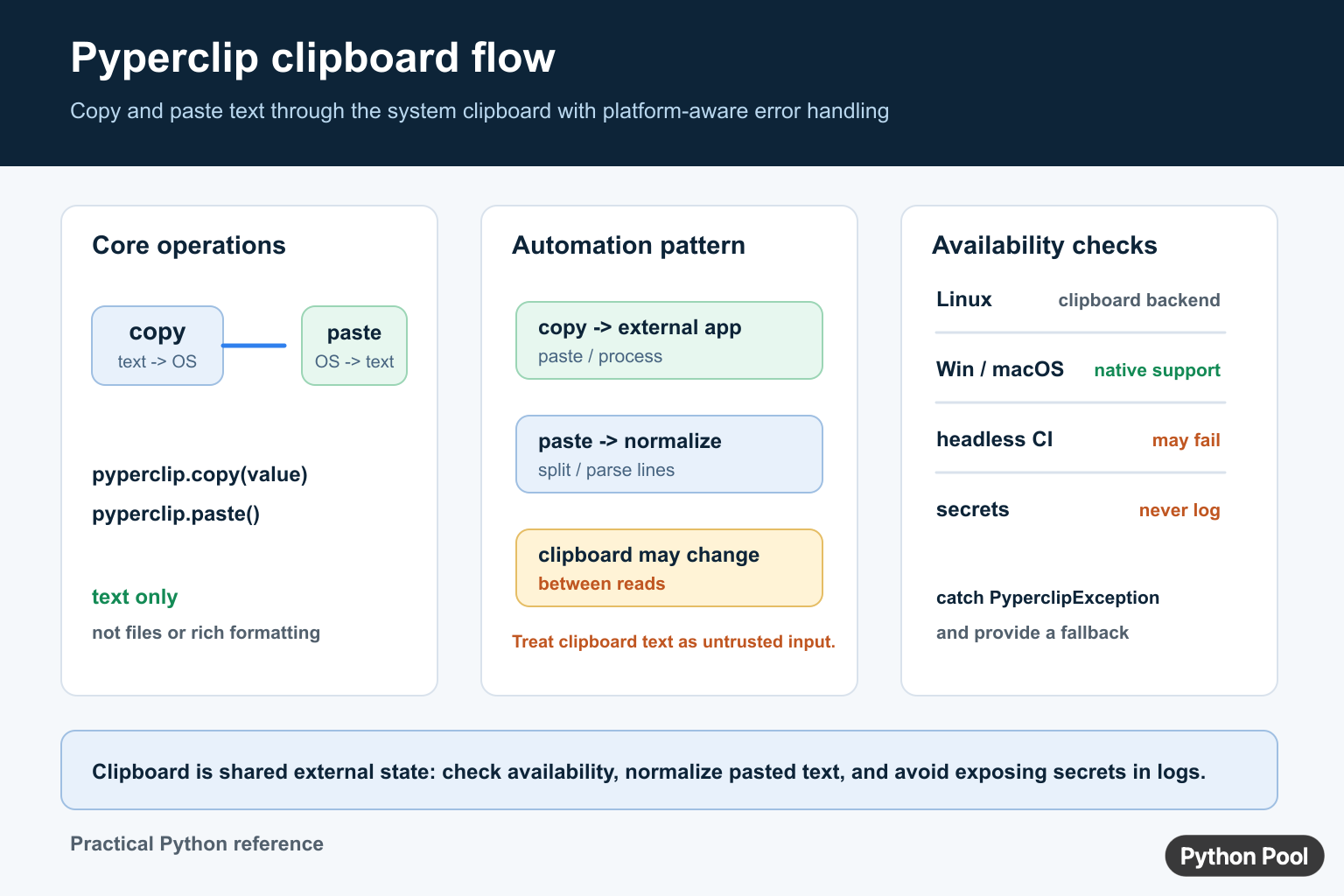
Pyperclip provides a small Python interface for copying text to and reading text from the operating system clipboard. The two core operations are pyperclip.copy(text) and pyperclip.paste(). It is convenient for desktop automation and quick scripts, but the clipboard is shared external state: platform backends may be missing, another application can change the value, and clipboard text should be treated as untrusted input.
Quick answer
Install the package with pip install pyperclip, import it, call copy() to place text on the clipboard, and call paste() to read text back. Pyperclip handles text rather than files or rich formatting. Its documentation describes the API and platform requirements.
Install and import Pyperclip
Install Pyperclip into the same virtual environment that will run the script. A successful installation does not guarantee that a headless server has a usable clipboard backend.
import pyperclip

pyperclip.copy("Python Pool")
value = pyperclip.paste()
print(value)
copy() returns None after requesting the clipboard update. paste() returns text. Keep the two roles separate so later code does not mistake a successful mutation for the clipboard contents.
Transform pasted text
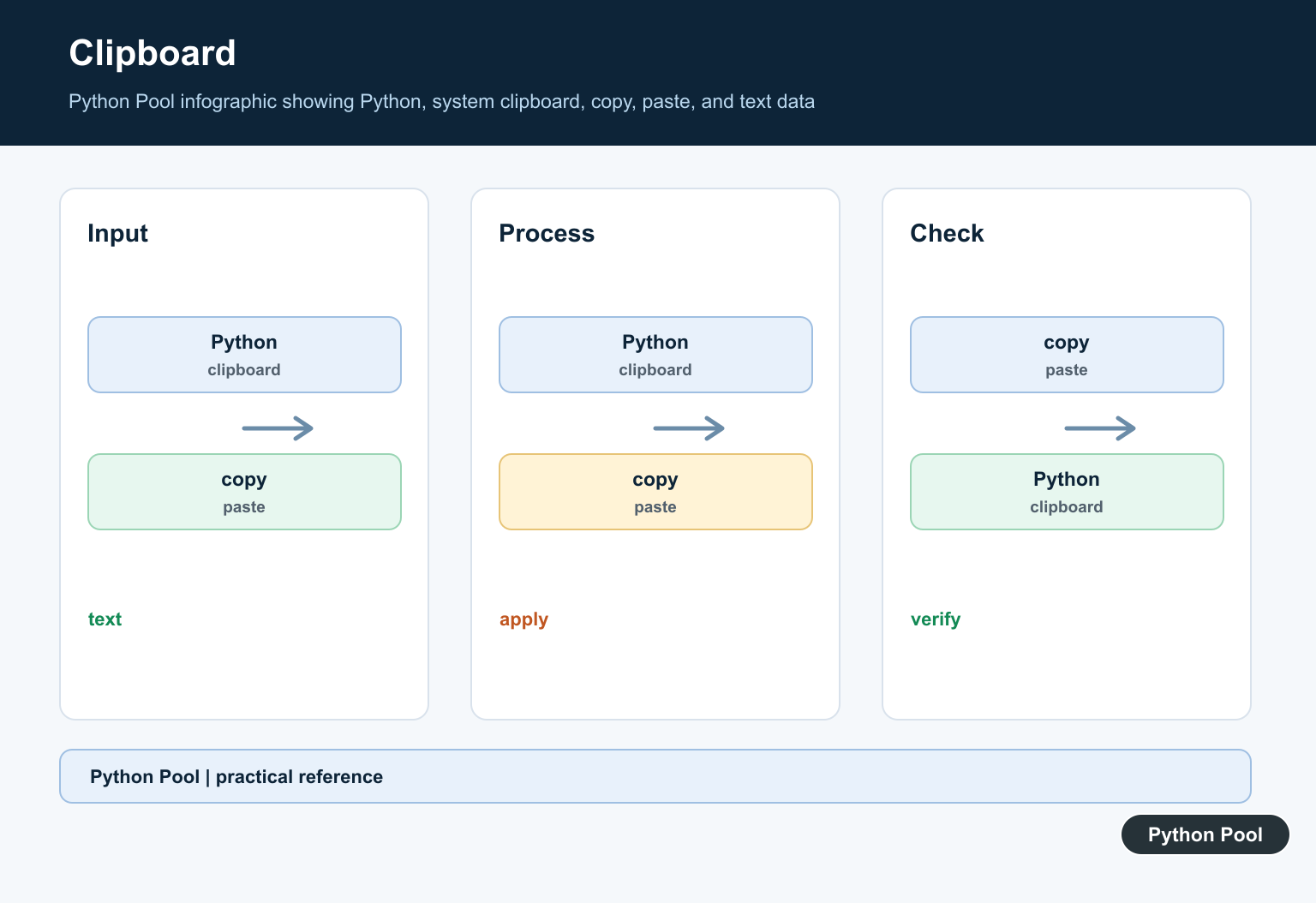
Clipboard contents often need normalization before parsing. Strip only the whitespace the input contract allows, split lines when the user pasted multiple records, and validate each field before using it.
import pyperclip

raw = pyperclip.paste()
lines = [line.strip() for line in raw.splitlines() if line.strip()]
for line in lines:
    print(line)
Do not assume that pasted text comes from a trusted application. It can contain unexpected control characters, very large input, or content that changes the behavior of a downstream parser.
Wait for new clipboard text
For a workflow that waits for a user to copy something, use a bounded wait rather than an infinite loop. Pyperclip versions expose wait helpers for detecting a changed or non-empty clipboard; check the installed version’s documentation and provide a timeout or cancellation policy.
import pyperclip

pyperclip.copy("old value")
try:
    pyperclip.waitForNewPaste(timeout=10)
except pyperclip.PyperclipTimeoutException:
    print("no new clipboard text")
else:
    print(pyperclip.paste())
A wait is still an interaction with shared desktop state. Another application or the user can update the clipboard between the event and the next read, so design the operation to tolerate that race.
Handle platform availability
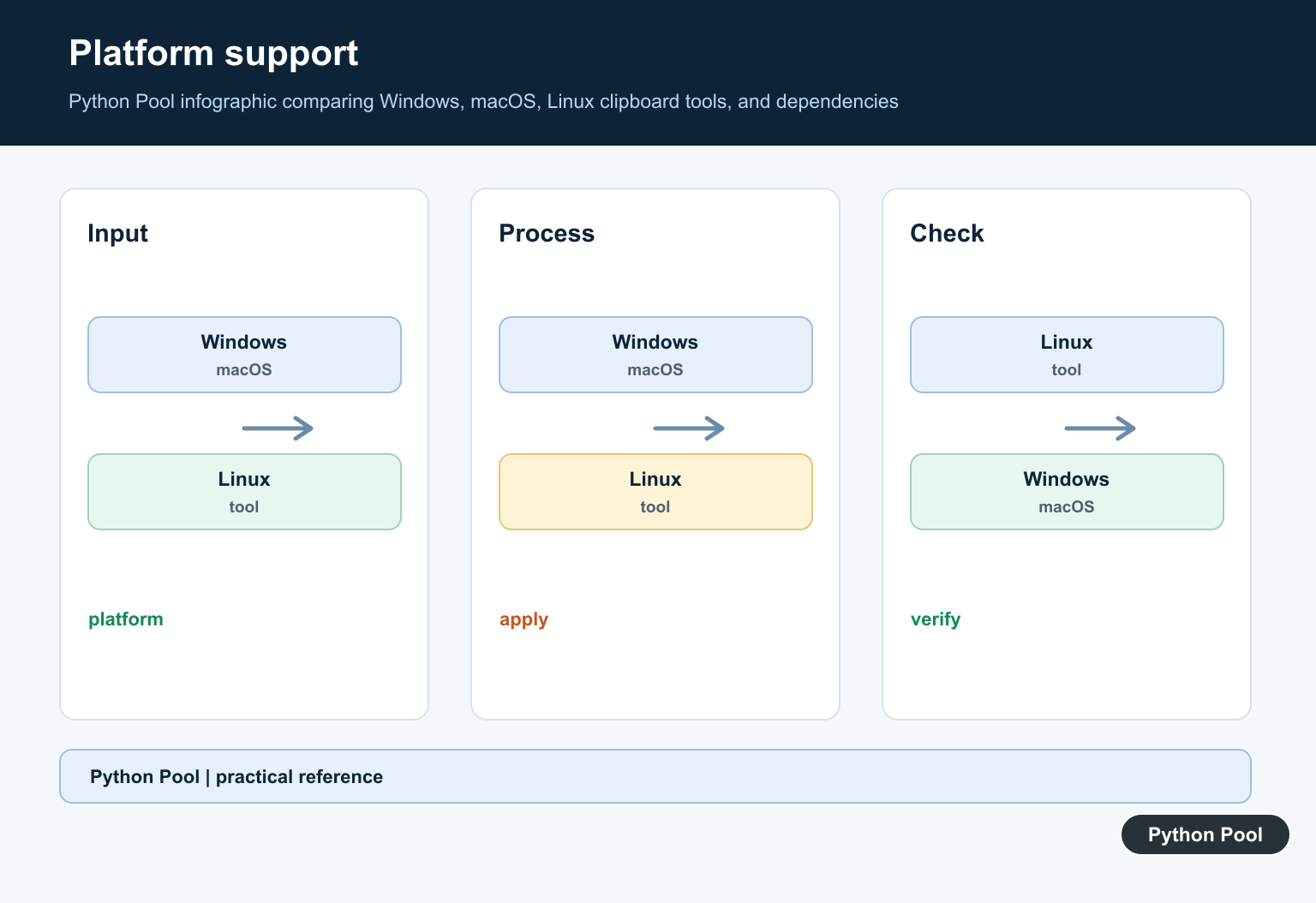
Windows and macOS commonly provide a native clipboard path. Linux environments may need an external backend such as xclip or xsel, and a headless continuous-integration runner may have no display or clipboard at all. Catch PyperclipException and provide a clear fallback when clipboard access is optional.
import pyperclip

try:
    pyperclip.copy("temporary text")
except pyperclip.PyperclipException as error:
    print("clipboard unavailable:", error)
Do not hide the exception and continue as though the copy succeeded. A fallback might write a file, return the text to the caller, or ask the user to paste manually.
Copy multiple lines and text types
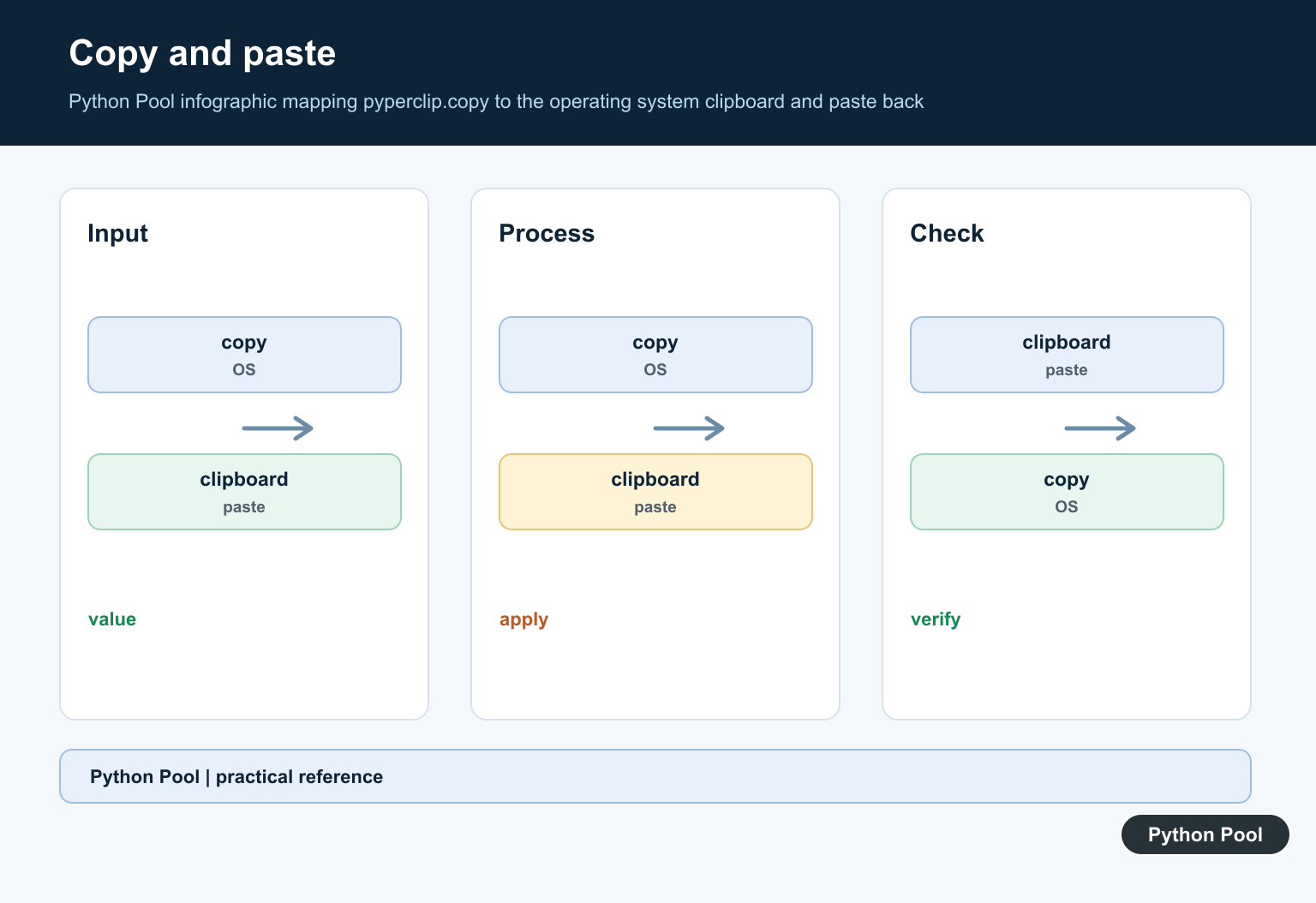
Build one string before copying multiple records. Use newline conventions that match the receiving application and keep encoding concerns separate from the clipboard operation. Pyperclip expects text; encode to bytes only when an external API specifically requires bytes.
Protect secrets
The clipboard can remain accessible to other applications and users. Avoid placing passwords, tokens, or private data on it unless the workflow requires it. Never log the value merely to prove that copy() ran, and clear sensitive content when the operating system and user workflow make that safe.
Keep tests independent from a real clipboard
Unit tests should not depend on whatever text a user’s desktop currently contains. Wrap Pyperclip behind a small interface and test application behavior with a fake copy/paste implementation. Use one focused integration check for the real backend on a machine that has a supported clipboard.
class Clipboard:
    def __init__(self, copy, paste):
        self.copy = copy
        self.paste = paste

def read_clean(clipboard):
    return clipboard.paste().strip()
This design makes headless CI deterministic and keeps platform-specific errors at the boundary. It also prevents a test from overwriting the developer’s clipboard without an explicit integration setup.
Install platform dependencies deliberately
Installing the Python package is only one part of Linux support. A desktop backend or display session may also be needed. Document those system prerequisites in the project setup and fail with an actionable message when they are absent.
Expect clipboard races
Between a copy, a user action, and a paste, another program can replace the clipboard. If the workflow depends on the copied value remaining unchanged, read it back and compare it with an expected marker, or design the operation to tolerate a changed value. Do not use a clipboard read as a synchronization primitive without an explicit protocol.
Separate text from files
Pyperclip transfers text, not file attachments or rich document formats. For a file workflow, pass a path or use the operating system’s file APIs. For binary data, define an encoding or serialization format before crossing the text clipboard boundary.
Make command-line tools predictable
A command-line utility that uses the clipboard should state whether it reads stdin, reads the clipboard, writes the clipboard, or does both. Provide a non-clipboard option for scripts and CI, and do not block forever waiting for a human action. Clear modes make automation safer than guessing from whether the clipboard happens to contain text.
When a copy operation is optional, return the text to the caller as the primary result and use Pyperclip as a convenience layer. That keeps the core logic testable and lets a caller choose a different transport.
For related text workflows, see Python string length, difflib comparisons, and string conversion errors.
For the authoritative API and current behavior, consult the Pyperclip source repository.
Frequently Asked Questions
What is Pyperclip used for?
Pyperclip provides simple copy() and paste() functions for moving plain text between Python and the system clipboard.
Why does Pyperclip fail on Linux?
Linux may need a supported clipboard backend such as xclip, xsel, or a desktop session; headless environments often need a different test strategy.
Does Pyperclip copy files or rich text?
Pyperclip is intended for clipboard text, not file objects or rich formatting. Use an appropriate platform API for those data types.
Is clipboard content safe to trust?
No. Clipboard text is shared external state, so validate and normalize it before parsing and never log passwords, tokens, or other secrets.