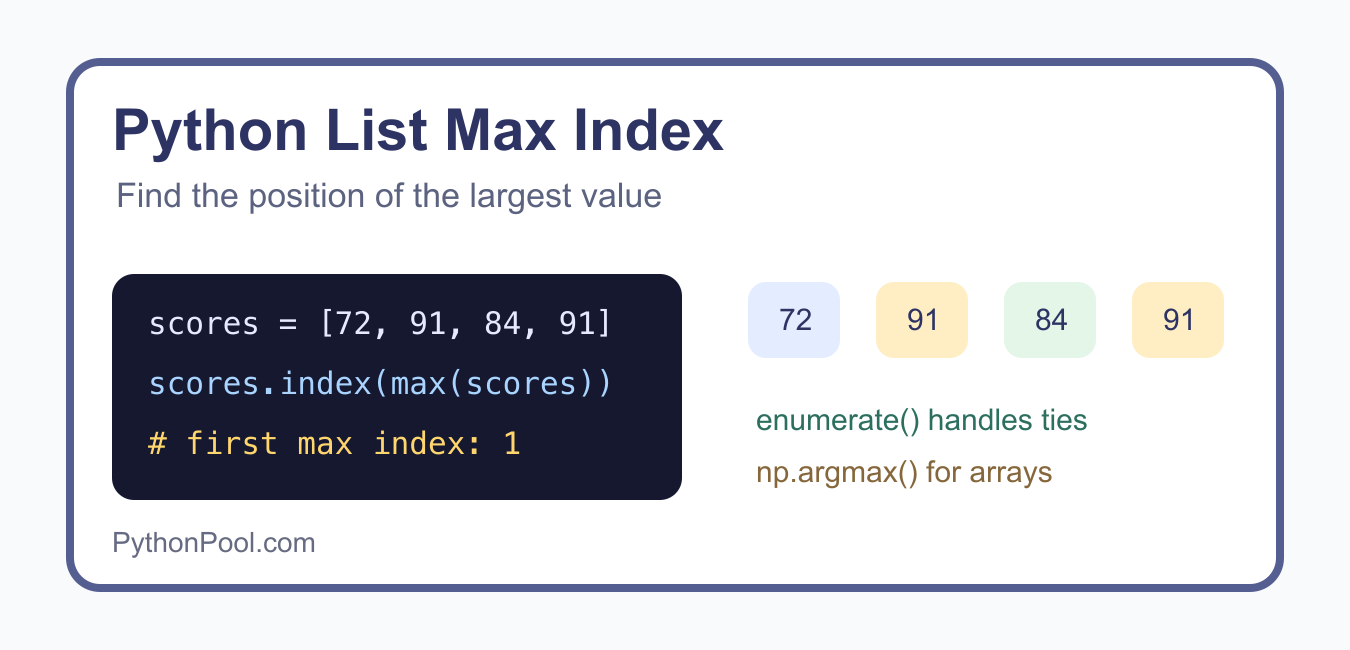
Quick answer: For the first maximum index, call values.index(max(values)) after handling an empty list. Use enumerate for one pass or for all tied positions, and use np.argmax for NumPy arrays with an explicit empty-input policy.
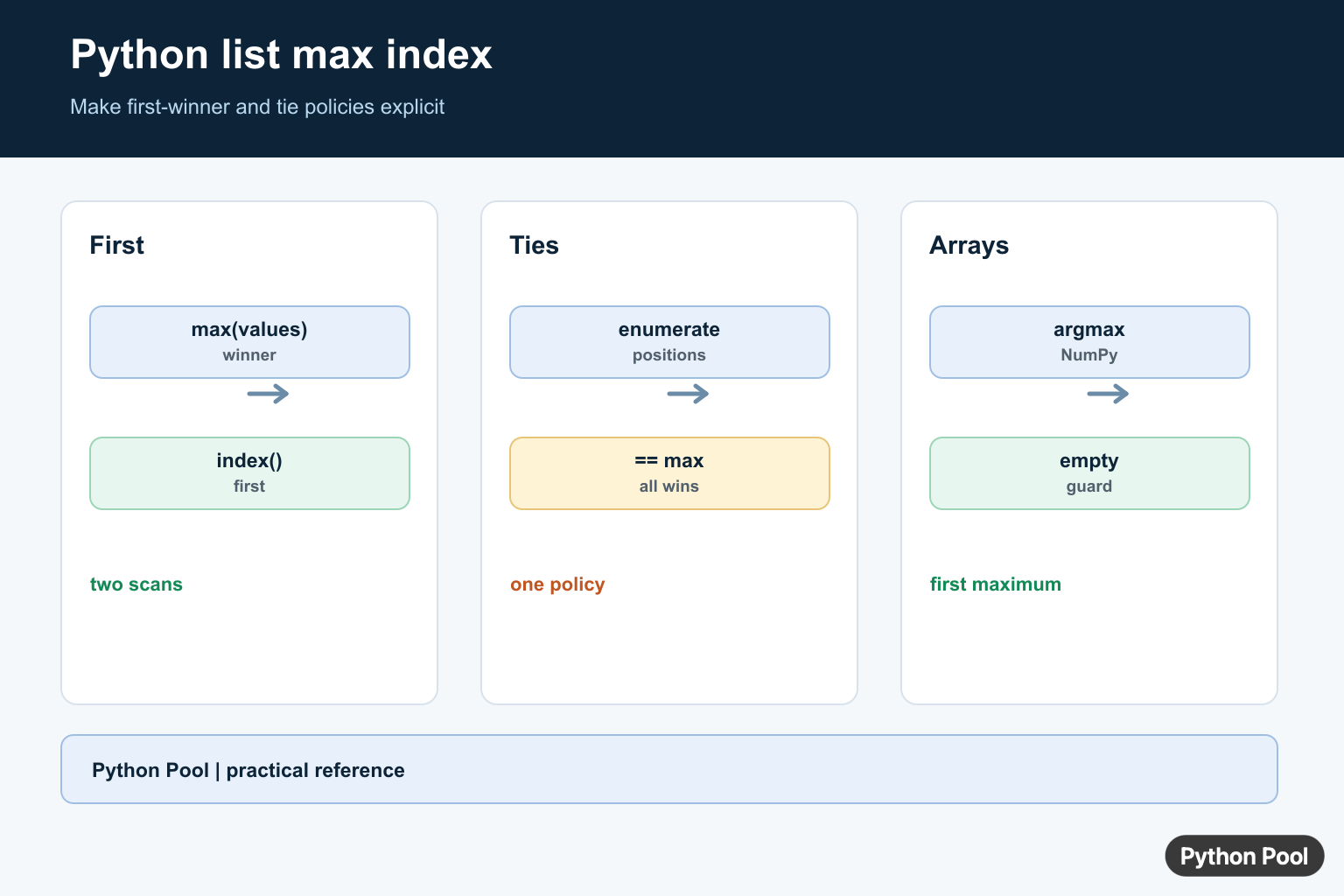
To find the index of the maximum value in a Python list, the common pattern is values.index(max(values)). It is short and readable, but it returns the first matching index when the maximum value appears more than once.
For more control, use enumerate() with max(). That approach can handle ties, custom keys, empty lists, and related data structures more clearly.
Quick Answer
Use max() to find the largest value, then list.index() to find the position of that value.
scores = [72, 91, 84, 91, 65]
max_index = scores.index(max(scores))

print(max_index)
print(scores[max_index])
This prints 1 because the first maximum value is at index 1. Python’s official max() documentation covers the built-in function, and the list methods docs cover list.index().
Handle Empty Lists
max([]) raises ValueError. Check for an empty list before searching for the maximum.
def max_index(values):
    if not values:
        return None
    return values.index(max(values))

print(max_index([4, 9, 2]))
print(max_index([]))
If your code later uses the returned index, handle None explicitly. For adjacent boundary errors, see PythonPool’s list index out of range guide.
Use enumerate() for Index and Value
enumerate() is often better when you need both the position and the value. Python’s official enumerate() documentation describes how it returns index-value pairs.
scores = [72, 91, 84, 91, 65]
index, value = max(enumerate(scores), key=lambda pair: pair[1])

print(index)
print(value)
This also returns the first maximum because max() keeps the first item when the key comparison is tied.
Find All Indexes of the Maximum Value
If ties matter, first find the maximum value, then collect every index where the list contains that value.
scores = [72, 91, 84, 91, 65]
largest = max(scores)
indexes = [index for index, value in enumerate(scores) if value == largest]

print(indexes)
This returns [1, 3]. Use this when equal top scores, equal prices, or duplicate measurements should all be reported.
Find Max Index with a Custom Key
For lists of dictionaries or tuples, compare by a specific field. operator.itemgetter() can make the key function clearer. Python documents it in the official operator.itemgetter() reference.
from operator import itemgetter

students = [
    {"name": "Ada", "score": 88},
    {"name": "Grace", "score": 95},
    {"name": "Linus", "score": 91},
]

index, student = max(enumerate(students), key=lambda pair: itemgetter("score")(pair[1]))

print(index)
print(student)
If you are working heavily with dictionaries, PythonPool’s dictionary size and sort dictionary by key guides are useful follow-ups.
Use NumPy argmax() for Arrays
For NumPy arrays, use np.argmax(). The official numpy.argmax() documentation covers axis behavior and return values.
import numpy as np

values = np.array([12, 18, 7, 18])
print(np.argmax(values))
Choose the Right Pattern
For a small, plain list, values.index(max(values)) is usually the best answer because it says exactly what the code is doing. It finds the largest value first and then asks the list for the position of that value. The tradeoff is that the list is scanned twice: once by max() and once by index(). That is fine for ordinary scripts, validation checks, and short lists.
When the list is large, when each item needs a custom comparison, or when you want the maximum index and value together, max(enumerate(values), key=...) is cleaner. It scans the iterable once and keeps the index attached to each value. This pattern also avoids repeating the same lookup later in the code, which makes bugs less likely when the list can contain duplicate maximum values.
If every tied maximum should be returned, do not use index() alone. Store the largest value in a variable and collect all matching indexes with enumerate(). That makes the tie behavior explicit for readers and for tests. In ranking, grading, pricing, and measurement code, this small decision matters because returning only the first matching maximum can hide valid results.
Practical Notes for Real Data
Indexes are only useful while the list order stays the same. If you call pop(), sort the list, filter values, or build a copied list, a previously saved max index may point to a different item. Keep the index close to the list version it came from, or save the value and any stable identifier you need before changing the list.
- Use
index(max(values))for quick first-match logic. - Use
enumerate()when you need the index and value together. - Use a list comprehension when duplicate maximum values must all be reported.
- Use a key function for dictionaries, tuples, objects, or records.
- Use
numpy.argmax()when the input is a NumPy array.
For production code, also decide what should happen when the list is empty. Returning None, raising a custom error, or supplying a default are all valid choices, but the behavior should be deliberate. Tests should include an empty list, one value, duplicate maximum values, negative numbers, and the data shape your function is meant to handle.
Common Mistakes
- Calling
max()on an empty list without checking first. - Forgetting that
index()returns the first matching position. - Using a saved index after removing items with
pop(). - Comparing dictionaries directly instead of using a key function.
- Using list logic on a NumPy array when
np.argmax()is clearer.
For tuple-style index and value unpacking, see unpack tuple in Python. If rounded values affect which item is largest, read Python round().
FAQs
How do I get the index of the max value in a list?
Use values.index(max(values)) for the first maximum value. Check that the list is not empty first.
How do I get all indexes of the max value?
Find the largest value, then use a list comprehension with enumerate() to collect every matching index.
What should I use for NumPy arrays?
Use numpy.argmax(). It is designed for arrays and supports axis-based maximum-index searches.
Find The First Maximum
max finds the largest value and list.index finds its first occurrence. This is readable for ordinary lists, but it scans the list twice. It also raises ValueError for an empty list, so validate input or expose that behavior intentionally.
values = [4, 9, 2, 9]

if not values:
    raise ValueError("values cannot be empty")
index = values.index(max(values))
print(index)
Find Every Tied Maximum
Compute the maximum once, then enumerate the list to retain every position with that value. This makes the tie policy visible instead of silently returning the first winner.
values = [4, 9, 2, 9]
target = max(values)
indexes = [
    index for index, value in enumerate(values)
    if value == target
]
print(indexes)
Use A Key For Structured Values
max can compare records through a key function, but the index should still refer to the original list. Store the maximum element or its score separately when the comparison field differs from the value you want to return.
records = [
    {"name": "A", "score": 8},
    {"name": "B", "score": 11},
]

best_index = max(range(len(records)), key=lambda i: records[i]["score"])
print(best_index, records[best_index])
Python’s max() and enumerate() references define the comparison and index patterns used here.
For related index searches, compare first matching NumPy indexes, array coordinates, and list index errors when defining boundary behavior.
Frequently Asked Questions
How do I get the index of the largest value in a Python list?
Call values.index(max(values)) after handling the empty-list case; this returns the first index containing the maximum value.
How do I find all indexes tied for the maximum?
Compute the maximum once and use enumerate to collect every position whose value equals it.
What happens with an empty list?
max([]) raises ValueError, so return a sentinel or raise a domain-specific error before trying to find an index.
How do I find a maximum index in a NumPy array?
Use np.argmax for one index, but remember that it returns the first maximum and requires an explicit empty-array policy.
How the a list with 5 indexes gives you 4?
The list is [10,72,54,25,90,40], so max() will return 90 for this list. And list.index(90) will get you 4.
This will be the index of the maximum value in the list.
Regards,
Pratik