
Quick answer: Voluptuous validates Python data structures against schemas and either returns validated or normalized data or raises a validation error. Put it at an input boundary, make required fields and defaults explicit, and keep malformed external data out of trusted application state.
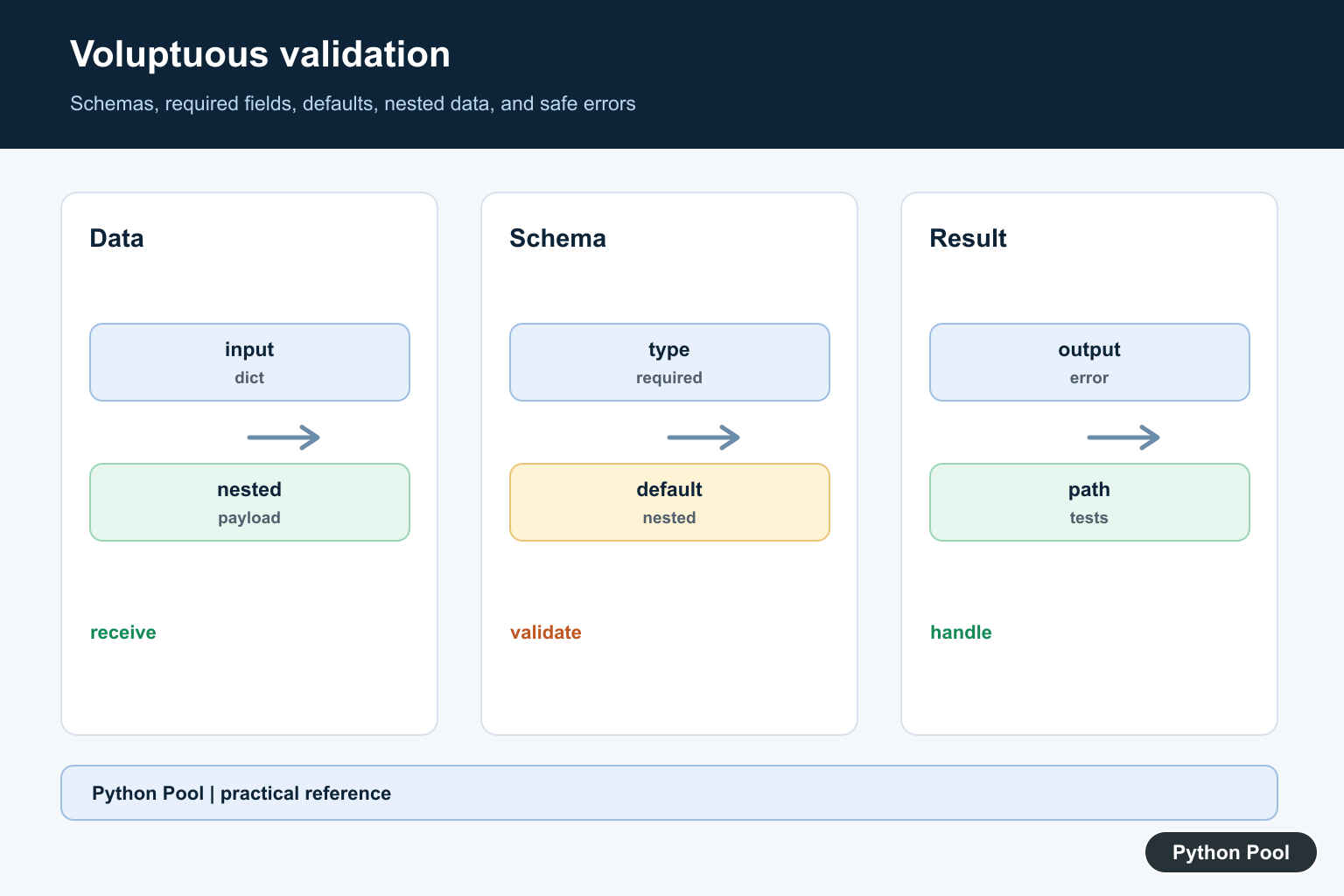
Voluptuous is a Python data validation library for checking dictionaries, configuration files, API payloads, and nested data structures. Instead of writing many manual if statements, you define a schema and let Voluptuous validate incoming data against that schema.
The library is useful when your data comes from JSON, YAML, command-line configuration, or user input. A schema can check required fields, optional fields, types, value ranges, coercion, and custom rules. The result is cleaner validation code and more useful error messages when data is wrong.
Voluptuous schemas are normal Python objects, so they fit naturally into scripts and applications that already use dictionaries. You do not need a separate schema language for common validation tasks.
Install and Import Voluptuous
Install the package from PyPI with pip. Most examples import the package as vol or import the validators directly.
from voluptuous import Schema

schema = Schema({"name": str})

result = schema({"name": "Ada"})
print(result)
The schema above requires a dictionary with a name key whose value is a string. If the input matches, the validated data is returned. If the input is wrong, validation stops with an exception instead of letting bad data move farther into the program.
Validate Required Keys
Use Required() when a key must be present. This is clearer than relying only on a plain dictionary schema when you want the requirement to be obvious to the next reader.
from voluptuous import Required, Schema

schema = Schema({
    Required("name"): str,
    Required("age"): int,
})

print(schema({"name": "Ada", "age": 36}))
If name or age is missing, Voluptuous raises a validation error. This is a good fit for configuration objects where missing values should stop the program early. Required keys also make tests easier because each invalid case can target one missing field.
Add Optional Keys and Defaults
Use Optional() when a key may be absent. You can also provide a default value so validated data has a predictable shape after validation.
from voluptuous import Optional, Required, Schema

schema = Schema({
    Required("name"): str,
    Optional("active", default=True): bool,
})

print(schema({"name": "Ada"}))
The returned dictionary includes active even though the input omitted it. Defaults are helpful for configuration files because callers can provide only the values they need to override. They also reduce repeated dict.get() calls after validation.
Coerce Input Types
Many inputs arrive as strings even when the program needs integers or booleans. Coerce() converts a value before validating the result.
from voluptuous import Coerce, Required, Schema

schema = Schema({
    Required("port"): Coerce(int),
})

print(schema({"port": "8080"}))
This converts the string "8080" to the integer 8080. Use coercion only when the conversion is intentional and safe. If you need to inspect raw strings first, PythonPool’s guide to checking whether a string is an integer covers related patterns.
Chain Rules With All()
All() applies multiple validators in order. This is useful when you want to coerce a value and then check a range, length, or custom rule.
from voluptuous import All, Coerce, Range, Required, Schema

schema = Schema({
    Required("retries"): All(Coerce(int), Range(min=0, max=5)),
})

print(schema({"retries": "3"}))
The value is first converted to an integer and then checked against the allowed range. Chained validation keeps the rule in one readable place. It also helps error messages point to the exact part of the schema that rejected the value.
Handle Validation Errors
Voluptuous raises MultipleInvalid when validation fails. Catch it at the boundary of your application, report the issue, and keep the rest of the code working with already-validated data.
from voluptuous import MultipleInvalid, Required, Schema

schema = Schema({Required("name"): str})

try:
    schema({"name": 42})
except MultipleInvalid as error:
    print(error)
Do not catch validation errors too deep inside business logic. Validate input early, then pass clean data through the rest of the program. That keeps your functions simpler and reduces repeated type checks.
When to Use Voluptuous
- Validating configuration dictionaries loaded from JSON or YAML.
- Checking API payloads before processing them.
- Coercing simple input values into expected Python types.
- Returning useful error messages for nested data structures.
If you only need to inspect whether a value can be called, use Python’s built-in tools such as callable(). If you need namespace inspection, see Python globals() and Python vars(). Voluptuous is most useful when the whole data structure needs a reusable validation contract.
Best Practices
Keep schemas near the boundary where data enters the program. Name schemas clearly, test invalid inputs, and avoid overly complex validators that hide business rules. When validation starts to describe application behavior rather than data shape, move that behavior into normal Python functions.
For larger projects, centralize common validators so schemas stay consistent. For example, one helper for positive integers or non-empty strings can be reused across multiple configuration schemas. This keeps validation consistent without duplicating the same rule in every schema.
References
Describe The Input Shape
A schema can express dictionaries, lists, nested structures, types, literals, ranges, and custom validators. Keep the schema close to the data contract and give complex fields useful descriptions or names.
Mark Required And Optional Fields
Required fields should fail when absent. Optional fields can be accepted without being inserted, while defaults can populate missing values. Distinguish absence from an explicit null value in the schema.
Normalize At The Boundary
Validation may convert or normalize data when a validator is designed to do so. Pass the returned value onward instead of continuing to use the original unvalidated object.
Handle Nested Errors
Voluptuous errors can identify a path into the input. Catch validation failures at the boundary, format a safe explanation for the caller, and avoid exposing secrets from the invalid payload.
Keep Schemas Explicit
Avoid accepting arbitrary extra keys or coercing ambiguous values unless the application needs that flexibility. A strict schema makes configuration drift visible earlier.
Test Valid And Invalid Data
Test missing keys, wrong types, defaults, nested errors, extra keys, boundary values, and already-normalized input. Treat the schema as executable documentation and regression-test it.
The official Voluptuous documentation describes schemas and validation errors. Related Python Pool references include safe diagnostics and tests.
For related input boundaries, compare safe validation logs, schema tests, and package configuration when validating data.
Frequently Asked Questions
What is Voluptuous used for in Python?
Voluptuous validates Python data structures such as dictionaries, lists, configuration objects, and API payloads against schemas.
How do I require a field in Voluptuous?
Use the Required marker in a schema and provide the expected type, validator, or nested schema for that field.
Can Voluptuous apply defaults?
Yes. Default markers can populate missing values, but defaults should be documented because validated output may contain keys the input did not include.
How should I handle VoluptuousInvalid errors?
Catch the appropriate validation exception at the input boundary, return a useful user-facing error, and avoid treating malformed external data as trusted internal state.