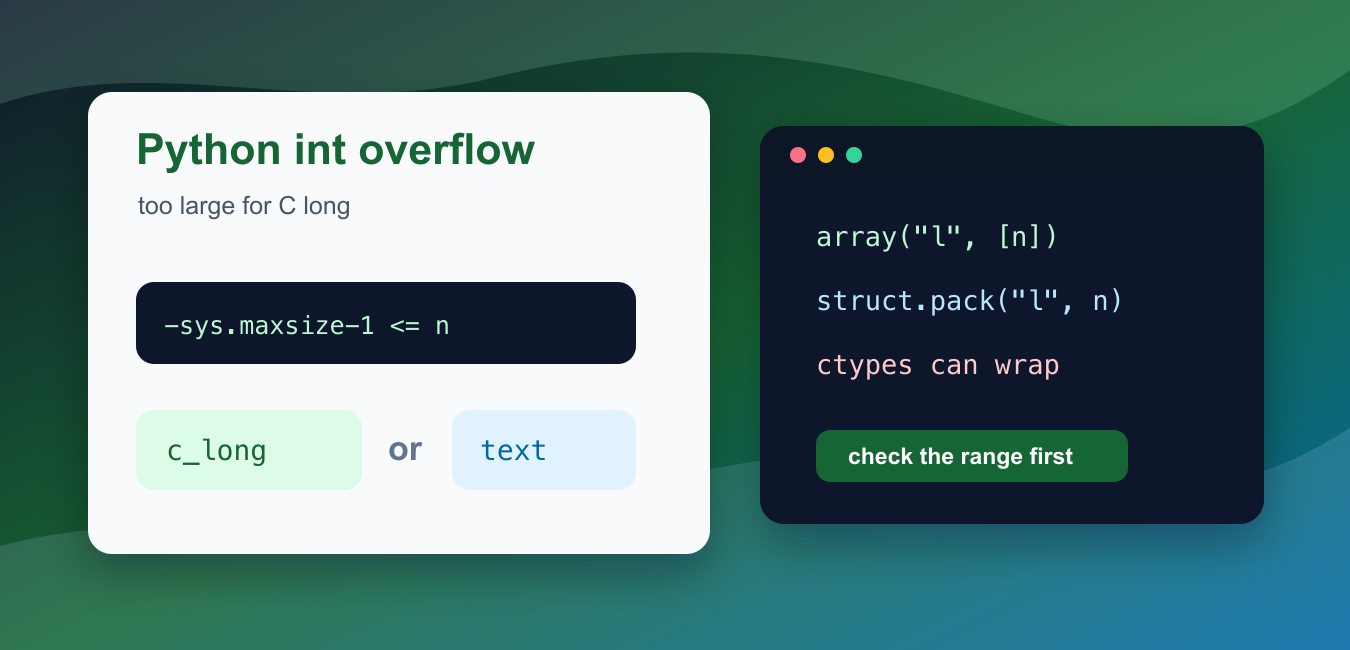
OverflowError: Python int too large to convert to C long means a Python integer reached an interface that expects a fixed-width C long, but the value was outside that interface’s range. Python’s arbitrary-precision integer is not the same thing as a native C integer.
Quick Answer
Find the conversion boundary, measure the target type on the running platform, validate the integer before conversion, and choose a wider or text representation when the value does not fit. Do not silently convert a large identifier to float.
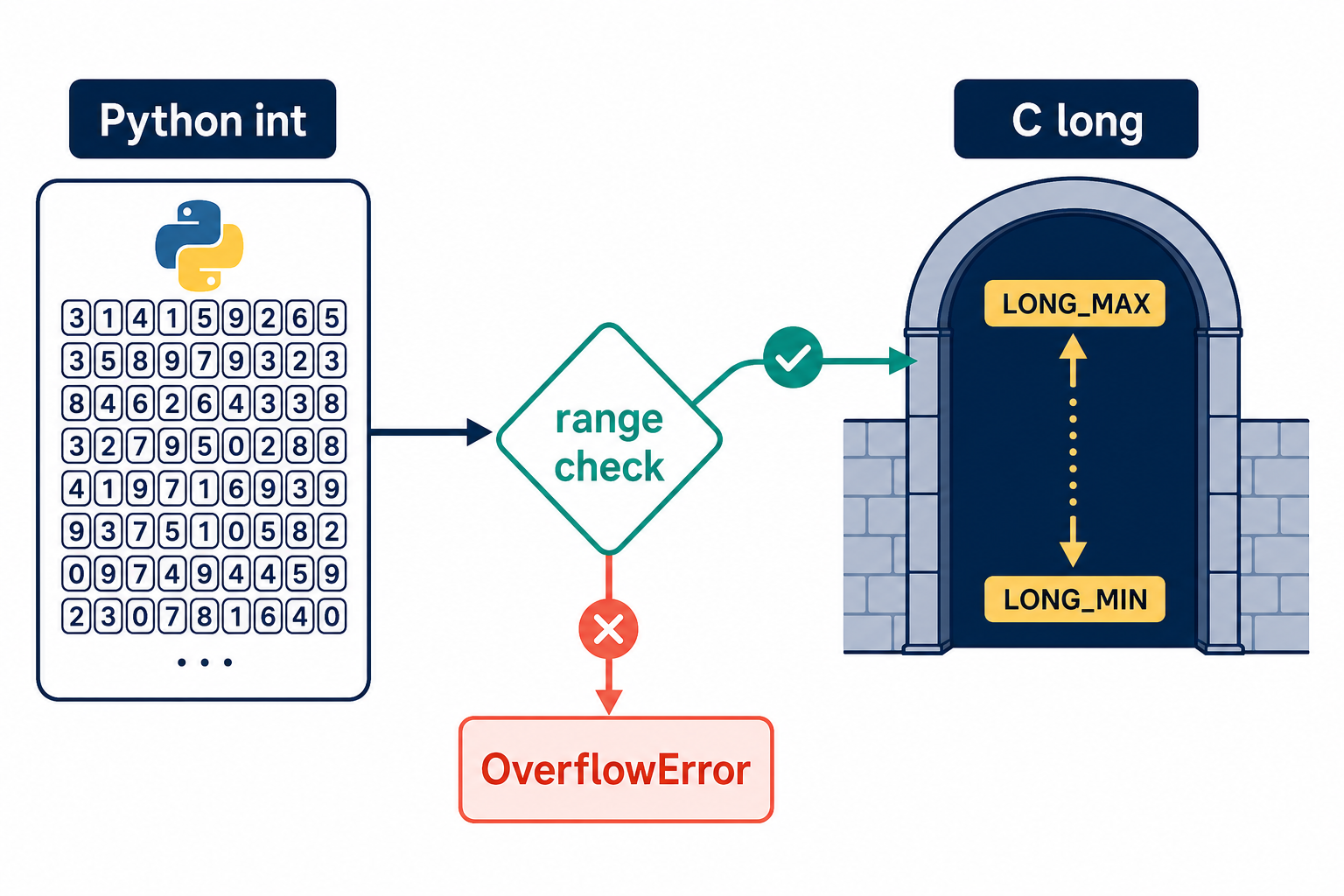
The CPython PyLong_AsLong reference states that a C long conversion raises OverflowError when the value is out of range. The exact limit belongs to the native target, so code that crosses the boundary should not hard-code a value copied from a different machine.
Python int And C long Are Different Types
Python integers grow as needed until the process runs out of memory. A C long is a native integer type with a fixed size selected by the platform ABI. A library may use a C long for an array index, timestamp, file field, database binding, or function argument even though the Python API accepts an ordinary int.
The error is therefore about the receiving interface, not about Python arithmetic. Pure Python multiplication, division, and comparisons can continue to work with a large integer; the failure appears when the value is passed into a bounded native representation.
Inspect The Running Platform
sys.maxsize is a useful clue about the process’s pointer-sized integer model, but it is not a universal promise for every C field. Use it for diagnosis and inspect the actual library or format documentation for the field you are calling.
import sys

print('Python max size clue:', sys.maxsize)
print('Python int:', 10 ** 40)
Run the diagnostic in the same interpreter that runs the failing code. A notebook kernel, IDE, container, and system shell can all use different Python installations or architectures.
Calculate A c_long Guard
When the destination really is a signed native c_long, derive its width with ctypes.sizeof() and guard the value.
import ctypes

def c_long_bounds():
    bits = ctypes.sizeof(ctypes.c_long) * 8
    upper = 2 ** (bits - 1) - 1
    lower = -(2 ** (bits - 1))
    return lower, upper

def fits_c_long(value):
    lower, upper = c_long_bounds()
    return lower <= value <= upper
This check makes the policy explicit and avoids a platform-specific magic number. It also lets you report a useful validation error before the native call is attempted.
Convert Only After Validation
After the guard passes, conversion through ctypes.c_long is deliberate. If it fails, keep the failure visible rather than masking it by truncating the value.
import ctypes

value = 2 ** 40

if fits_c_long(value):
    native_value = ctypes.c_long(value)
    print(native_value.value)
else:
    raise ValueError('value is outside the C long range')
Do not use a modulo operation or a silent cast unless the API explicitly documents wraparound semantics. A wrapped identifier, file offset, or database key can be worse than an exception because it looks valid while referring to the wrong record.
Other Fixed-Width Boundaries
The same pattern appears with struct formats, numeric arrays, operating-system calls, database drivers, and C or Cython extensions. Each interface has its own width and signedness rules.
import struct

value = 2 ** 40
try:
    packed = struct.pack('@l', value)
except (OverflowError, struct.error) as error:
    print('fixed-width conversion failed:', error)
Read the destination format before choosing a guard. A standard-width format, a native-width format, and an unsigned format are not interchangeable. Negative values also need a separate check when the destination is unsigned.
Choose A Representation That Fits
If a value is a large identifier, account number, hash-derived integer, or exact decimal quantity, storing it as text may be safer than forcing it through a native integer field. If it is a measurement, choose a documented wider integer or decimal type instead of converting only to make the exception disappear.
def choose_storage(value):
    if fits_c_long(value):
        return 'native integer field'
    return 'decimal text or a wider documented field'

for value in [2026, 10 ** 40]:
    print(value, choose_storage(value))
Converting to float is not a general solution: IEEE-754 floats have finite precision, so large integers can lose low-order digits. For exact values, preserve the integer or serialize it as decimal text.
Debug The Caller, Not Just The Error
- Print the value and its type immediately before the failing call.
- Identify whether the call uses ctypes, struct, an array dtype, a database driver, or a native extension.
- Check the interpreter and machine architecture that actually run the code.
- Test both boundary values and one value outside the allowed range.
- Document the accepted range next to the conversion code.
The reliable fix is to make the native boundary visible, validate before crossing it, and choose a representation that preserves the data’s meaning. Python’s large integer support is not the problem; an undocumented fixed-width destination is.
Signed, Unsigned, And Width Rules
A signed type uses part of its bit pattern for negative values. An unsigned type can represent larger positive values of the same width but cannot represent negative inputs under the same conversion rules. A C long may also have a different width from a C int or a long long.
Do not infer the destination type from a Python function’s name. Read the library’s parameter documentation, inspect the format string, or reproduce the conversion in a minimal example. The correct guard is the one that matches the actual boundary.
Library And Platform Differences
Many Python libraries accept a Python integer and convert it internally. The visible exception can therefore appear far away from the call that chose the value. Check recent changes in dependencies, operating-system architecture, and data-source size when the same code behaves differently on two machines.
When a third-party extension raises the error, report the smallest reproducible integer, the Python version, the package version, and the platform. A package maintainer can then identify whether the field should be widened, validated, or documented.
Write Boundary Tests
Boundary tests should cover the smallest accepted value, the largest accepted value, one value below the lower limit, and one above the upper limit. Include negative values when the destination is signed and explicitly reject them when it is unsigned.
Do not test only the current production sample. A data source that currently fits can grow over time, and the failure often appears first after an import, timestamp change, or customer identifier crosses the old implicit limit.
Serialization And APIs
When a large integer crosses a process or service boundary, document its representation. JSON consumers may parse numbers differently, while a decimal string preserves the digits across languages and storage systems. A schema should state whether the field is an exact integer, a bounded native value, or a textual identifier.
Changing a database column or wire format can be the correct fix, but it should be treated as a data migration rather than a local cast. Preserve existing values, validate new ones, and test readers and writers together.
Keep The Guard Close To The Boundary
Validate immediately before the native call or serialization step. A check performed much earlier can become stale if the value is transformed later, and a helper that silently truncates the value makes the source of corruption harder to find.
For numeric limits, compare C long conversion errors with math range overflow and Python integer limits. Read overflowerror math range error and python max int for the related workflow.
Frequently Asked Questions
Why does Python int overflow when C long is involved?
Python integers are not limited to the same fixed width as a C long. The error occurs when an API or extension tries to convert a value outside the platform’s C long range.
Is the C long range always the same?
No. Its width is platform-dependent. Check the actual boundary used by the target process instead of assuming that a limit from another operating system applies.
Should I convert the integer to float?
Usually no. A float can lose integer precision and does not make a fixed-width destination capable of representing the original value. Validate the boundary or choose a wider representation.
How do I prevent this error?
Validate values before passing them to ctypes, struct, arrays, database drivers, or native extensions, and choose a storage or wire format whose documented range covers the input.