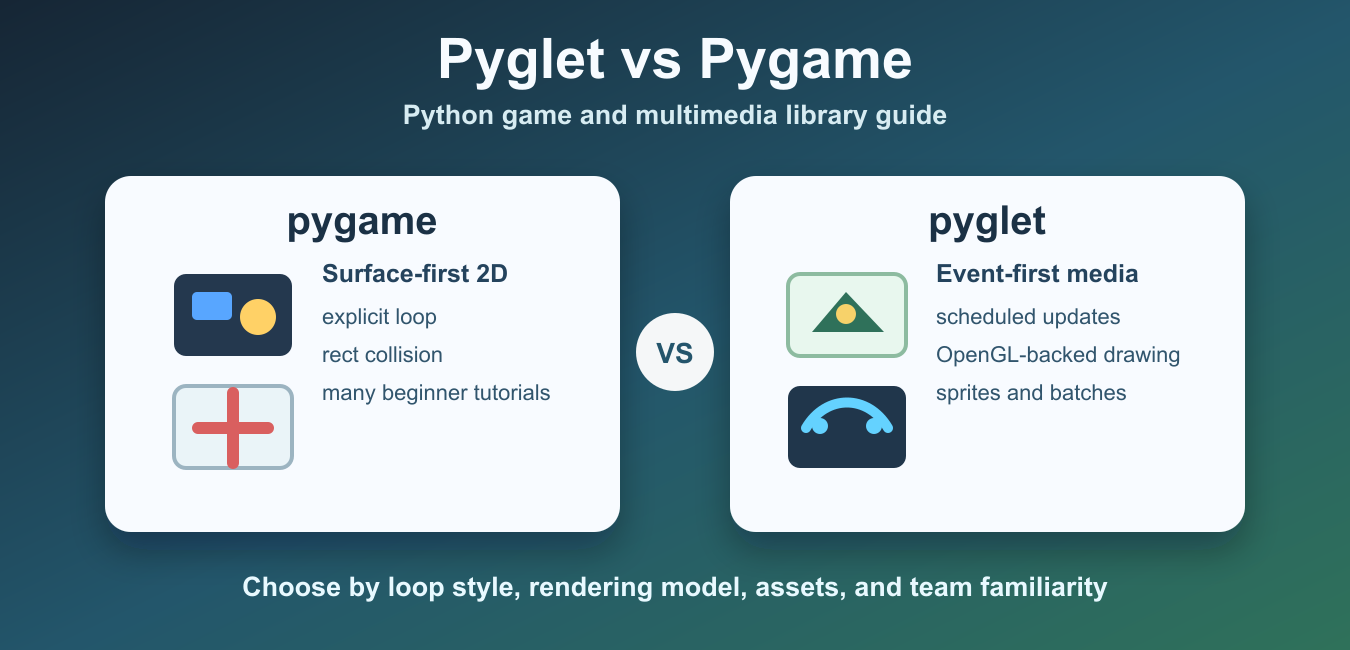
Quick answer: Pyglet and Pygame can both support Python games, but they emphasize different abstractions and workflows. Compare windowing, events, rendering, audio, assets, packaging, documentation, and the target platform with a small prototype instead of choosing from a feature checklist alone.
Choosing between pyglet and pygame is mostly a question of project shape. Both are used for Python games and multimedia, but they guide you toward different architecture. Pygame is built around SDL-style surfaces, rectangles, events, and an explicit loop that you own. Pyglet is built around a window event loop, OpenGL-backed drawing, scheduled callbacks, and media features exposed through a Pythonic API.
The official pyglet documentation describes pyglet as a cross-platform windowing and multimedia library for games and visually rich applications. Its application event loop guide, clock API, and image and sprite guide are the main references to read first. The official pygame documentation documents pygame as a set of modules for games and multimedia, with core pages for display control, Surface objects, and sprites.
The short answer is practical: choose pygame when you want the largest beginner ecosystem, classic 2D game loops, pixel surfaces, rectangular collision, and many tutorials. Choose pyglet when you want an event-driven model, OpenGL-oriented rendering, a clean windowing API, and built-in support for images, sound, video, controllers, and scheduled callbacks. Neither choice is automatically more professional; the better choice is the one that fits your rendering model and your team’s experience.
Check What Is Installed
Before comparing APIs, check what is available in your current Python environment. The block below imports each library only when it is present and does not open a window or play audio.
from importlib import import_module
from importlib.util import find_spec

def load_optional(name):
    if find_spec(name) is None:
        return None
    return import_module(name)

for name in ("pyglet", "pygame"):
    module = load_optional(name)
    if module is None:
        print(f"{name}: not installed")
        continue

    version = getattr(module, "__version__", "version unknown")
    if name == "pygame":
        version = getattr(module.version, "ver", version)
    print(f"{name}: {version}")
If neither library is installed, install only the one you plan to test first. Keeping the first prototype small makes the comparison honest because you can judge how the core loop, drawing model, and packaging feel before adding art, sound, and menus.
Rendering Model
Pygame centers on Surface objects. You draw on surfaces, blit one surface onto another, then update the display. This model is direct and easy to inspect. It is a strong fit for tile maps, retro arcade games, UI prototypes, simulations, educational projects, and 2D tools where rectangles and pixel buffers are natural.
Pyglet leans toward OpenGL-backed drawing. You normally create drawables such as sprites, shapes, labels, or batches, then let pyglet draw them during the window’s draw event. That style fits projects that benefit from GPU-backed batches, transformations, richer window events, and a rendering pipeline closer to OpenGL concepts.
choices = {
    "beginner 2D arcade game": {"pygame": 3, "pyglet": 2},
    "surface and rectangle collision": {"pygame": 3, "pyglet": 1},
    "OpenGL-oriented rendering": {"pygame": 1, "pyglet": 3},
    "event-driven multimedia app": {"pygame": 2, "pyglet": 3},
}
project_needs = {
    "beginner 2D arcade game": 2,
    "surface and rectangle collision": 2,
    "OpenGL-oriented rendering": 1,
    "event-driven multimedia app": 1,
}

totals = {"pygame": 0, "pyglet": 0}
for need, weight in project_needs.items():
    scores = choices[need]
    for library, score in scores.items():
        totals[library] += score * weight

winner = max(totals, key=totals.get)
print(winner, totals)
This scoring example is intentionally simple. In a real decision, replace the labels with your own project needs: target platforms, artwork style, frame timing, input devices, packaging, team familiarity, and the amount of community material your learners need.
Pygame Off-Screen Drawing
A useful pygame strength is that many drawing operations can be tested on an off-screen surface. The next example uses the dummy video driver and never creates a visible window.
import os
from importlib.util import find_spec

os.environ.setdefault("SDL_VIDEODRIVER", "dummy")

if find_spec("pygame") is None:
    print("pygame not installed; skipping surface demo")
else:
    import pygame

    pygame.display.init()
    try:
        canvas = pygame.Surface((160, 90))
        canvas.fill((18, 24, 38))
        pygame.draw.rect(canvas, (70, 150, 240), pygame.Rect(20, 20, 50, 30), border_radius=4)
        pygame.draw.circle(canvas, (255, 210, 96), (110, 45), 18)
        print(canvas.get_size())
        print(canvas.get_at((110, 45))[:3])
    finally:
        pygame.display.quit()
This is good for tests because you can inspect pixels, sizes, rectangles, and collision math without launching a full game. When you do create a real display, the same surface ideas still apply: draw or blit to the screen surface, then call a display update function.
Pygame Sprites And Rects
Pygame’s sprite tools are optional, but they provide a familiar starting point for grouping objects and checking collisions. Rect-based collision is especially approachable for classic 2D games.
import os
from importlib.util import find_spec

os.environ.setdefault("SDL_VIDEODRIVER", "dummy")

if find_spec("pygame") is None:
    print("pygame not installed; skipping sprite demo")
else:
    import pygame

    class Actor(pygame.sprite.Sprite):
        def __init__(self, x, y, color):
            super().__init__()
            self.image = pygame.Surface((24, 24))
            self.image.fill(color)
            self.rect = self.image.get_rect(topleft=(x, y))

    player = Actor(10, 10, (80, 180, 240))
    coins = pygame.sprite.Group(
        Actor(18, 12, (250, 210, 80)),
        Actor(80, 50, (250, 210, 80)),
    )

    hits = pygame.sprite.spritecollide(player, coins, dokill=False)
    print(len(hits))
This style is simple to explain: each sprite has an image and a rectangle, and groups make batch updates and collision checks easier. It is a major reason pygame remains comfortable for beginners and for courses focused on fundamentals.
Pyglet Clock And Events
Pyglet programs usually let pyglet own the event loop. Instead of writing a manual while running loop, you register event handlers and schedule updates with the clock. The next example uses a standalone clock, so it does not open a window.
from importlib.util import find_spec

if find_spec("pyglet") is None:
    print("pyglet not installed; skipping clock demo")
else:
    import pyglet

    ticks = []

    def update(dt):
        ticks.append(round(dt, 4))

    timer = pyglet.clock.Clock()
    timer.schedule(update)
    for _ in range(3):
        timer.tick(poll=True)
    timer.unschedule(update)

    print(len(ticks), ticks)
That event-driven shape is clean for apps that react to keyboard input, mouse input, timers, media events, and redraw requests. It also separates update timing from drawing in a way that maps well to pyglet’s documented event loop.
Pyglet Image Objects
Pyglet can load images and create image objects without making you manage a pixel surface directly. This example creates a small generated image in memory and prints its size without drawing it to a window.
from importlib.util import find_spec

if find_spec("pyglet") is None:
    print("pyglet not installed; skipping image demo")
else:
    import pyglet

    pattern = pyglet.image.SolidColorImagePattern((40, 120, 220, 255))
    image = pattern.create_image(32, 32)
    print(image.width, image.height)
In a full pyglet app, you would normally pair images with sprites and put many drawables in a batch. The batch approach is one of pyglet’s advantages when a scene has many objects that should be drawn together efficiently.
Event Loop Differences
The event loop is the biggest day-to-day difference. Pygame commonly uses a loop that polls events, updates state, draws a frame, and ticks a clock. This is explicit, predictable, and close to how many game programming tutorials explain frame updates. It also makes it obvious where to add pause handling, fixed-step updates, and shutdown logic. Before choosing a graphics layer, Tic Tac Toe Python Game Logic Guide provides a small game whose board state, move validation, and win logic can remain independent of the UI.
Pyglet encourages registration. You attach handlers such as draw, key press, or mouse motion, then call pyglet.app.run(). Scheduled functions handle periodic updates. This can feel less familiar at first, but it keeps input and draw responsibilities clean once the pattern clicks.
Audio, Video, And Assets
Both libraries can play sound in normal desktop environments, but you should test your exact formats and deployment target early. Pygame’s mixer is common in beginner games. Pyglet’s media layer also covers sound and video in its documentation, which can be attractive for multimedia apps that are not only games.
For image assets, pygame’s surface pipeline is straightforward when you think in pixels and blits. Pyglet’s image, sprite, and batch tools feel more natural when you think in positioned objects and GPU-backed drawing. If you are building a small retro game, pygame may be faster to teach. If you are building a visual app that may later use OpenGL ideas, pyglet may be a better fit.
Learning Curve And Ecosystem
Pygame has a larger beginner trail: tutorials, classroom examples, and small projects are easy to find. That matters when the goal is learning game loops, collision, input, and simple animation. It also helps when a new developer needs an answer to a common issue quickly.
Pyglet’s docs are polished and current, but the learning path asks you to accept event handlers and scheduled callbacks sooner. Developers who already like event-driven GUI code may enjoy pyglet quickly. Developers who want a manual loop with every frame step visible may prefer pygame.
Which One Should You Pick?
Pick pygame for a beginner 2D game, a classroom project, a surface-heavy tool, or a prototype where tutorial coverage matters. Pick pyglet for event-driven multimedia, OpenGL-friendly rendering, sprites drawn through batches, or a cleaner separation between events and scheduled updates.
For a serious project, build the same tiny scene in both: a moving sprite, keyboard input, one collision, one sound trigger guarded behind a user action, and a packaged run command. The comparison will quickly show which codebase feels easier to maintain. The winner is not the library with the longest feature list; it is the one whose core model keeps your game’s code clear as the project grows.

Compare The Main Loop
A game needs predictable input polling or events, updates, rendering, timing, and shutdown. Prototype this loop in both libraries and measure how naturally it represents the game you want to build.
Evaluate Rendering Needs
Pygame is familiar for many 2D surfaces and sprites, while Pyglet can suit an OpenGL-oriented window and media workflow. The right choice depends on effects, performance, coordinate abstractions, and the rest of the stack.
Check Input And Audio
Test keyboard, mouse, controller, window focus, sound effects, music, and pause behavior on the target operating systems. A library that looks ideal for drawing may still be awkward for the input or audio requirements.
Plan Assets And Packaging
Load images, fonts, audio, and data through a resource strategy that works from a development checkout and a packaged application. Test relative paths and distribution early rather than at the final release.
Avoid Mixing APIs Casually
A prototype can compare libraries, but production code should keep a clear ownership boundary. Mixing event loops or rendering objects without a deliberate adapter increases debugging and portability costs.
Choose Based On Maintenance
Read the current documentation, supported Python versions, examples, issue activity, and deployment constraints. A smaller library with a good fit and clear maintenance path can be better than a longer feature list.
Use the current Pyglet documentation and Pygame documentation for version-specific APIs. Related Python Pool references include testing and logging.
For related application structure, compare game-loop tests, runtime logging, and packaging before selecting a library.
For the authoritative API and current behavior, consult the pyglet documentation.
Frequently Asked Questions
Which is easier, Pyglet or Pygame?
Pygame is often approachable for classic 2D game loops, while Pyglet can suit applications that prefer an OpenGL-oriented window and media framework; the project determines the better fit.
Can Pyglet and Pygame create 2D games?
Yes. Both can support 2D games, but their APIs and rendering abstractions differ, so a small prototype is the best comparison.
Which library handles game events?
Both provide event mechanisms, but event names, window setup, and loop integration differ; follow the current documentation for the chosen version.
How should I choose between them?
Compare the rendering needs, input model, audio and asset workflow, ecosystem, deployment target, and the maintainers’ current documentation.
Thanks for the article. It is a useful comparison. I think you need to swap the 4th row in the table, though, since the left column refers to pygame and the right column refers to pyglet.
Thank you for reporting a mistake. I’ve updated the article accordingly.