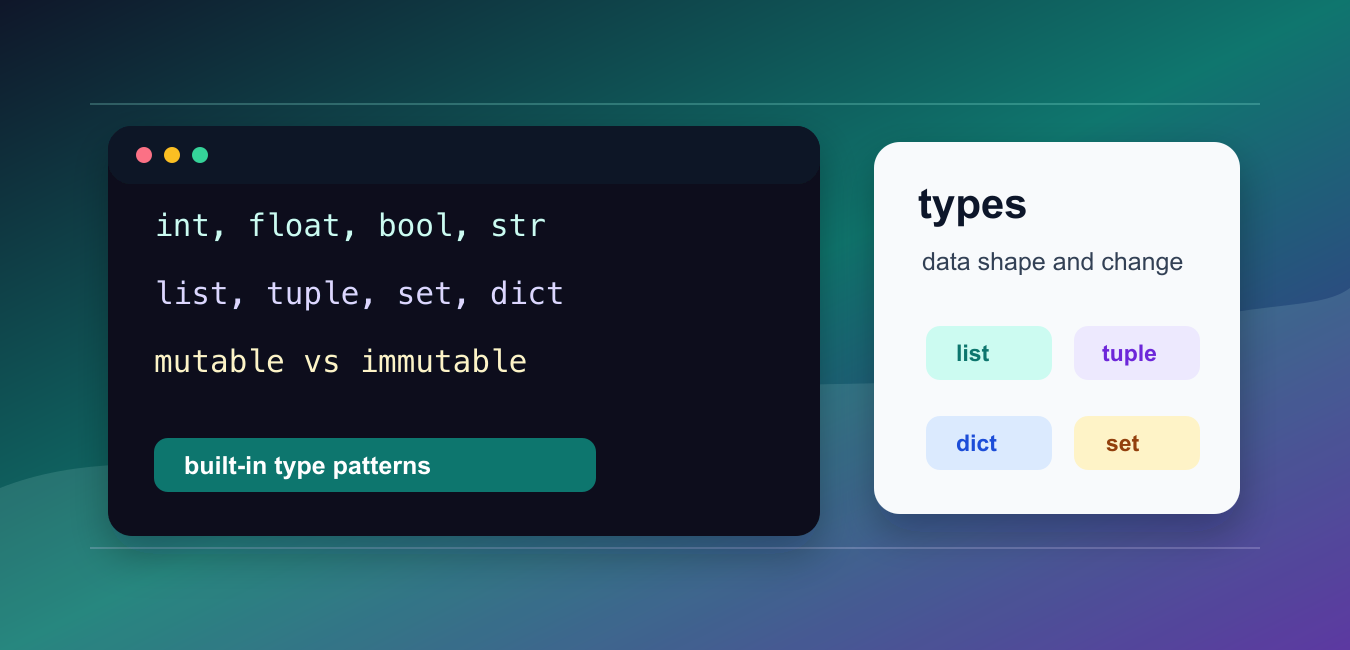
Quick answer: Python data types describe values and the operations they support. Learn them through value semantics, mutability, equality versus identity, collection protocols, and explicit boundary checks rather than memorizing an isolated list of names.

Python data types describe what kind of value an object holds and what operations that object supports. Common built-in types include numbers, strings, lists, tuples, sets, and dictionaries.
The official Python documentation covers built-in types, the type() function, and data structures.
The most important practical split is mutability. Mutable objects can be changed in place. Immutable objects cannot be changed after creation; operations that seem to change them create a new object instead.
Understanding that difference helps with function arguments, shared lists, dictionary updates, caching, tests, and debugging surprising changes in nested data.
Use the sections below as a compact map of the built-in types you will see most often.
When code feels confusing, print the type and the shape of the data first. That usually narrows the problem quickly.
Check Basic Scalar Types
Integers, floats, booleans, and strings are common scalar values.
number = 42
price = 19.95
enabled = True
text = "Python"

for item in [number, price, enabled, text]:
    print(type(item).__name__)
This prints the type name for each value.
Use type() for quick inspection while debugging. Use isinstance() when writing checks in production code because it handles inheritance correctly.
Numbers and strings are immutable. If you add to a number or build a new string, Python creates a new object rather than changing the existing one.
Use Sequence Types
Lists, tuples, and strings are sequence types. They support indexing, slicing, and length checks.
items = ["red", "green", "blue"]
point = (10, 20)
word = "python"

print(len(items))
print(point[0])
print(word.upper())
A list is mutable, while a tuple and a string are immutable.
Use a list when the collection needs to grow, shrink, or be reordered. Use a tuple for a fixed group of values, such as a coordinate or a returned pair.
Strings are sequences of text characters, but string methods return new strings instead of changing the original text.
Use Sets And Dictionaries
Sets store unique items. Dictionaries store key-value pairs.
colors = {"red", "green", "red"}
settings = {"theme": "dark", "page_size": 20}

print(colors)
print(settings["theme"])
The duplicate "red" appears only once in the set.
Use sets for membership checks and duplicate removal. Use dictionaries for lookup tables, configuration, counters, grouped records, and structured results.
Both sets and dictionaries are mutable, so updates affect the existing object.

See Mutable List Behavior
A list can be changed in place. If two names point to the same list, both names see the change.
items = [1, 2]
alias = items

items.append(3)

print(alias)
This prints [1, 2, 3] because alias and items refer to the same list object.
This behavior is useful when shared state is intentional, but it can also cause bugs when a function updates a list that the caller expected to stay unchanged.
Copy the list first when a separate editable list is needed.
See Immutable Tuple Behavior
A tuple cannot be changed in place.
point = (10, 20)

try:
    point[0] = 99
except TypeError as error:
    print(type(error).__name__)
This raises TypeError because tuple items cannot be reassigned.
To represent a changed coordinate, create a new tuple. That keeps the original tuple unchanged and makes the update explicit.
Immutable objects are useful for fixed records, dictionary keys, set members, and values that should not be edited after creation.

Copy Mutable Data Before Editing
Use copy() when you need a separate list before making changes.
original = ["draft", "review"]
updated = original.copy()

updated.append("publish")

print(original)
print(updated)
The original list stays unchanged because updated is a separate list object.
For nested lists or dictionaries, a shallow copy may not be enough because inner objects can still be shared. Use copy.deepcopy() when nested mutable objects also need to be independent.
Copying deliberately is better than guessing whether a function will modify the data it receives.
Common Data Type Mistakes
The first common mistake is checking exact types too aggressively. Prefer isinstance() for validation unless exact type identity matters.
The second mistake is forgetting that lists, dictionaries, and sets are mutable. Passing them into a function allows that function to change their contents unless the function makes a copy first.
The third mistake is expecting tuple immutability to protect nested mutable objects. A tuple cannot replace its own items, but a list stored inside a tuple can still be changed.
In short, use numbers and strings for scalar values, lists for editable sequences, tuples for fixed groups, sets for uniqueness, dictionaries for key-based lookup, and copying when mutable data should be edited independently.
Group The Built-ins
Numbers, booleans, strings, bytes, None, sequences, sets, mappings, iterators, and callable objects have different protocols. Choose operations based on the behavior the function needs.

Understand Mutability
Lists and dictionaries can change in place, while integers, strings, and tuples are immutable. Aliasing a mutable object can make a change visible through multiple references, so copy deliberately.
Separate Equality And Identity
== asks whether values compare equal, while is asks whether two names refer to the same object. Use is for singletons such as None and value equality for data.
Use Type Checks Carefully
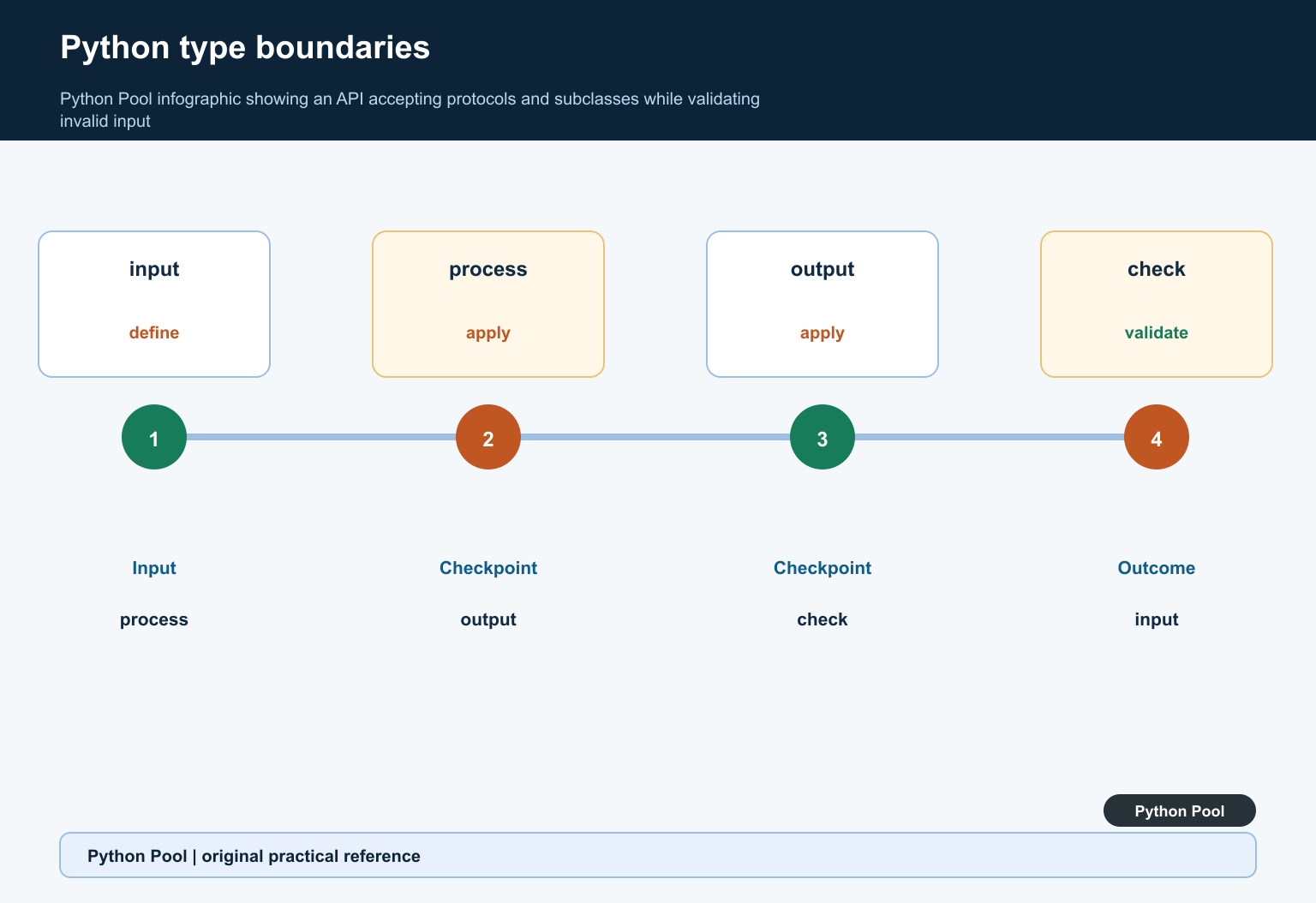
isinstance accepts subclasses and can express an interface or family of types. Exact type checks with type() are narrower and should be reserved for a deliberate contract.
Prefer Protocols When Possible
A function that only needs iteration, mapping lookup, or a numeric operation can often accept a protocol instead of one concrete class. This improves reuse without hiding required validation.
Test Boundary Behavior
Test empty and non-empty values, mutable aliases, nested collections, numeric coercion, None, subclasses, iterators, invalid types, and serialization when types cross a public API boundary.
Use the official Python standard-types documentation and isinstance documentation. Related Python Pool references include testing and dictionaries.
For related Python semantics, compare type tests, sequence behavior, and mapping behavior before designing a data boundary.
Frequently Asked Questions
What are common built-in Python data types?
Common built-ins include int, float, complex, bool, str, bytes, NoneType, list, tuple, range, set, frozenset, dict, and callable or iterator objects.
What is the difference between mutable and immutable types?
Mutable objects such as lists and dictionaries can change in place, while immutable values such as strings, tuples, and integers require a new value for a change.
Should I use type() or isinstance()?
isinstance() is usually better for accepting subclasses and expressing a behavioral type relationship; type() checks the exact runtime class.
Why does identity matter in Python?
== compares values while is compares object identity. Use is for singletons such as None, not as a general value comparison.