![[Fixed] attributeerror Module Numpy has No Attribute Bool](https://www.pythonpool.com/wp-content/uploads/2023/10/attributeerror-Module-Numpy-has-No-Attribute-Bool.webp)
Quick answer: np.bool was a deprecated alias removed from newer NumPy versions. Replace it with built-in bool for ordinary Python boolean behavior or numpy.bool_ when a NumPy scalar type is required, then verify the dependent package in the exact environment where the error occurs.
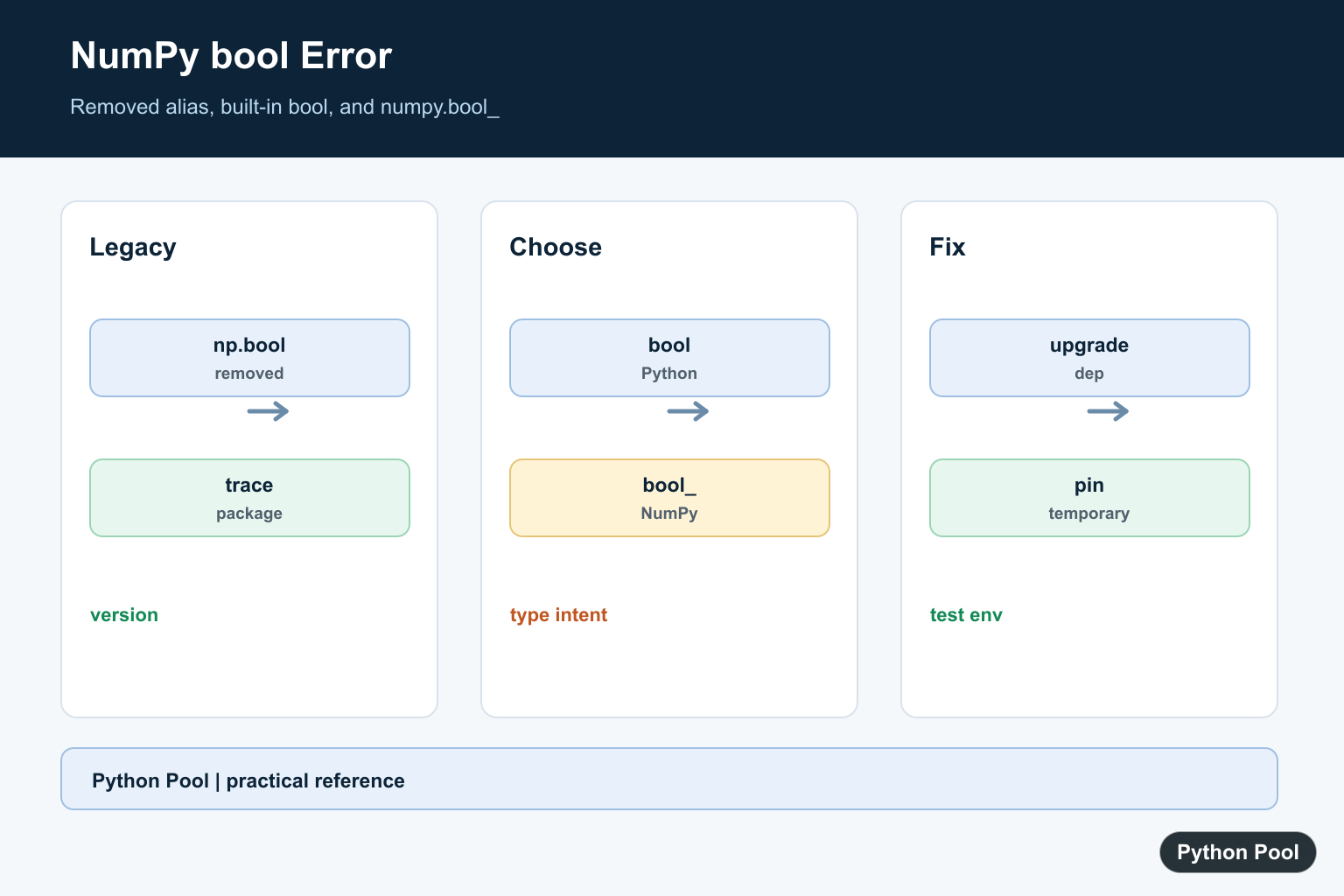
The error AttributeError: module 'numpy' has no attribute 'bool' usually means that code in your project, or in one of your installed packages, still uses the old np.bool alias in a NumPy version where that alias is not available. The removed np.typeDict alias is another NumPy deprecation failure; Fix module numpy has no attribute typedict replaces it with sctypeDict or explicit dtypes.
The safest fix is usually simple: replace np.bool with Python’s built-in bool, or use np.bool_ when you specifically need the NumPy scalar boolean type. If the line appears inside a third-party package, update that package first.
Why this error happens
For years, np.bool was an alias for Python’s built-in bool. NumPy deprecated aliases such as np.bool, np.int, and np.float in NumPy 1.20. The NumPy 1.20 release notes explain that replacing these aliases with the built-in types works the same for ordinary use.
In NumPy 1.24, that deprecation expired. The NumPy 1.24 release notes state that aliases including np.bool and np.int now raise errors. That is why old code can suddenly break after a NumPy upgrade.
There is one modern nuance: NumPy 2.0 introduced np.bool again as the canonical NumPy boolean dtype, with np.bool_ as an alias. The NumPy 2.0 release notes describe this change for Array API compatibility. For code that must run across NumPy 1.24, 1.26, and 2.x, bool and np.bool_ are still the safest choices.
Quick fix in your own code
If the stack trace points to your file, change this:
import numpy as np

mask = np.array([True, False, True], dtype=np.bool)
To this:
import numpy as np

mask = np.array([True, False, True], dtype=bool)
Using dtype=bool is correct for normal boolean arrays. NumPy will create an array with a boolean dtype.
Use np.bool_ when you need the NumPy scalar type
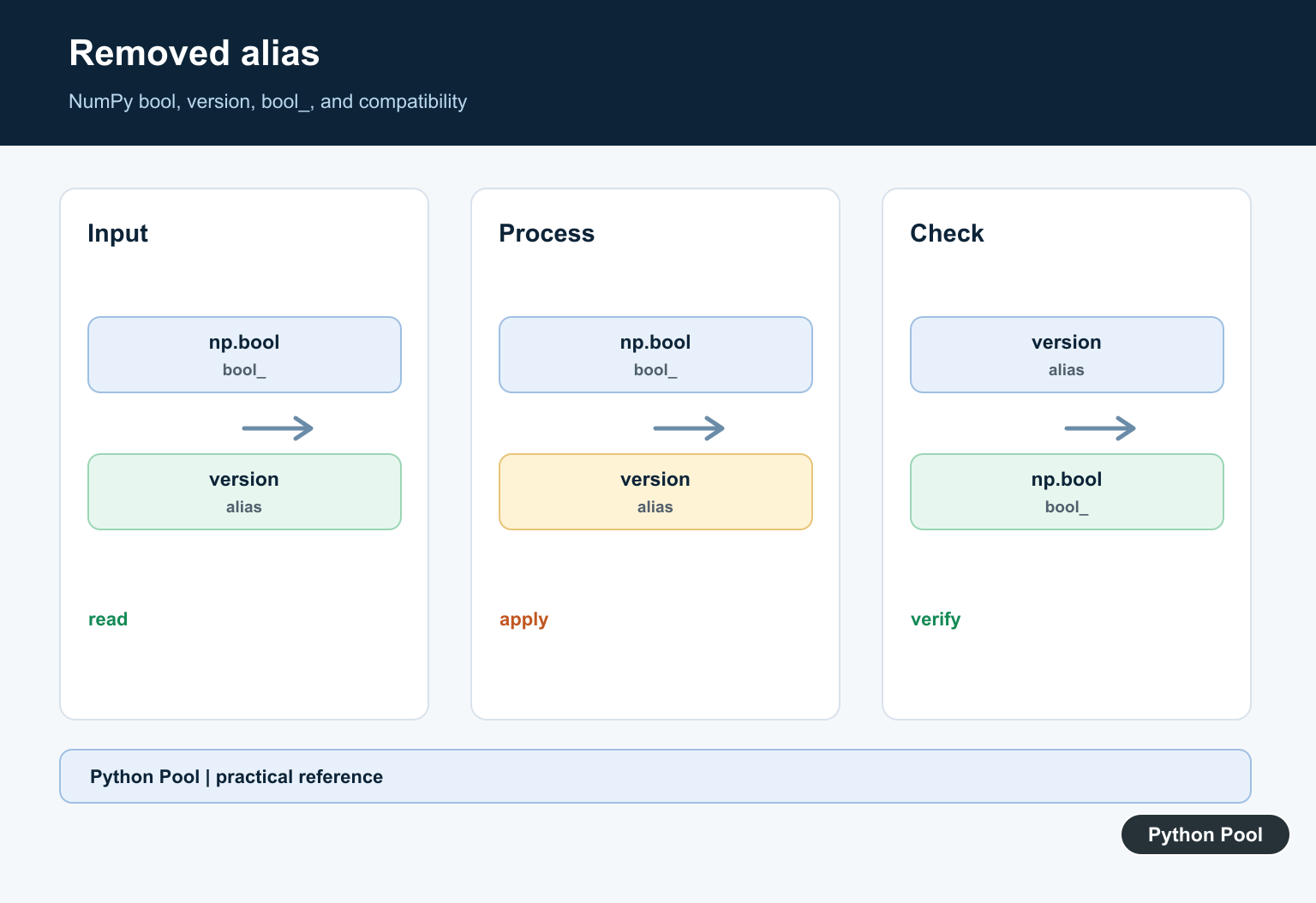
If you specifically want NumPy’s scalar boolean type, use np.bool_. NumPy’s scalar type documentation lists bool_ as the NumPy boolean scalar type.
import numpy as np

value = np.bool_(True)
print(value)
print(type(value))
Output:
True
<class 'numpy.bool'>
Depending on your NumPy version, the displayed class name may use the newer canonical name, but np.bool_ remains the reliable spelling for compatibility.
Fix dtype conversion with astype(bool)
If the old code uses astype(np.bool), replace it with astype(bool) or astype(np.bool_).
import numpy as np

numbers = np.array([0, 1, 2, 0])
mask = numbers.astype(bool)
print(mask)
Output:
[False True True False]The official ndarray.astype() documentation covers dtype conversion for arrays.
If the error comes from another package
Read the full traceback and find the first line that belongs to an installed package instead of your project. If an old version of TensorFlow, MXNet, Theano, PyMC, scikit-learn, or another library is still calling np.bool, update that library.
python -m pip install --upgrade numpy
python -m pip install --upgrade package-name
For Conda environments, prefer Conda-compatible updates when the package was installed through Conda:
conda update numpy
conda update package-name
Do not downgrade NumPy as the first fix. Pinning NumPy to an older version can hide the error, but it may create dependency conflicts or security and compatibility problems. Use a temporary pin only when you must run an old unmaintained package and you understand the environment tradeoff.
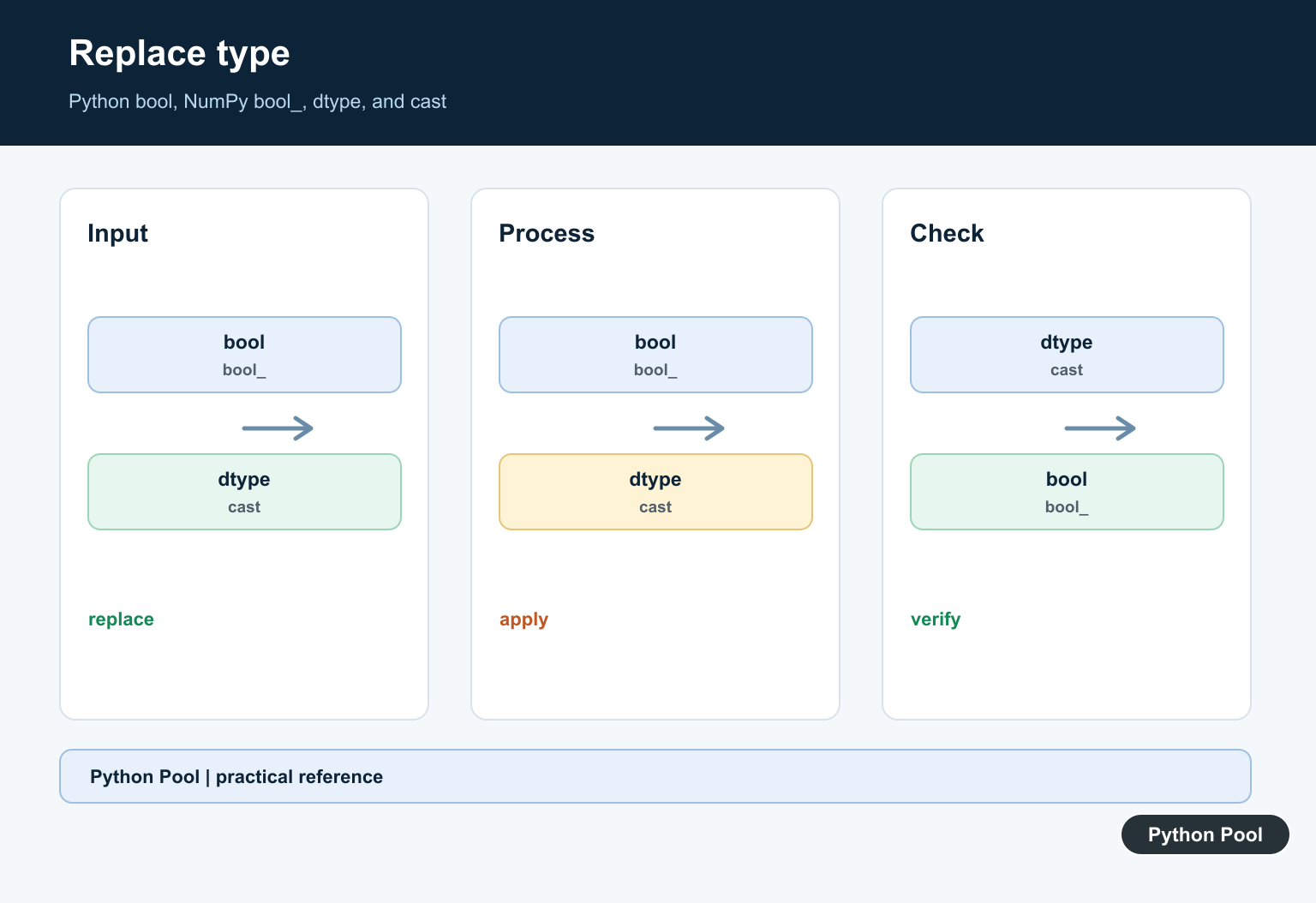
Check your NumPy version
Use this command inside the same environment that runs your script:
import numpy as np

print(np.__version__)
If your terminal shows one NumPy version and your IDE shows another, you are probably using different Python environments. Create a clean virtual environment and install the packages there.
python -m venv .venv
source .venv/bin/activate
python -m pip install --upgrade pip numpy
On Windows PowerShell, activate the environment with:
.venvScriptsActivate.ps1Common replacements
| Old code | Preferred replacement | Use when |
|---|---|---|
np.bool |
bool |
You need the normal Python boolean type or array dtype. |
np.bool |
np.bool_ |
You specifically need the NumPy scalar boolean type. |
astype(np.bool) |
astype(bool) |
You are converting an array to a boolean mask. |
dtype=np.bool |
dtype=bool |
You are creating a boolean NumPy array. |
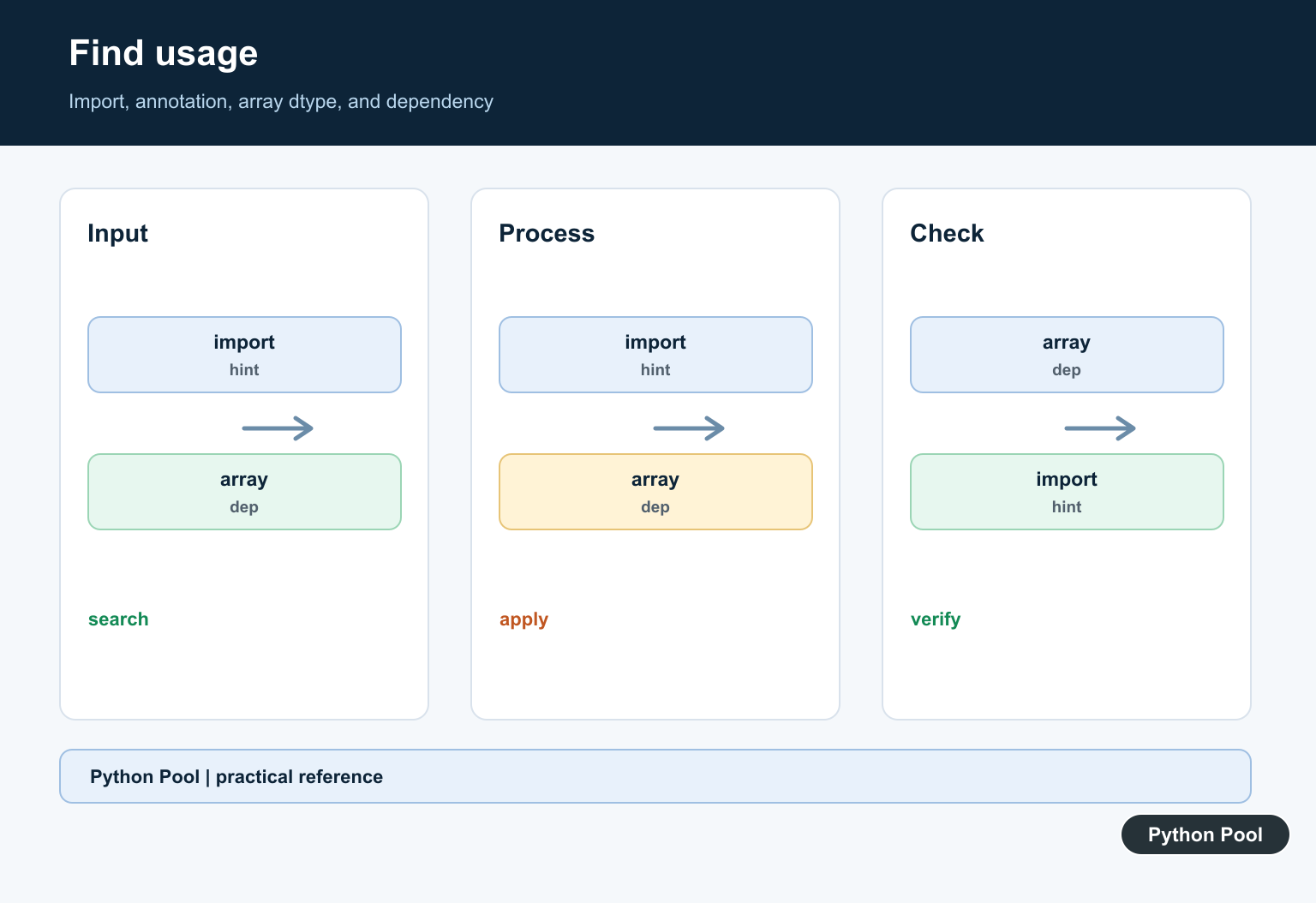
Related AttributeError and NumPy guides
For general troubleshooting, see our guide to Python AttributeError.
Conclusion
To fix module 'numpy' has no attribute 'bool', replace old np.bool usage with bool for ordinary boolean arrays or np.bool_ for the NumPy scalar type. If the error comes from a dependency, update that dependency. Only pin NumPy to an old version as a temporary compatibility workaround for legacy projects.
Choose The Replacement
The built-in bool is usually the correct replacement for type checks, flags, and ordinary arrays. numpy.bool_ is appropriate when preserving a NumPy scalar dtype is part of the API.
import numpy as np

python_flag = bool(1)
numpy_flag = np.bool_(1)
print(type(python_flag), type(numpy_flag))
Check Versions In Context
Print the interpreter path and NumPy version from the failing process. A package may be loading a different environment from the one where pip installed a fix.
import sys
import numpy as np

print(sys.executable)
print(np.__version__)
Update The Dependent Package
If the traceback points into a third-party package, check its release notes and supported NumPy range. Updating that package is preferable to editing installed files or globally downgrading NumPy.
from packaging.version import Version

installed = Version("1.24.0")
if installed >= Version("1.20.0"):
    print("removed aliases may require updated dependencies")
Pin Only As A Temporary Boundary
A compatibility pin can unblock a legacy application, but record the constraint and test the upgrade path. Do not mix a legacy NumPy with packages built for a different ABI without checking support.
from pathlib import Path

Path("constraints.txt").write_text("numpy<1.24\n", encoding="utf-8")
print("temporary compatibility constraint recorded")
NumPy’s 1.24 release notes document removed aliases, and the numpy.bool_ reference defines the scalar type. Related references include import compatibility, environment selection, and package metadata.
For related package compatibility, compare import diagnosis, environment selection, and package metadata when updating NumPy dependencies.
Frequently Asked Questions
Why does NumPy have no attribute bool?
The deprecated np.bool alias was removed from newer NumPy releases, so older code now fails at import or runtime.
Should I replace np.bool with bool?
Use built-in bool for ordinary Python booleans and numpy.bool_ when a NumPy scalar dtype is specifically required.
Can I just downgrade NumPy?
A pinned older version may be a temporary compatibility measure, but updating the dependent code is safer for long-term support.
How do I find which package uses np.bool?
Read the traceback, search installed source or dependency releases, and reproduce the issue in the exact interpreter environment.