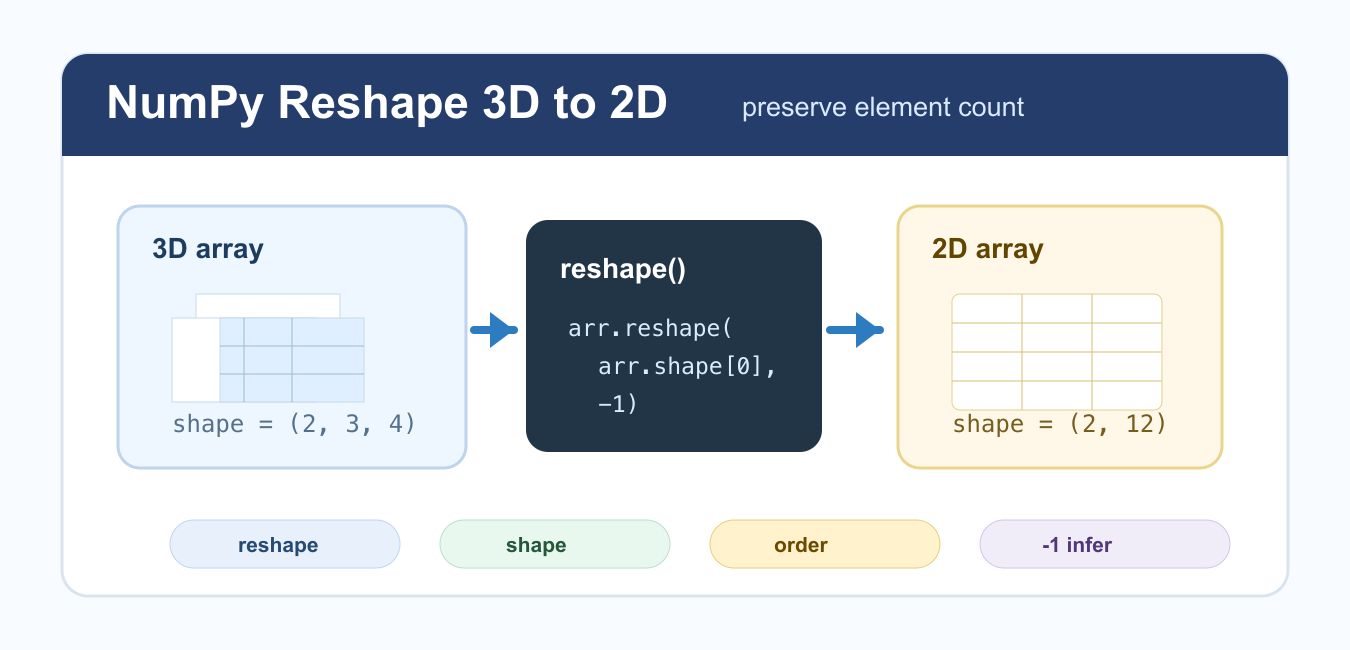
Quick answer: A 3D-to-2D NumPy reshape preserves the total number of elements but changes how axes are viewed as rows and columns. Choose the target shape and order from the data meaning, then check whether the result is a view or copy when memory sharing matters.
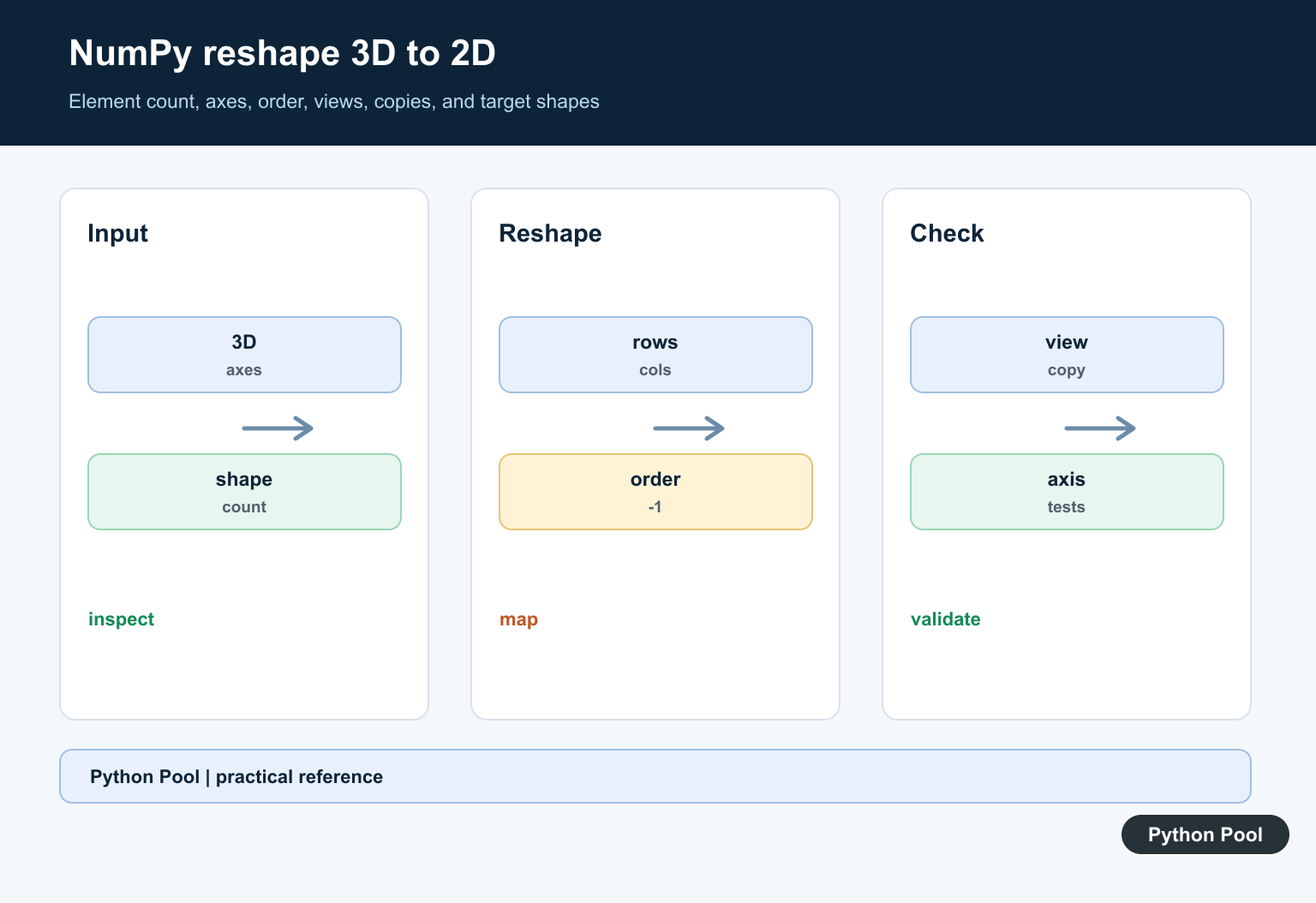
Use numpy.reshape() to convert a 3D array to a 2D array when you want a different view of the same values without changing the number of elements. The important rule is simple: the product of the new shape must equal the product of the old shape. A 3D array with shape (2, 3, 4) has 2 * 3 * 4 = 24 elements, so valid 2D shapes include (2, 12), (6, 4), (3, 8), and (1, 24).
Most bugs happen because the target shape is chosen before checking what each axis means. In many datasets, the first axis stores batches or samples, the middle axis stores rows or time steps, and the last axis stores features or columns. If you flatten the wrong axis, the code may still run but the resulting matrix will have the wrong meaning for analysis, plotting, or model input.
Check Shape and Size First
Start by printing .shape and .size. The shape tells you how the values are arranged now, while size tells you the total element count that must be preserved. This mirrors the behavior described in the official NumPy reshape documentation.
import numpy as np

array_3d = np.arange(24).reshape(2, 3, 4)

print(array_3d.shape)
print(array_3d.size)
This array has two 3-by-4 blocks. Because the total size is 24, any valid 2D reshape must also contain exactly 24 values. If you are not sure where the values came from, inspect a small sample before reshaping a large array.
Reshape Each 3D Slice Into One Row
A common pattern is to keep the first axis and flatten everything after it. With a shape of (2, 3, 4), this creates a 2D matrix with shape (2, 12). Each original 3D block becomes one row. This is useful when the first axis represents samples and every sample should become one feature row.
import numpy as np

array_3d = np.arange(24).reshape(2, 3, 4)
array_2d = array_3d.reshape(array_3d.shape[0], -1)

print(array_2d.shape)
print(array_2d)
The -1 asks NumPy to infer the second dimension from the element count. In this case, NumPy calculates 24 / 2, so the inferred column count is 12. This is usually safer than typing the flattened size manually.
Keep the Last Axis as Columns
Another common reshape keeps the last axis unchanged and merges the earlier axes. With (2, 3, 4), this produces (6, 4). Use this when the last axis already represents columns or features, and the earlier axes represent repeated groups that should be stacked into rows.
import numpy as np

array_3d = np.arange(24).reshape(2, 3, 4)
array_2d = array_3d.reshape(-1, array_3d.shape[-1])

print(array_2d.shape)
This layout is common before passing data to tools that expect a 2D matrix, such as many plotting, tabular processing, and machine learning workflows. It is also easier to reason about than flattening everything into a single row.
Use -1 to Infer One Dimension
NumPy allows only one inferred dimension in a reshape call. You can write reshape(2, -1) or reshape(-1, 4), but not reshape(-1, -1). When you know the axis that must stay stable, set that axis explicitly and let NumPy calculate the other one.
import numpy as np

array_3d = np.arange(24).reshape(2, 3, 4)

flat_rows = array_3d.reshape(2, -1)
tall_matrix = array_3d.reshape(-1, 4)

print(flat_rows.shape)
print(tall_matrix.shape)
If your code receives arrays dynamically, this pattern is better than hard-coding every number. It also pairs well with shape checks from a related guide such as finding list shape in Python before converting nested data into NumPy arrays.
C Order vs Fortran Order
The order argument controls the order in which values are read and written during reshape. The default is order="C", which follows row-major C-style indexing. order="F" uses column-major Fortran-style indexing. Both outputs can have the same shape while arranging values differently.
import numpy as np

array_3d = np.arange(12).reshape(2, 2, 3)

c_order = np.reshape(array_3d, (2, 6), order="C")
f_order = np.reshape(array_3d, (2, 6), order="F")

print(c_order)
print(f_order)
For everyday Python code, keep the default unless you specifically need column-major behavior for interoperability or numerical routines. If you are changing dimensions as part of a larger array workflow, the broader NumPy reshape guide and the ndarray.reshape reference are useful companion references.
Common ValueError
If the requested shape cannot hold the same number of elements, NumPy raises a ValueError. For example, 24 values cannot be reshaped into (5, 5) because that target shape needs 25 values.
import numpy as np

array_3d = np.arange(24).reshape(2, 3, 4)

try:
    array_3d.reshape(5, 5)
except ValueError as error:
    print(error)
When this error appears, multiply the current dimensions, multiply the target dimensions, and compare the totals. If one axis may vary, use -1. If your goal is just to remove dimensions of length one, use numpy.squeeze or the practical NumPy squeeze guide instead of reshape. If your goal is to add a new axis before reshaping, see how to add a dimension to a NumPy array.
reshape vs ravel vs flatten
Use reshape() when you know the exact 2D target layout. Use numpy.ravel when you want a 1D view where possible. Use flatten() when you specifically need a 1D copy. If you are new to arrays, the NumPy array tutorial is a better starting point before moving into shape transformations.
Best Practice
For a 3D-to-2D reshape, decide which axis should remain meaningful before writing the target shape. Use arr.reshape(arr.shape[0], -1) when each 3D block should become a row. Use arr.reshape(-1, arr.shape[-1]) when the last axis should remain as columns. In both cases, verify the output shape immediately so later code does not silently operate on the wrong matrix layout.
Confirm The Element Count
If the source shape is (a, b, c), the target dimensions must multiply to a * b * c. Use -1 for one inferred dimension only after the other dimensions are fixed.
Choose The Row Meaning
Reshaping can combine dimensions in multiple ways. Decide whether each first-axis sample becomes a row, whether channels or features should be last, and whether transpose or moveaxis must happen first.
Understand Order
C and Fortran order describe how elements are traversed for the reshape. The default often matches row-major data, but a non-contiguous source can make the result’s memory behavior less obvious.
Distinguish View From Copy
reshape may return a view when layout permits and a copy otherwise. Use np.shares_memory or the documented array behavior when mutating one object must affect the other.
Avoid Silent Semantic Errors
A reshape can succeed while grouping the wrong values for a machine-learning feature matrix or image batch. Add axis comments, shape assertions, and a small hand-checked example.
Test Real Input Shapes
Test singleton dimensions, non-contiguous arrays, inferred dimensions, incompatible targets, transpose-before-reshape, view or copy behavior, and round-trip restoration of the original shape.
The official NumPy reshape documentation defines shape and order behavior. Related Python Pool references include NumPy arrays and tests.
For related array transformations, compare NumPy shape handling, axis tests, and row organization before reshaping data.
Frequently Asked Questions
How do I reshape a 3D NumPy array into 2D?
Choose a 2D shape whose product equals the original element count and call reshape with that target shape.
Can I use -1 in reshape?
One dimension can be inferred with -1, but the remaining dimensions must determine an exact compatible element count.
Does reshape always copy the array?
It may return a view or a copy depending on layout and order, so do not rely on memory sharing without checking the actual result.
Why does the reshaped matrix look scrambled?
The element order and axis semantics may not match your intended row and column grouping; transpose or move axes before reshaping when needed.