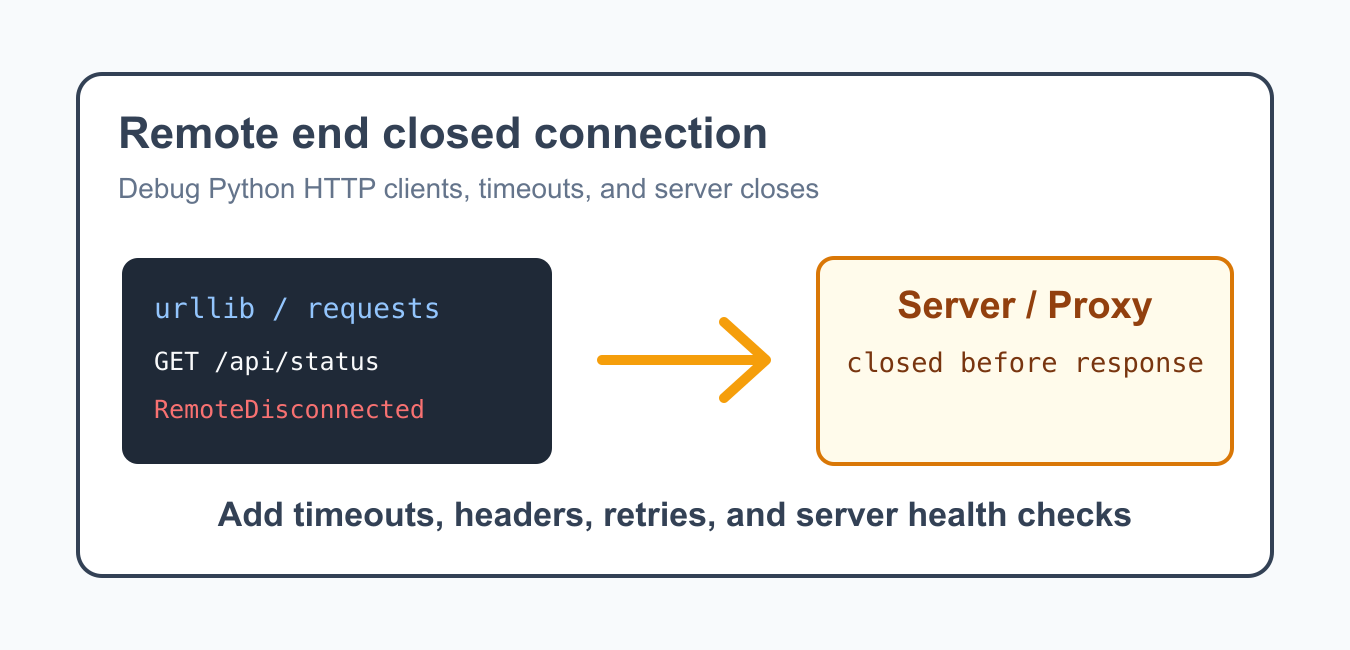
Quick answer: Treat RemoteDisconnected as a connection-lifecycle failure: identify the client and server, set an explicit timeout, log the request context, and retry only a safely repeatable request after checking proxy and server logs.
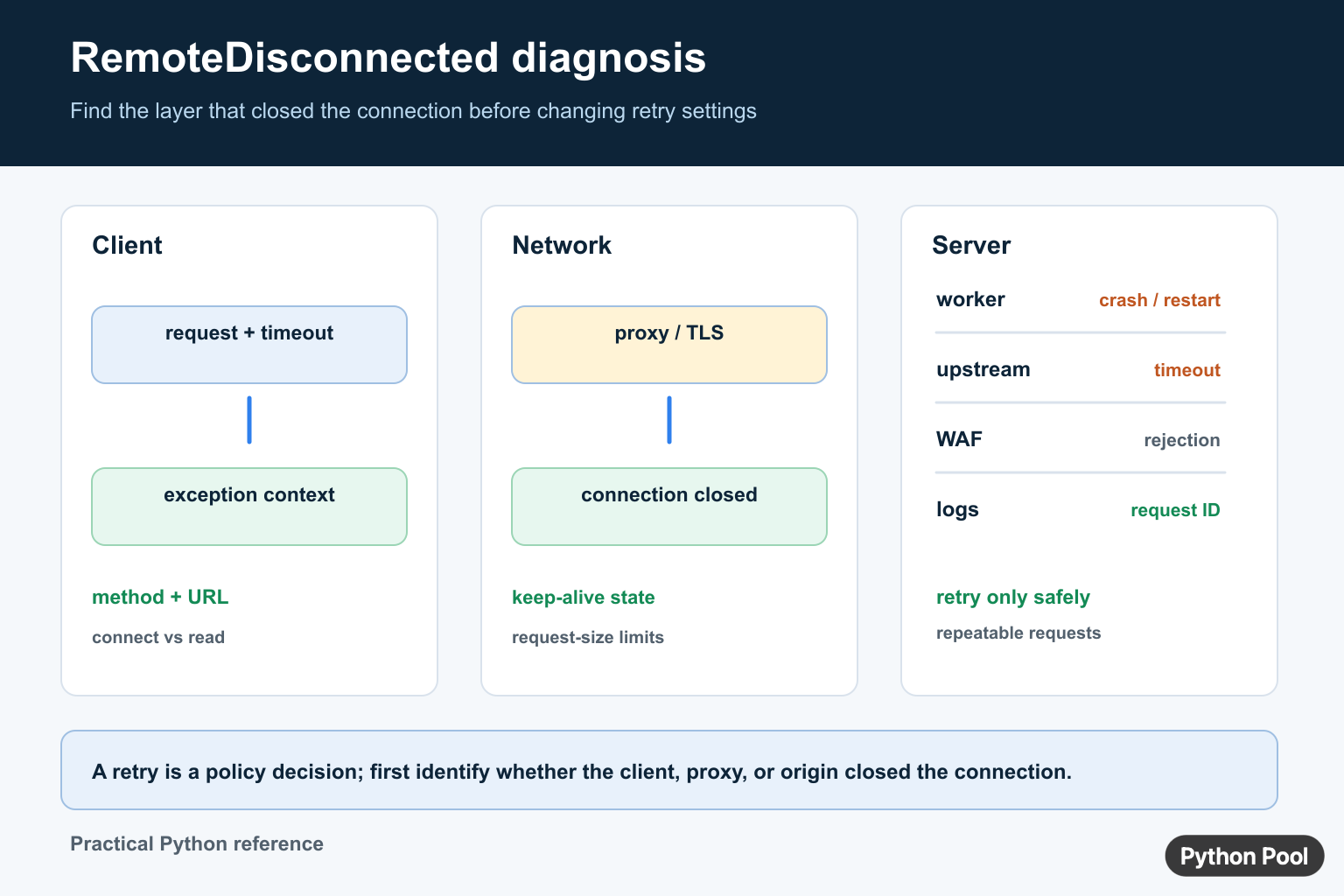
Remote end closed connection without response means the server closed the TCP connection before sending a complete HTTP response. In Python, it often appears through http.client.RemoteDisconnected, urllib, or a library built on top of them.
The problem can be on either side. The client may be missing headers, using a short timeout, reusing a stale connection, or sending a request the server rejects. The server may crash, close idle connections, reject large payloads, or sit behind a proxy that drops the request.
That is why this error needs a systematic check instead of one random retry. Treat it as a connection lifecycle problem: the socket opened, but the HTTP response did not arrive. The next step is to learn whether the server saw the request, whether a proxy interrupted it, or whether the client sent something the server refused to handle.
The Python RemoteDisconnected documentation defines the exception. For related server setup, see the Python HTTP server guide and the FastAPI documentation.
Catch The urllib Error
Start by catching the specific exception so your script can log the failed URL and retry safely if appropriate.
from http.client import RemoteDisconnected
from urllib.error import URLError
from urllib.request import urlopen

try:
    with urlopen("https://example.com/api/status", timeout=10) as response:
        body = response.read()
        print(response.status, len(body))
except RemoteDisconnected as error:
    print("Server closed the connection:", error)
except URLError as error:
    print("URL error:", error)
If the failure is intermittent, it is often a timeout, load balancer, proxy, or keep-alive issue. If it happens every time, inspect headers, method, payload, and server logs.
Also compare the failing request with a known working request from a browser, curl, or API client. Differences in headers, authentication, request body size, and TLS settings often explain why only the Python client fails.
Add Headers And A Timeout
Some servers reject requests that look incomplete or automated. Send a clear user agent and always set a timeout.
from urllib.request import Request, urlopen

request = Request(
    "https://example.com/api/status",
    headers={
        "User-Agent": "PythonPoolClient/1.0",
        "Accept": "application/json",
    },
)

with urlopen(request, timeout=15) as response:
    print(response.status)
    print(response.read().decode("utf-8"))
A timeout prevents the client from hanging forever. Headers make the request easier to identify in server and proxy logs.
Do not set the timeout so low that normal server latency becomes a failure. Pick a value that matches the endpoint and then log it so production failures have enough context.
Retry Idempotent Requests
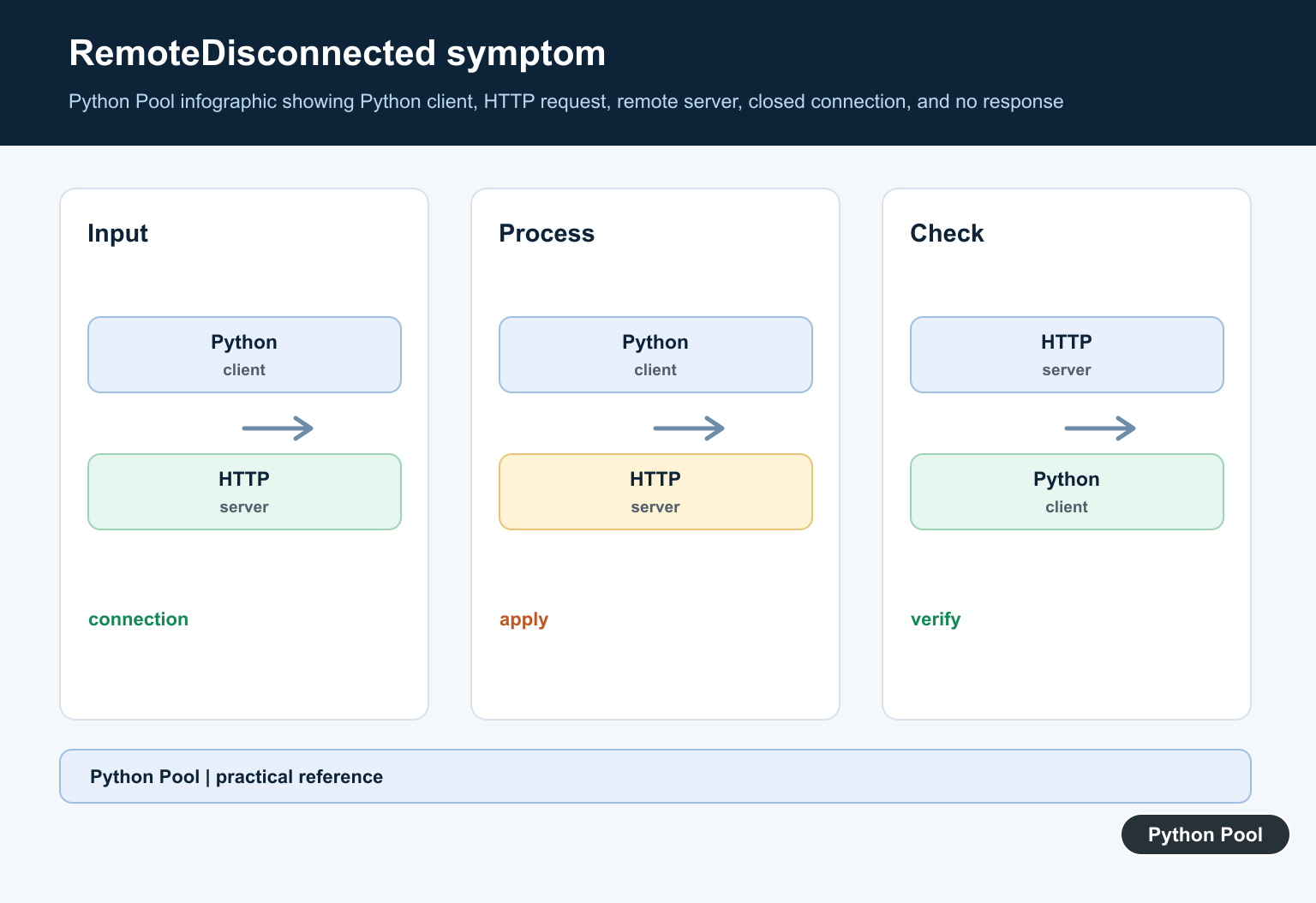
Retries are reasonable for safe, idempotent requests such as many GET calls. Be more careful with writes.
import time
from http.client import RemoteDisconnected
from urllib.request import urlopen

def fetch_with_retry(url, attempts=3):
    for attempt in range(1, attempts + 1):
        try:
            with urlopen(url, timeout=10) as response:
                return response.read()
        except RemoteDisconnected:
            if attempt == attempts:
                raise
            time.sleep(0.5 * attempt)

print(len(fetch_with_retry("https://example.com/api/status")))
Backoff gives the server time to recover. Avoid unbounded retry loops because they can make an overloaded service worse.
Only retry operations that are safe to repeat. A failed write may still have reached the server before the connection closed, so retrying it blindly can create duplicates.
Use requests With A Session
If you use requests, a session can reuse configuration and make timeout handling consistent.
import requests

session = requests.Session()
session.headers.update({
    "User-Agent": "PythonPoolClient/1.0",
    "Accept": "application/json",
})

response = session.get("https://example.com/api/status", timeout=15)
response.raise_for_status()

print(response.json())
If the session reuses a stale connection, close the session and retry once with a new session. Persistent connection behavior can differ across proxies and servers.
For long-running workers, recreate sessions periodically or after network errors. That can avoid repeatedly reusing a connection pool that contains broken sockets.
Check Server-Side Health
When you control the server, add a small health endpoint and confirm that it returns a normal response before debugging complex routes.
from fastapi import FastAPI

app = FastAPI()

@app.get("/health")
def health_check():
    return {"status": "ok"}

@app.get("/items/{item_id}")
def read_item(item_id: int):
    return {"item_id": item_id}
If the health endpoint works but one route fails, inspect that route for unhandled exceptions, long-running work, streaming responses, and payload parsing problems.
Server logs are decisive here. If the server logs an exception before sending headers, the client may see a closed connection instead of a clean HTTP 500 response.
Log Enough Context
Good logs make this error much easier to diagnose. Log method, host, path, timeout, and retry count, but avoid printing secrets.
import logging

logging.basicConfig(level=logging.INFO)
logger = logging.getLogger("client")

def log_request(method, url, timeout, attempt):
    logger.info(
        "request method=%s url=%s timeout=%s attempt=%s",
        method,
        url,
        timeout,
        attempt,
    )

log_request("GET", "https://example.com/api/status", 15, 1)
Pair client logs with server logs from the same time window. If the request never reaches the server, check DNS, firewall, proxy, TLS, and load balancer settings.
When the request passes through a reverse proxy, inspect proxy timeout limits and maximum body sizes. The application server may be healthy while the proxy closes the connection first.
Best Fix Strategy
First, make the client request explicit: URL, method, headers, timeout, and payload. Next, retry only safe requests with backoff. Then inspect the server or proxy to see whether it closed the connection intentionally or crashed before responding.
Do not hide the error with broad exception handling. A closed connection can indicate a real server failure, a blocked request, or a misconfigured client. Handle it deliberately and log enough detail to reproduce it.
The reliable pattern is to add timeouts, send clear headers, retry safe reads, avoid stale sessions, and check server health. That turns a vague remote-disconnect message into a specific client, network, or server fix.
Separate The Failure Layers
RemoteDisconnected means the remote side closed the connection without sending a usable response. It does not identify the root cause. A server process may have crashed, a reverse proxy may have rejected or timed out the request, or the client may be reusing a stale connection or sending an unexpected request. Record which layer saw the failure before changing retry settings.
Use Explicit Timeouts And Bounded Retries
Never let a network call depend on an implicit timeout. Set separate connect and read limits when the client supports them, then use a small retry budget with backoff. Retrying a GET is usually easier to reason about than retrying a payment, upload, or other non-idempotent operation. A retry should not turn one server failure into a traffic spike.
import time
from http.client import RemoteDisconnected
import requests

for attempt in range(3):
    try:
        response = requests.get(url, timeout=(3.05, 15))
        response.raise_for_status()
        break
    except (RemoteDisconnected, requests.exceptions.ConnectionError):
        if attempt == 2:
            raise
        time.sleep(2 ** attempt)
For production clients, use a configured retry adapter or transport policy when the library supports it, and classify status codes separately from connection exceptions. Log the final failure with a request identifier so the server team can match it to access and error logs.
Check The Server And Proxy
Compare a failing request with a small request that succeeds. Check server worker crashes, upstream timeouts, keep-alive settings, request-size limits, TLS termination, rate limiting, and WAF decisions. A client-side header change can help only when the server is intentionally rejecting the original request; it cannot repair an overloaded origin.
Frequently Asked Questions
What does RemoteDisconnected mean in Python?
It means the remote side closed the HTTP connection without sending a usable response; the root cause may be the client, a proxy, or the server.
How do I prevent RemoteDisconnected errors?
Set explicit connect and read timeouts, use a session correctly, send the headers the server expects, and check server and proxy health.
Should I retry RemoteDisconnected?
Retry only safely repeatable requests with a small bounded budget and backoff; do not blindly repeat non-idempotent operations such as payments or uploads.
What should I log when debugging it?
Log the HTTP method, URL or request ID, attempt number, timeout values, exception type, proxy path, and matching origin or reverse-proxy logs.