
Quick answer: Use math.comb(n, k) for the binomial coefficient C(n, k), which counts unordered selections of k items from n. It validates integer inputs and handles the arithmetic directly; use itertools.combinations() only when the actual selections, not just their count, are needed.
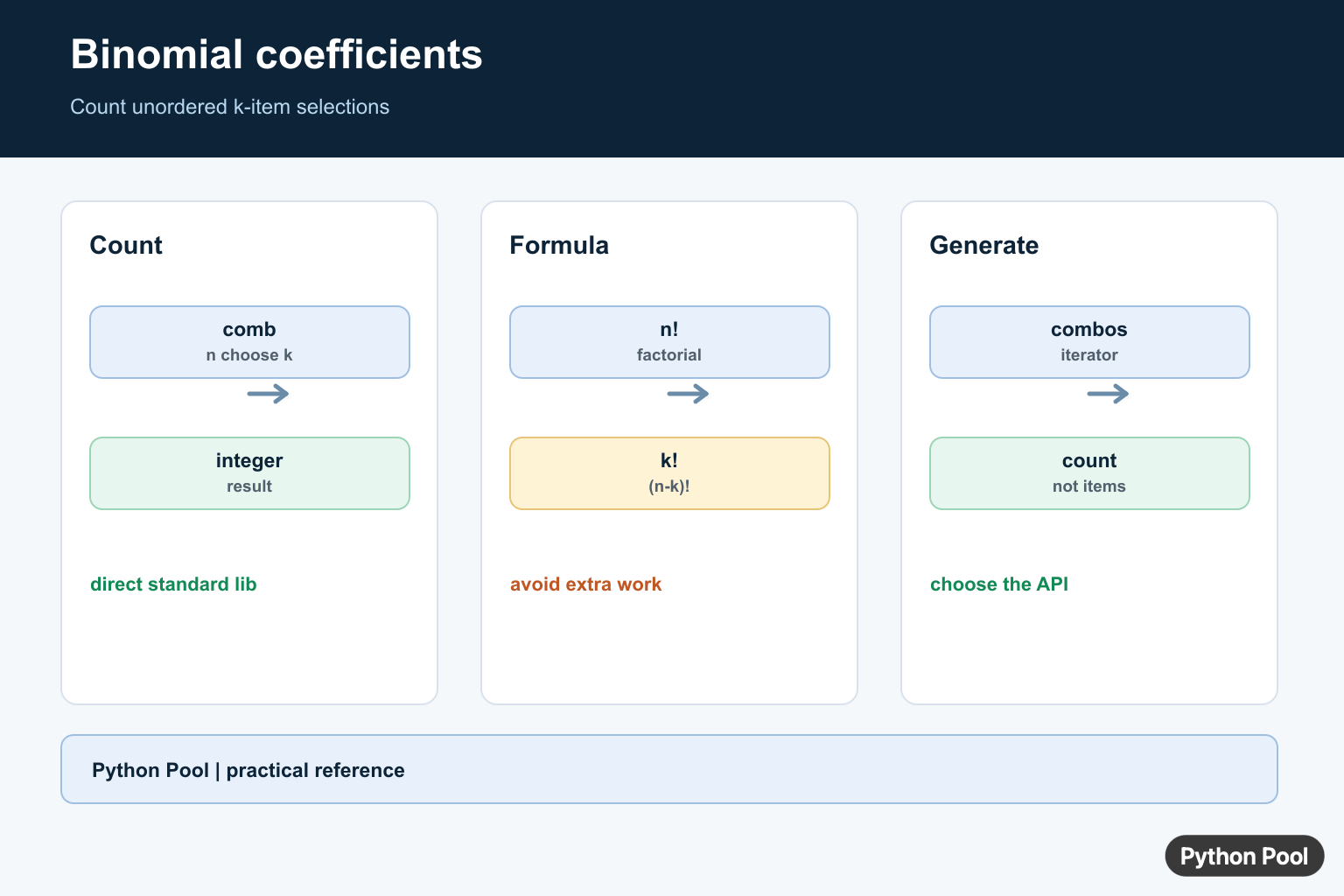
A binomial coefficient counts how many ways you can choose k items from n items when order does not matter. It is often written as C(n, k) or “n choose k”.
In modern Python, the best direct tool is math.comb(). It is exact, fast, and avoids the mistakes that can happen in hand-written factorial code. The official math.comb documentation defines the function, the itertools.combinations documentation shows the related iterator, and SciPy documents scipy.special.comb for scientific workflows.
Use math.comb
math.comb(n, k) returns the exact integer binomial coefficient for non-negative integers.
import math

ways = math.comb(5, 2)

print(ways)
The result is 10, because there are ten ways to choose two items from five.
Use math.comb() when you need a single coefficient or a table of exact values. It is the clearest standard-library choice.
Calculate With The Factorial Formula
The formula for a binomial coefficient is n! / (k! * (n-k)!). Python can express that with math.factorial().
import math

def binomial(n, k):
    numerator = math.factorial(n)
    denominator = math.factorial(k) * math.factorial(n - k)
    return numerator // denominator

print(binomial(6, 3))
This returns 20. The integer division is safe here because the formula always produces an integer when the inputs are valid.
The formula is useful for learning, but math.comb() is preferred in production code because it validates inputs and avoids unnecessary large intermediate values.
Count Actual Combinations
itertools.combinations() generates the selected groups themselves. Counting those groups matches the binomial coefficient.
from itertools import combinations

letters = ["a", "b", "c", "d"]
pairs = list(combinations(letters, 2))

print(pairs)
print(len(pairs))
The length is 6, the same as math.comb(4, 2). This approach is helpful when you need the actual combinations, not only the count.
Do not materialize every combination for large inputs just to count them. Use math.comb() for counts and itertools.combinations() only when the groups are needed.
Build A Pascal Row
Each row of Pascal’s triangle is a list of binomial coefficients. Row n contains C(n, 0) through C(n, n). Each row of Pascal’s triangle contains binomial coefficients; Print Pascal’s Triangle in Python builds the rows iteratively and with combinations.
import math

def pascal_row(n):
    return [math.comb(n, k) for k in range(n + 1)]

print(pascal_row(5))
The result is [1, 5, 10, 10, 5, 1]. This is a compact way to generate rows for math examples, probability calculations, or polynomial expansions.
Pascal rows are symmetric. For example, C(5, 2) and C(5, 3) are both 10.
Use Coefficients In A Binomial Expansion
Binomial coefficients appear in expansions such as (a + b)^n. The coefficients for n = 4 are the fourth Pascal row.
import math

power = 4
terms = []

for k in range(power + 1):
    coefficient = math.comb(power, k)
    terms.append((coefficient, power - k, k))

print(terms)
Each tuple stores the coefficient, the exponent for a, and the exponent for b. This representation is easy to format later.
This is useful when teaching algebra, generating symbolic output, or checking expansion logic.
Use SciPy For Scientific Arrays
When you are already using SciPy, scipy.special.comb() can calculate combinations and supports options useful in scientific code.
from scipy.special import comb

exact_count = comb(8, 3, exact=True)
float_count = comb(8, 3, exact=False)

print(exact_count)
print(float_count)
Use exact=True when an exact integer is required. Floating results can be convenient in numeric pipelines but are not the same as exact integer arithmetic.
If your project does not already depend on SciPy, do not add it only for a basic coefficient. The standard library already has math.comb().
Input Rules And Edge Cases
A valid binomial coefficient uses non-negative integers with 0 <= k <= n. Python raises errors for invalid inputs in math.comb(), which is better than silently returning a misleading number.
Remember the boundary cases: C(n, 0) is 1, and C(n, n) is also 1. Choosing nothing and choosing every item each has exactly one outcome.
Symmetry is also useful: C(n, k) equals C(n, n-k). For example, choosing two items to include is equivalent to choosing the remaining items to leave out. Libraries already handle this efficiently, but the property helps when checking results by hand.
Be careful with recursive examples. A direct recursive definition matches the math idea, but it repeats the same work many times unless you add caching. That makes recursion a poor default for large inputs. It is fine for teaching, while math.comb() is better for real programs.
Factorial-based code is also easy to read, but it can create very large intermediate numbers. Python handles large integers well, yet the direct library function is still cleaner and usually faster. Use the formula when explaining the concept, then switch to math.comb() for implementation.
Which Method Should You Use?
Choose the method based on the output you need. If you need only the count, use math.comb(). If you need the actual selected groups, use itertools.combinations(). If you need an entire triangle row, use a comprehension around math.comb(). If you are already working inside SciPy, scipy.special.comb() can fit naturally with the rest of that stack.
For tests, include small known values such as C(5, 2) = 10, C(6, 3) = 20, and boundary values such as C(8, 0) = 1. These examples catch off-by-one mistakes quickly.
The practical default is to use math.comb() for counts, itertools.combinations() for actual groups, and SciPy only when it already belongs in the numeric stack.
Calculate n Choose k
The notation C(n, k) means the number of ways to choose k items from n without regard to order. Python’s math.comb() is the direct standard-library operation and returns an integer without you having to manage factorial cancellation manually.
from math import comb

print(comb(5, 2))
print(comb(52, 5))
Understand The Factorial Formula
The mathematical formula is n! / (k! * (n-k)!). A direct factorial implementation is useful for learning, but intermediate factorials grow quickly and can do more work than necessary. Prefer comb() in application code.
from math import factorial


def binomial(n, k):
    if not 0 <= k <= n:
        return 0
    return factorial(n) // (factorial(k) * factorial(n - k))

print(binomial(5, 2))
Count Versus Generate Combinations
math.comb(n, k) returns only the count. itertools.combinations(iterable, k) generates each selection lazily, so it is the right tool when you need to inspect or process the combinations themselves. The number of generated results can still be enormous.
from itertools import combinations

items = ["A", "B", "C", "D"]
print(list(combinations(items, 2)))
Use The Boundary Rules
For nonnegative k greater than n, comb() returns zero under the combinatorial convention. Negative inputs are invalid. Keep n and k as integers and validate any user-provided values before using the result as a loop bound or allocation size.
from math import comb

print(comb(4, 6))
try:
    print(comb(4, -1))
except ValueError as error:
    print(error)
Python’s official math.comb() reference defines the coefficient and boundary behavior; itertools.combinations() generates the selections.
For related counting problems, compare factorials, itertools combinations, and Pascal’s triangle when the result or the actual selections are required.
Frequently Asked Questions
How do I calculate n choose k in Python?
Call math.comb(n, k) for the binomial coefficient when n and k are nonnegative integers with k no larger than n.
What is the binomial coefficient formula?
C(n, k) equals n! divided by k! times (n-k)!, although math.comb() avoids manually managing those factorials.
What happens when k is greater than n?
math.comb(n, k) returns 0 for a nonnegative k greater than n, matching the usual combinatorial convention.
How is a binomial coefficient related to combinations?
It counts the same unordered k-element selections represented by itertools.combinations(), without materializing every selection.