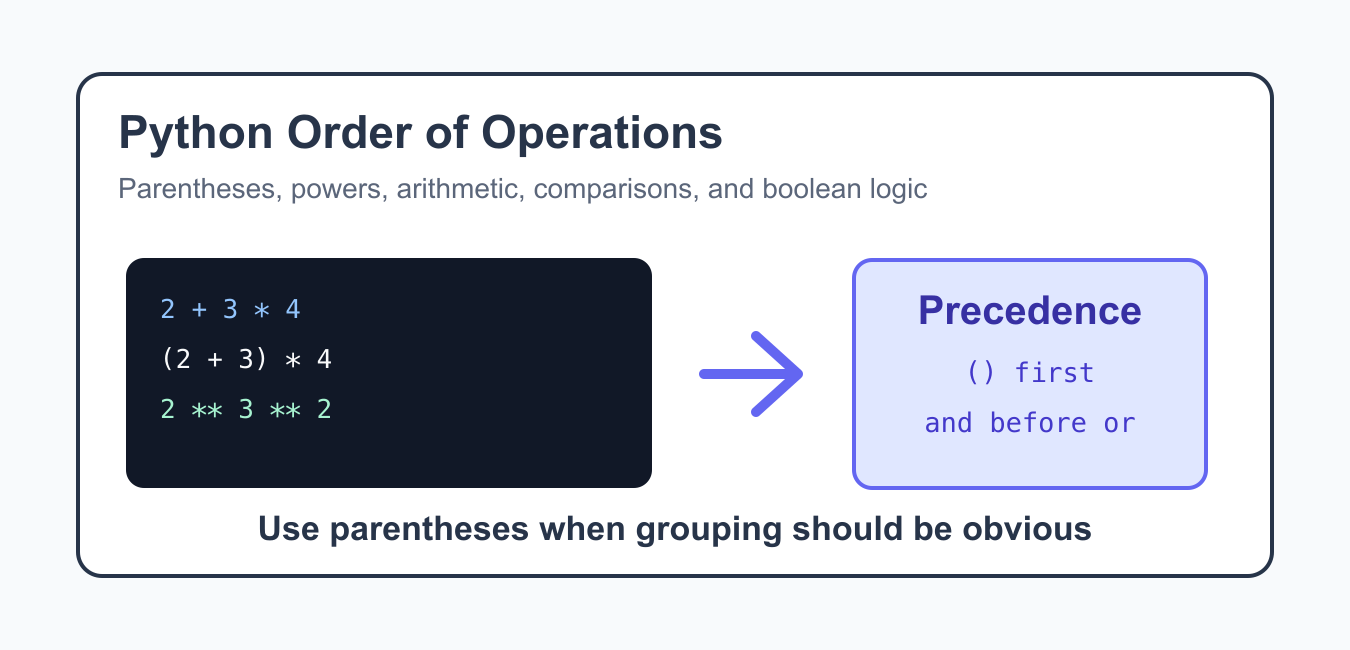
Quick answer: Python groups an expression using its precedence and associativity rules. Parentheses come first, exponentiation binds tightly, arithmetic operators follow, then comparisons and boolean operators. Use parentheses to make an important grouping visible instead of relying on readers to remember every table entry.
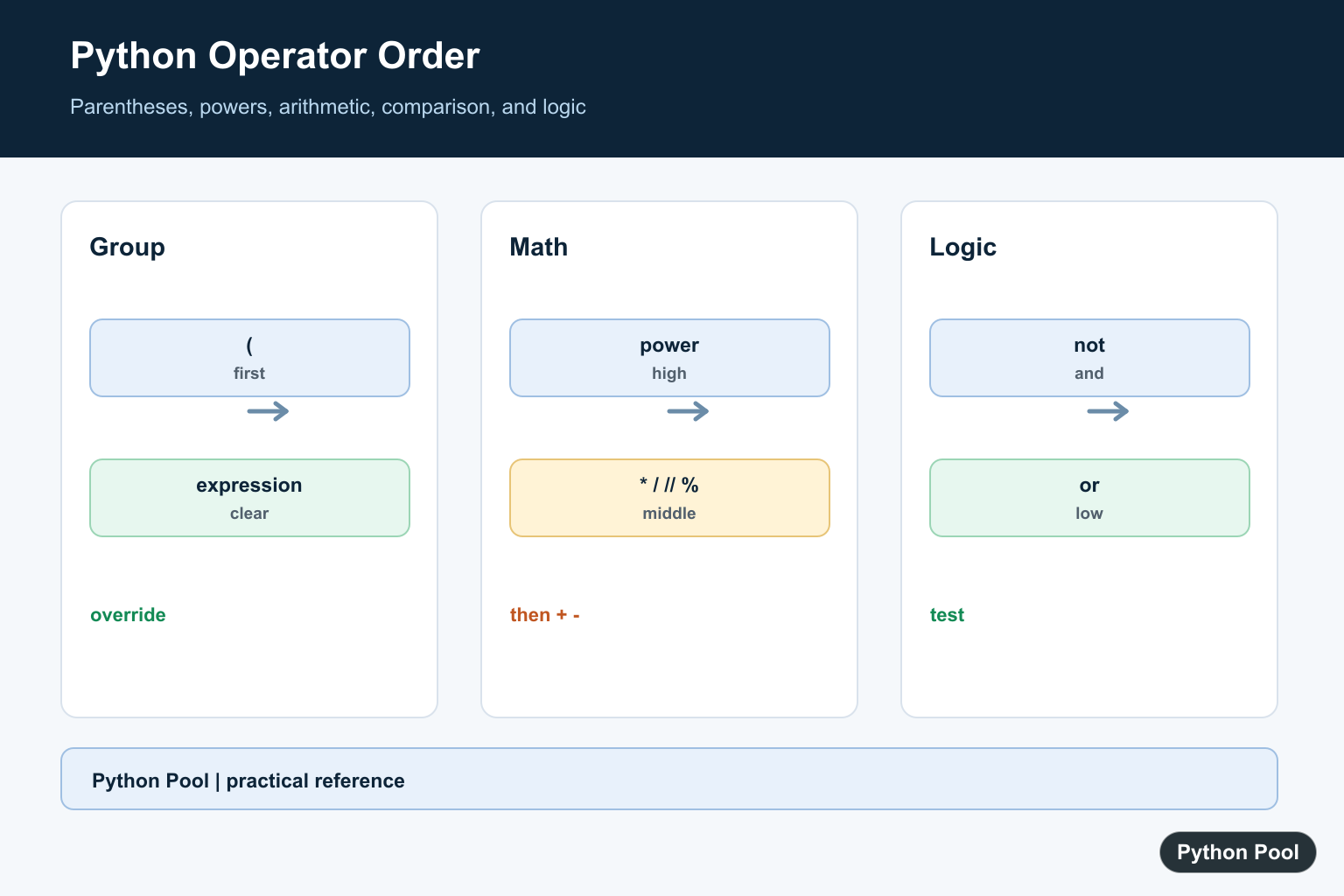
Python order of operations decides how an expression is grouped before it is evaluated. Parentheses are handled first, then operators follow Python’s precedence rules. This matters for arithmetic, comparisons, boolean expressions, and mixed expressions that would be unclear without grouping.
Operator precedence does not mean that compact code is always better. When an expression mixes several operators, parentheses can make the intended grouping obvious. Use the rules to understand Python, and use parentheses to help the next reader.
The safest way to think about precedence is as Python’s default grouping rule. If the default grouping matches the formula and the expression is short, you can leave it alone. If the expression is long or business-critical, make the grouping visible even when Python would already do the right thing.
The official Python operator precedence table, power operator documentation, and boolean operations documentation are the primary references.
Arithmetic Precedence
Multiplication, division, floor division, and modulo bind more tightly than addition and subtraction.
result = 2 + 3 * 4
grouped = 2 + (3 * 4)

print(result)
print(grouped)
Both expressions print 14. Python multiplies 3 * 4 before adding 2.
This rule is the same reason 10 - 6 / 2 gives 7.0, not 2.0. Division happens before subtraction unless parentheses say otherwise.
Parentheses Override Precedence
Parentheses make Python evaluate a subexpression first. Use them when the intended grouping should be visible.
without_parentheses = 2 + 3 * 4
with_parentheses = (2 + 3) * 4

print(without_parentheses)
print(with_parentheses)
This prints 14 and 20. The parentheses change the grouping, so the addition happens before multiplication.
Parentheses are also useful when formulas are copied from math, spreadsheets, or documentation. They reduce the chance that a future edit changes the calculation accidentally.
Exponentiation Groups From The Right
The power operator has a special associativity rule: chained powers group from the right.
plain = 2 ** 3 ** 2
explicit = 2 ** (3 ** 2)
left_grouped = (2 ** 3) ** 2

print(plain)
print(explicit)
print(left_grouped)
The first two expressions produce 512, while the left-grouped expression produces 64. Add parentheses when chained powers appear in real code.
Chained powers are rare in everyday programs, but this rule matters in scientific, financial, and scoring formulas. A small grouping difference can change the result by a large amount.
Unary Operators And Powers
Unary minus can be surprising around exponentiation. Python reads -2 ** 2 as the negative of 2 ** 2.
first = -2 ** 2
second = (-2) ** 2

print(first)
print(second)
This prints -4 and 4. Parentheses are the clearest way to show whether the negative sign belongs to the base.
When a negative base is intentional, write it with parentheses. That makes the expression clear to readers and avoids subtle mistakes during refactoring.
Comparison Chaining
Python supports chained comparisons. The middle expression is evaluated once and compared on both sides.
age = 18

is_adult_range = 13 <= age < 20
same_result = 13 <= age and age < 20

print(is_adult_range)
print(same_result)
Chained comparisons are often clearer than repeating the same value in two comparisons. They are common for numeric ranges.
Do not confuse chained comparisons with arithmetic chaining. a < b < c is a special comparison form, while arithmetic operators still follow their normal precedence and associativity rules.
Boolean Operator Order
For boolean logic, not binds more tightly than and, and and binds more tightly than or.
logged_in = True
is_admin = False
has_token = True

allowed = logged_in and is_admin or has_token
clear_allowed = (logged_in and is_admin) or has_token

print(allowed)
print(clear_allowed)
Even when you know the precedence rules, boolean expressions are often easier to review with parentheses around meaningful groups.
This is especially true when conditions control permissions, filters, or validation. Grouping the policy with parentheses makes it easier to test and discuss with someone who is not reading the precedence table.
Practical Rules
Use Python's precedence table to understand how expressions work, but do not rely on readers memorizing every row. Parentheses are cheap and useful when an expression combines arithmetic, comparisons, and boolean logic.
When an expression becomes hard to scan, split it into named intermediate results. A few extra lines can make a calculation easier to debug, and tests can target each piece separately.
For maintainable code, keep expressions small, name intermediate results when a calculation has business meaning, and add tests for formulas that affect money, dimensions, indexing, or filtering. The best expression is not the shortest one; it is the one that gives the correct result and can be reviewed quickly.
The reliable pattern is to trust Python's standard precedence for simple arithmetic, use parentheses for clarity in mixed expressions, and be especially explicit around exponentiation, unary minus, and boolean logic.
Start With Parentheses
Parentheses explicitly group a subexpression and override the default precedence. They are valuable around a business rule, a security check, or any expression whose meaning would be costly to misread.
Know Arithmetic Precedence
Exponentiation binds more tightly than multiplication, division, floor division, and modulo; those bind more tightly than addition and subtraction. Comparison operators are evaluated after arithmetic has produced its values.
Understand Associativity
Operators at the same precedence do not all group in the same direction. Exponentiation has a different associativity pattern from most arithmetic operators, so parentheses are preferable when powers are nested.
Read Boolean Conditions Carefully
not binds more tightly than and, and and binds more tightly than or. A long condition should be split into named predicates or grouped explicitly so short-circuit behavior and intent remain clear.
Test The Intended Grouping
Use small examples and assert the result of mixed expressions rather than guessing from visual layout. A formatter will not change the evaluation rules, and a code review should be able to see the intended grouping.
The Python operator-precedence table defines grouping and associativity. Related references include conditional expressions, division operators, and expression tests.
For related expression choices, compare conditional expressions, division operators, and expression tests when making grouping explicit.
Frequently Asked Questions
What is Python's order of operations?
Python groups expressions according to its operator precedence rules, with parentheses overriding the default grouping.
Does exponentiation happen before multiplication?
Yes. Exponentiation binds more tightly than multiplication, division, floor division, and modulo.
Should I always add parentheses?
Use them when they clarify intent, protect a business rule, or make a mixed expression easier to review; unnecessary parentheses can also add noise.
How does boolean precedence work?
not binds more tightly than and, and and binds more tightly than or, but explicit grouping is preferable for complex conditions.