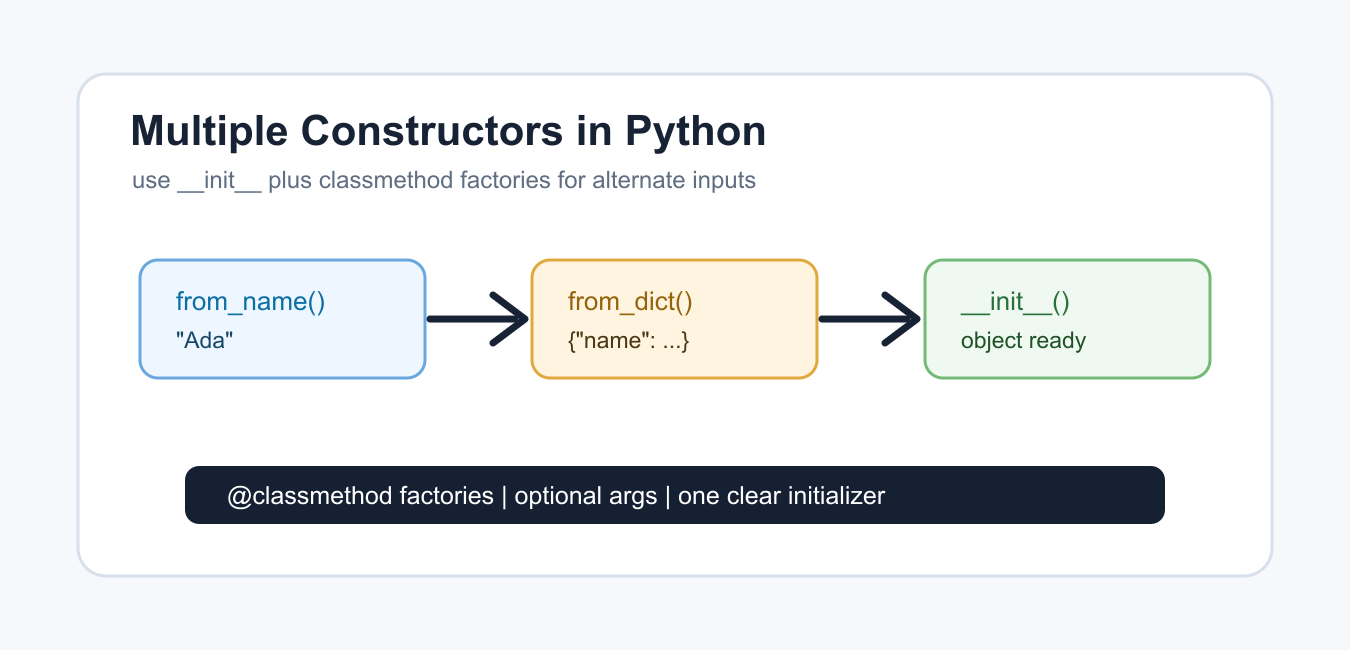
Quick answer: Python normally has one __init__ method per class. Use optional parameters for closely related inputs, classmethod alternate constructors for named input formats, or factory functions when construction must choose between different types.
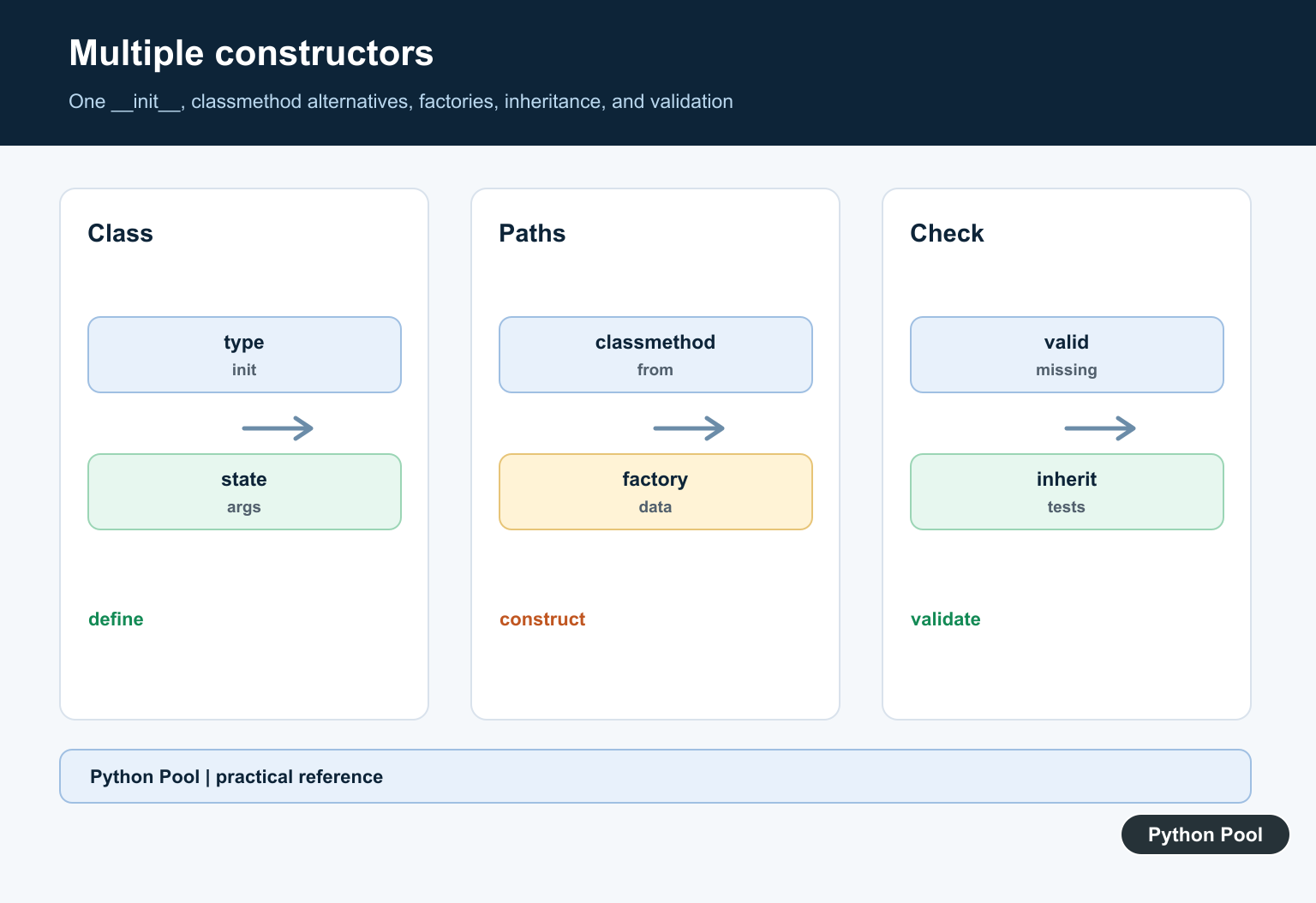
Python does not support multiple __init__ methods in the same class the way some languages support overloaded constructors. If you define __init__ more than once, the later definition replaces the earlier one.
The usual Python solution is to keep one clear __init__ method and add alternate constructors with @classmethod. Those class methods prepare input in different shapes and then call cls(...) to create the object.
The official Python documentation covers classes, classmethod(), and dataclasses.
Use alternate constructors when the same object can be created from a string, dictionary, file row, API payload, or existing object. The public factory names should explain the input format.
The benefit is separation of concerns. __init__ receives clean final values, while each factory deals with one messy input format. That keeps validation and parsing easier to test.
Factories also work well with subclasses because cls(...) creates an instance of the class that received the call, not necessarily the base class where the method was first written.
Only One __init__ Is Used
If a class defines __init__ twice, the second definition wins.
class User:
    def __init__(self, name):
        self.name = name

    def __init__(self, name, role):
        self.name = name
        self.role = role

user = User("Ada", "admin")
print(user.name)
print(user.role)
The one-argument initializer is no longer available. This is why Python code should not try to overload constructors by repeating __init__.
Use optional arguments or class methods instead, depending on how different the input forms are.
This behavior is normal Python name binding. The class body is executed, and the name __init__ ends up pointing to the last function assigned to it.
Use Optional Arguments Carefully
Optional arguments work when the construction choices are small and closely related.
class Product:
    def __init__(self, name, price=0):
        self.name = name
        self.price = price

free = Product("Sample")
paid = Product("Book", 25)

print(free.price)
print(paid.price)
This is simple because both calls still provide the same kind of data. The second argument just has a default.
If the input forms become very different, optional arguments can make the initializer confusing. That is when named factory methods are clearer.
Optional arguments are best for a small number of simple defaults. They are not a good substitute for several unrelated construction paths.
Add A classmethod Factory
A class method receives the class as cls. It can parse input and then call cls(...).
class User:
    def __init__(self, first_name, last_name):
        self.first_name = first_name
        self.last_name = last_name

    @classmethod
    def from_full_name(cls, full_name):
        first_name, last_name = full_name.split(maxsplit=1)
        return cls(first_name, last_name)

user = User.from_full_name("Ada Lovelace")
print(user.first_name)
print(user.last_name)
The initializer stays focused on the final fields. The factory handles the string format.
Factory names such as from_full_name, from_dict, and from_row make calling code easier to read than a long initializer with many optional parameters.
They also make errors easier to explain. A bad full-name string can raise an error from from_full_name, while a bad dictionary can raise a different error from from_dict.
Create From A Dictionary
A dictionary factory is useful when data comes from JSON, forms, or APIs.
class Point:
    def __init__(self, x, y):
        self.x = x
        self.y = y

    @classmethod
    def from_dict(cls, data):
        return cls(data["x"], data["y"])

point = Point.from_dict({"x": 3, "y": 4})
print(point.x)
print(point.y)
This keeps key lookup and validation out of the basic initializer. If required keys are missing, the factory is the right place to raise a clear error.
Use a dictionary factory when the external field names should not leak into every call site.
If external keys change, only the factory needs to know about the mapping. The rest of the class can continue using normal attribute names.
Use Dataclasses With Factories
Dataclasses generate the basic initializer, and you can still add classmethod factories.
from dataclasses import dataclass

@dataclass
class Rectangle:
    width: int
    height: int

    @classmethod
    def square(cls, size):
        return cls(size, size)

shape = Rectangle.square(5)
print(shape.width)
print(shape.height)
This keeps the data model short while still providing a named construction shortcut.
Dataclasses are useful when the class mostly stores data and does not need a custom handwritten initializer.
A factory can still add domain-specific names such as square, from_size, or from_config. That keeps construction expressive without giving up the generated initializer.

Validate In One Place
Factories should still route through the normal initializer so validation stays consistent.
class Account:
    def __init__(self, balance):
        if balance < 0:
            raise ValueError("balance cannot be negative")
        self.balance = balance

    @classmethod
    def from_text(cls, text):
        return cls(int(text))

account = Account.from_text("100")
print(account.balance)
The factory converts text to an integer, but the initializer enforces the balance rule. Every construction path gets the same validation.
This prevents one factory from accidentally creating an invalid object. If the invariant belongs to the object, put it in the shared initializer or a shared validation helper.
The practical rule is simple: keep one __init__, use defaults for small variations, and use @classmethod factories for genuinely different input formats.
Good tests should create objects through every factory and confirm they all produce the same valid internal state. Also test bad input for each factory so parsing errors are clear.
Understand One Initializer
A later __init__ definition replaces an earlier one; Python does not overload methods by signature. Keep the main initializer focused on establishing a valid object invariant.

Add Named Alternate Constructors
A classmethod such as from_config or from_json can parse a representation and call cls with validated values. Using cls preserves subclass behavior better than hard-coding the base class.
Use A Factory For Type Choices
A factory function is useful when input can produce several classes, when construction requires external dependencies, or when the caller should not know the concrete type.
Share Validation
Do not duplicate checks across every construction path. Normalize each input format into a common representation, validate once, and then invoke the canonical initializer.

Handle Inheritance Carefully
A subclass can extend or replace initialization, but it should preserve the base class invariant and call super when required. Document which arguments each path accepts.
Test Every Path
Test valid inputs, missing fields, conflicting arguments, malformed representations, subclasses, and failed validation. Assert both the object state and the type returned by a factory.
The official Python data model documentation explains object construction and methods. Related Python Pool references include tests and configuration mappings.
For related class design, compare construction-path tests, configuration mappings, and validation diagnostics when adding alternate constructors.
Frequently Asked Questions
Can a Python class have multiple __init__ methods?
No. Defining __init__ more than once replaces the earlier definition; use optional parameters, classmethods, or factories instead.
What is an alternate constructor in Python?
It is usually a classmethod that accepts a different input representation and returns an instance of the class.
Should I use classmethod or a factory function?
Use the option that makes ownership and naming clear; a classmethod works well when the method belongs naturally to the type, while a factory can coordinate several types.
How do I validate multiple construction paths?
Route each path through shared validation or a common initializer and test valid, missing, conflicting, and malformed inputs separately.