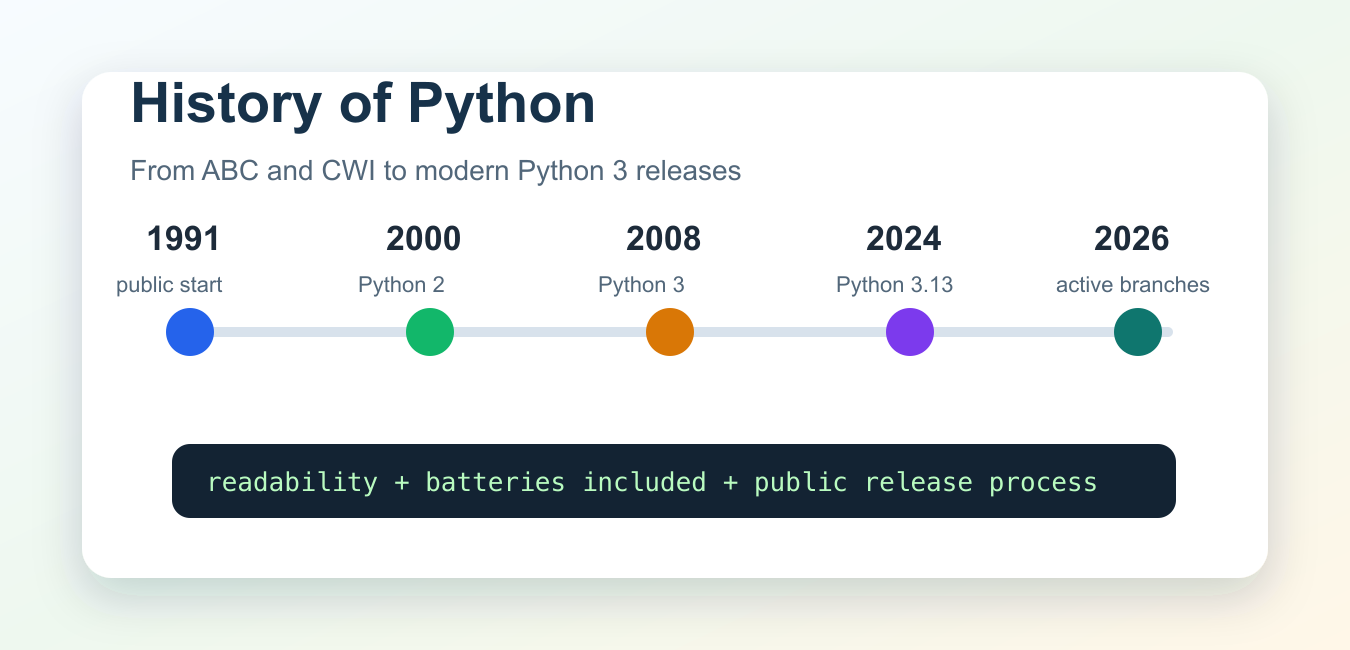
Quick answer: Python began at CWI in the Netherlands, was created by Guido van Rossum as a successor to ABC, and was first released publicly in 1991. Its history is a story of readability, extensibility, community governance, and deliberate language evolution.
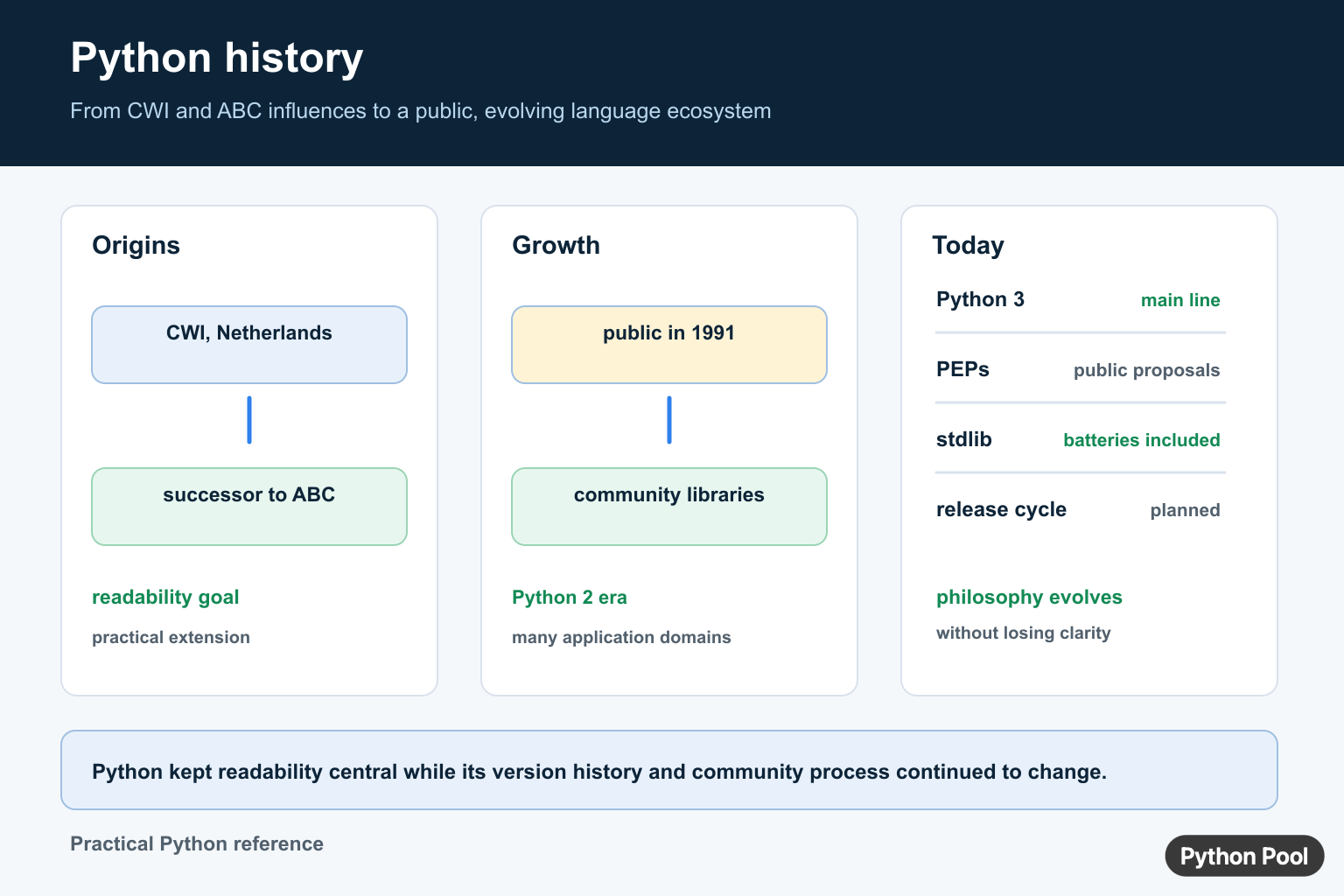
The history of Python starts at CWI in the Netherlands, where Guido van Rossum created the language in the early 1990s as a successor to ABC. The goal was not to make a tiny scripting trick. Python was designed to be readable, practical, extensible, and pleasant enough for everyday programming.
Python became public in 1991 and grew through contributions from many people. Its core ideas stayed recognizable: indentation defines blocks, code should be readable, batteries-included libraries matter, and programmers should be able to build useful software without fighting the language.
The official references for this guide are Python’s History and License, the general Python FAQ, What is Python?, the Python downloads page, Python version status, and PEP 719 for Python 3.13.
This timeline is useful because Python’s present-day design makes more sense when you know what it kept and what it changed. Python 2 supported a long era of growth. Python 3 cleaned up text handling and language behavior. Modern Python now follows planned release branches and a public enhancement process.
Another lesson from the timeline is that Python changes deliberately. New syntax and standard-library behavior usually arrive through public discussion, release candidates, documentation updates, and migration notes. That process is why teams should read release notes before upgrading important applications.
Start With The Early Timeline
A compact timeline helps separate landmark events from folklore. The official documentation places Python’s creation in the early 1990s at CWI, with public writing about Python appearing in 1991.
timeline = [
    (1991, "Python becomes publicly visible"),
    (1994, "Python 1.0 era begins"),
    (2000, "Python 2.0 is released"),
    (2008, "Python 3.0 is released"),
]

for year, event in timeline:
    print(f"{year}: {event}")
The exact story has many smaller milestones, but these dates explain the large shape. Python starts as a new readable language, becomes widely used through Python 2, then moves into the Python 3 line that current projects use.
Understand The ABC Influence
Python’s official license history says it was created as a successor to ABC. That matters because readability and teaching-friendly syntax were not accidental side effects.
influences = {
    "ABC": "readable teaching language influence",
    "C": "extension and systems integration context",
    "Unix": "scripting and tooling culture",
}

for name, note in influences.items():
    print(f"{name}: {note}")
Python did not copy ABC directly. It kept the spirit of clear notation while adding modules, exceptions, system integration, and enough flexibility for real applications.
The result is a language that works for short scripts, teaching, automation, data work, services, and application glue. That range is part of why Python history matters: many modern use cases grew from the same readability-first foundation.
Track Python 2 And Python 3
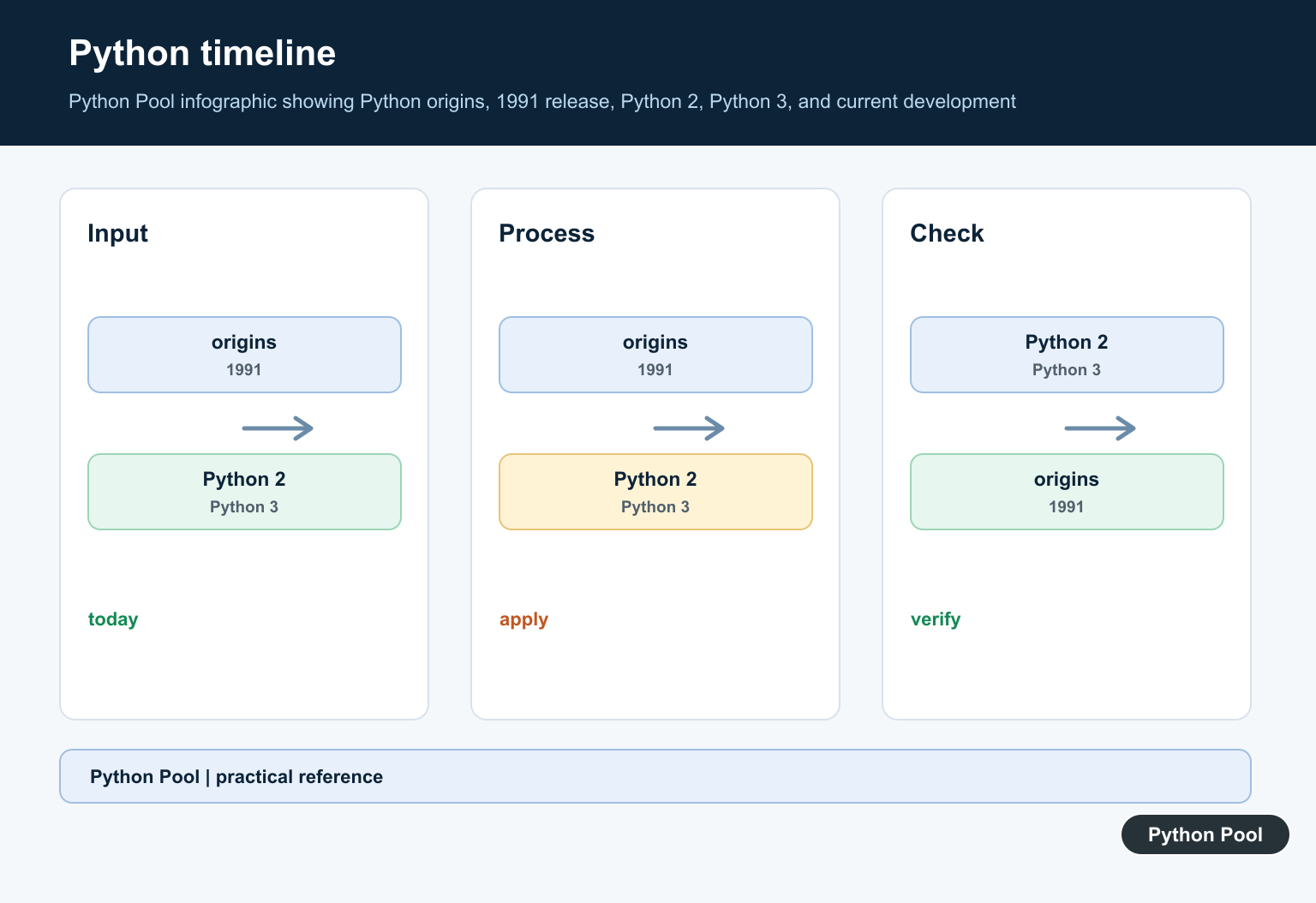
Python 2 and Python 3 are the biggest split in the language’s public history. Python 3 was not just a feature release; it fixed long-standing design issues, especially around text and bytes.
major_lines = {
    "Python 1": "early public language growth",
    "Python 2": "large ecosystem expansion",
    "Python 3": "current language line",
}

print(major_lines["Python 3"])
print(list(major_lines))
Modern tutorials should target Python 3. Python 2 is historically important, but new code should use the maintained Python 3 branch that matches your operating system, package support, and deployment target.
Connect History To The PSF
Python’s growth eventually needed a long-term home for legal, educational, and community work. The Python Software Foundation now supports the project and community around the language.
organizations = [
    "CWI",
    "CNRI",
    "BeOpen.com",
    "Python Software Foundation",
]

for index, organization in enumerate(organizations, start=1):
    print(index, organization)
That institutional history helps explain why Python is not controlled by one vendor. The language has core developers, steering processes, PEPs, documentation, conferences, packaging work, and community support.
Read Release Branches Carefully
Current Python development uses release branches with planned support windows. The active versions change over time, so always check python.org or the developer guide when choosing a runtime.
branches = {
    "3.11": "security branch",
    "3.12": "security branch",
    "3.13": "bugfix branch",
    "3.14": "bugfix branch",
}

for version, status in branches.items():
    print(version, status)
The exact branch status will move as new versions are released. For production work, choose a maintained branch and confirm that your framework, host, and packages support it.
Use History To Make Better Choices
Python history is not just trivia. It explains why code style, compatibility, package support, and documentation quality matter in real projects.
def choose_runtime(project_kind):
    if project_kind == "new":
        return "Use a maintained Python 3 release."
    if project_kind == "legacy":
        return "Audit dependencies before upgrading."
    return "Check python.org release status."

for kind in ["new", "legacy", "unknown"]:
    print(choose_runtime(kind))
A new project should start on a maintained Python 3 release. A legacy project should first list dependencies, test coverage, deployment constraints, and old syntax. That practical approach honors Python’s history without getting stuck in it.
In short, Python began at CWI under Guido van Rossum, became public in the early 1990s, grew through Python 1 and Python 2, made a major cleanup with Python 3, and now moves through planned public releases. The best way to use that history is to write readable Python 3 code and keep an eye on official release status.
A Practical Timeline
Python’s history is easier to understand as a sequence of design decisions than as a list of release dates. The early language grew from work at CWI, Python 2 became a widely used platform, and Python 3 later established a cleaner long-term language direction. The important continuity is the emphasis on readable code and useful abstractions.
- Before Python: ABC influenced the language’s creator and the goal of making programming more approachable.
- 1991: Python became publicly available and began to attract users beyond its original development environment.
- Python 2 era: The ecosystem expanded through libraries, web frameworks, scientific tools, and community contributions.
- Python 3: Text, iteration, and other language behaviors were cleaned up in a forward-looking version that eventually became the main line.
- Modern releases: New features are proposed, discussed, implemented, and documented through public processes such as PEPs.
Why Readability Stayed Central
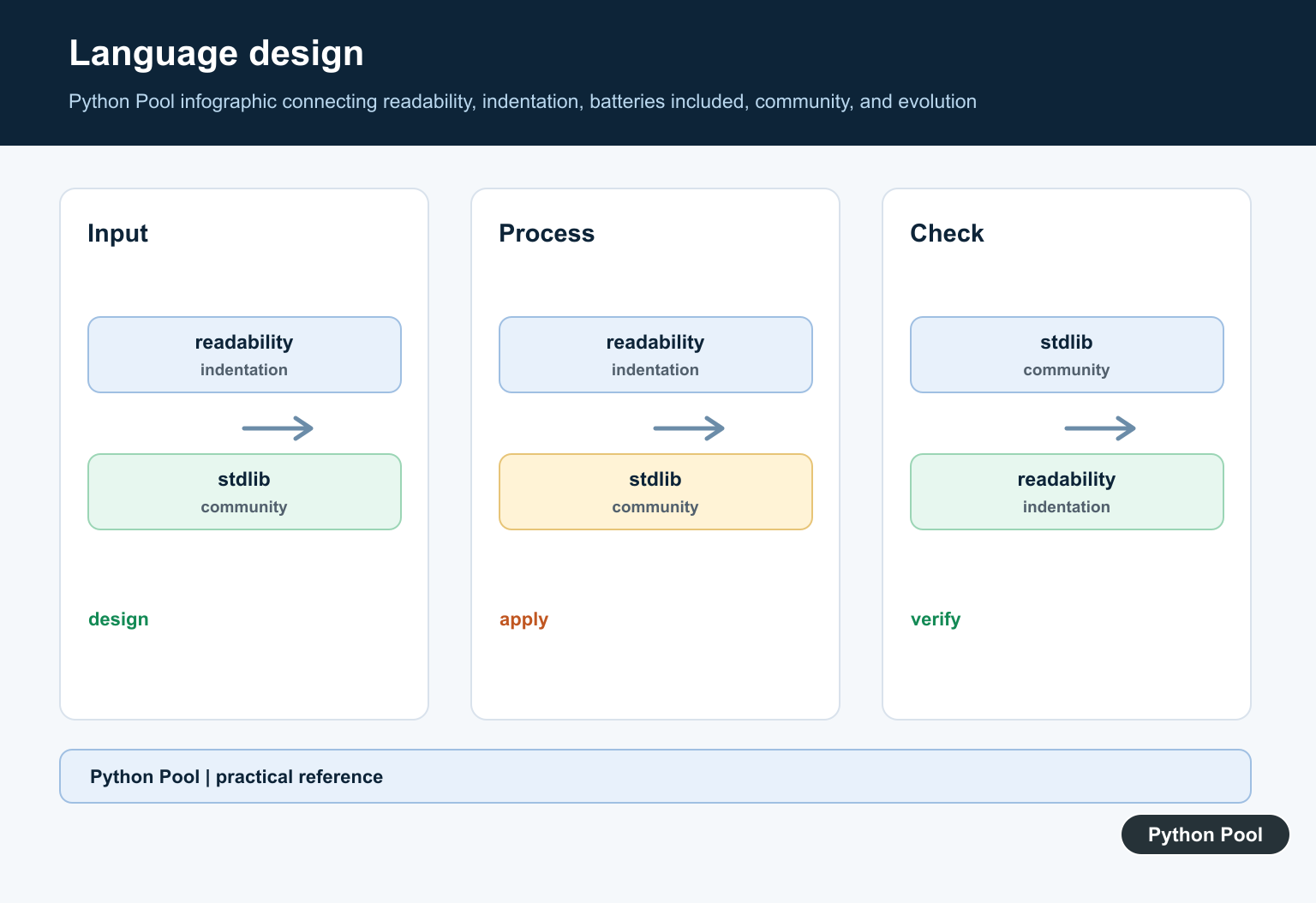
Python’s indentation-based blocks and preference for direct syntax were not cosmetic choices. They reduced the amount of punctuation a reader had to track and made shared code easier to review. The standard library and open-source package ecosystem then made the same language useful for scripting, web services, automation, education, and scientific computing.
History should not be used as a reason to keep obsolete habits. Check the Python version, current documentation, and supported release branch before copying an old example. The language has preserved its philosophy while changing APIs and defaults when the long-term benefit was clear.
For version context and language discovery, compare Python version checks with help(). Read how to check python version and python help function for the related workflow.
Frequently Asked Questions
When was Python first released?
Python was first made publicly available in 1991 after Guido van Rossum created it at CWI in the Netherlands.
Who created Python?
Guido van Rossum created Python as a successor to ABC, with a strong emphasis on readable syntax and practical extensibility.
Why was Python 3 created?
Python 3 provided a cleaner long-term language direction and changed several behaviors, including text and iteration semantics, even though migration required work.
How does Python evolve today?
Python evolves through public proposals, implementations, documentation, release schedules, and contributions from the Python community.