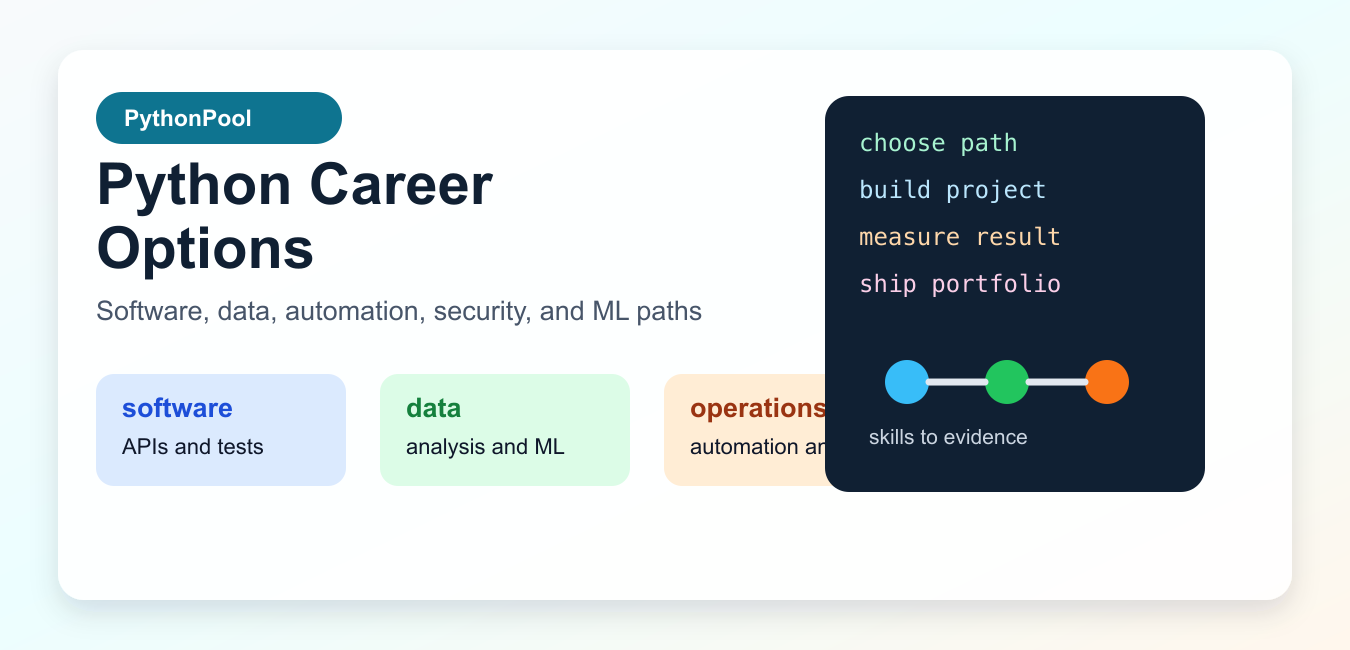
Quick answer: Python supports several career paths, but the strongest path is role-specific: build fundamentals, choose a problem area, ship a small maintainable portfolio, and show tests, documentation, tradeoffs, and communication rather than collecting disconnected tutorials.
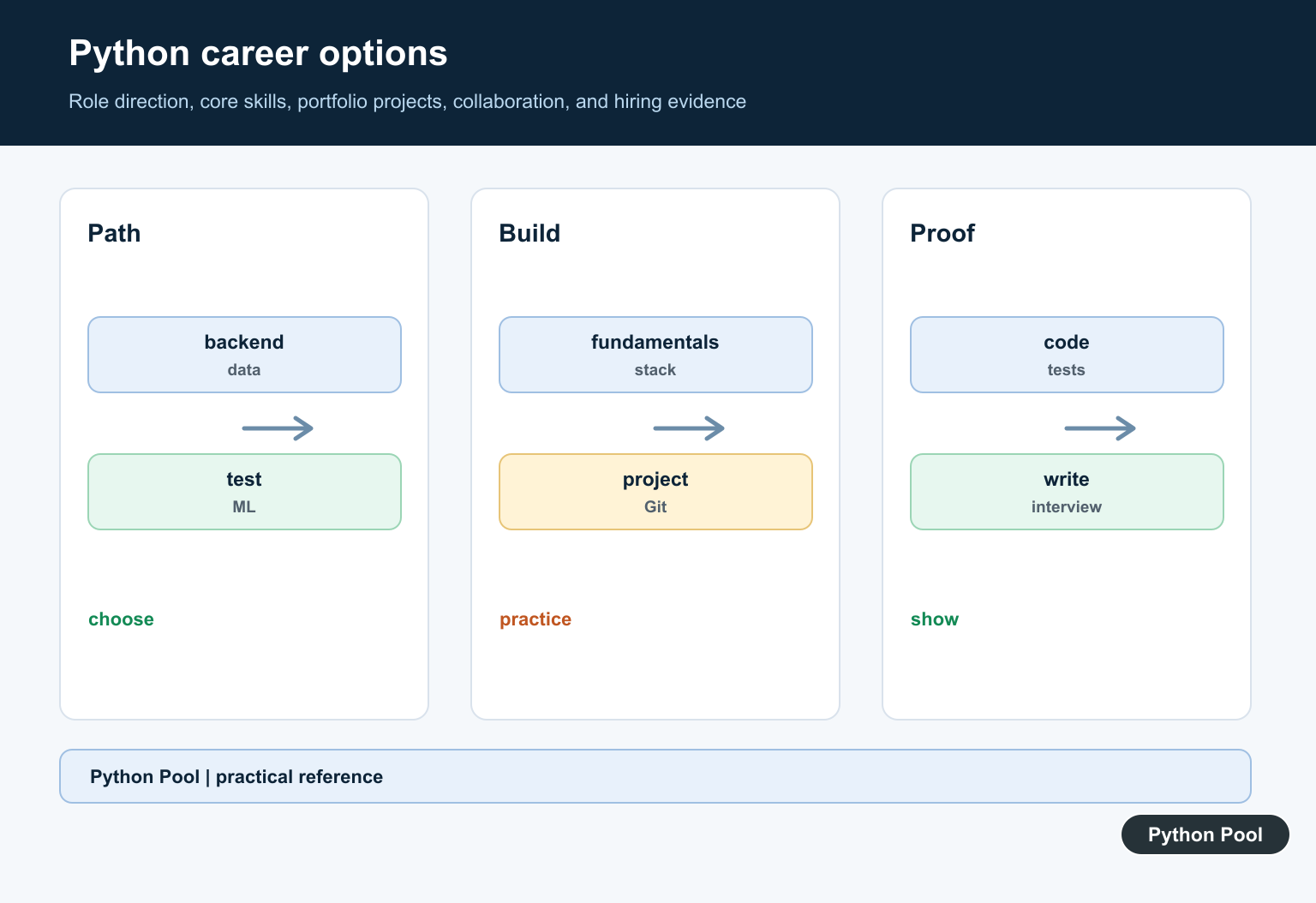
Career options with Python are broad, but the best path depends on the kind of problems you want to solve and the evidence you can show. Python can support backend services, data analysis, automation, testing, security work, machine learning, and scientific computing. A better question than “which role pays the most?” is “which role can I prove I am ready for with projects, tests, and clear results?” Before choosing a specialization, use How Long Does It Take to Learn Python? to set a realistic study timeline.
For current labor context, the U.S. Department of Labor O*NET summaries for software developers, data scientists, and information security analysts are more useful than hype posts. For skills, start from the official Python tutorial, the pandas getting started guide, and the FastAPI tutorial.
PythonPool guides that fit these paths include CRUD in Python, web crawling in Python, data science algorithms, and deep learning opportunities. Use them as project building blocks, not as a substitute for shipping a complete, reviewed project.
1. Python Backend Developer
Backend developers build APIs, business logic, integrations, scheduled jobs, and data access layers. Python is used with frameworks such as Django, Flask, and FastAPI. A strong beginner portfolio should include authentication-aware routes, database CRUD, tests, logging, and deployment notes. This path suits people who like product features and service reliability.
roles = {
    "backend": {"api": 5, "sql": 4, "testing": 4, "statistics": 1},
    "data": {"api": 2, "sql": 4, "testing": 2, "statistics": 5},
    "security": {"api": 3, "sql": 2, "testing": 4, "statistics": 2},
}

profile = {"api": 4, "sql": 3, "testing": 5, "statistics": 1}


def match_score(role_skills, learner):
    return sum(min(level, learner.get(skill, 0)) for skill, level in role_skills.items())


scores = {name: match_score(skills, profile) for name, skills in roles.items()}
print(sorted(scores.items(), key=lambda item: item[1], reverse=True))
2. Data Analyst Or Analytics Engineer
Data analysts use Python to clean files, join tables, check quality, and explain trends. Analytics engineers go further into repeatable pipelines, SQL models, and dashboards. pandas, SQL, charts, and clear written analysis matter more than advanced model claims. Build a project that starts with raw data and ends with a concise report.
from statistics import fmean

rows = [
    {"team": "support", "tickets": 42, "hours": 18},
    {"team": "billing", "tickets": 31, "hours": 12},
    {"team": "platform", "tickets": 28, "hours": 16},
]


def tickets_per_hour(row):
    return row["tickets"] / row["hours"]


rates = [tickets_per_hour(row) for row in rows]
best = max(rows, key=tickets_per_hour)

print(round(fmean(rates), 2))
print(best["team"])
3. Data Scientist Or Machine Learning Engineer
Data scientists explore data, build models, evaluate results, and communicate uncertainty. Machine learning engineers make model workflows reliable in production. Python helps in both, but the job is not only notebooks. The important evidence is a project with a baseline, a validation split, metrics, model limitations, and a repeatable run command.
def split_train_test(items, every=4):
    train = []
    test = []
    for index, item in enumerate(items):
        if index % every == 0:
            test.append(item)
        else:
            train.append(item)
    return train, test


records = list(range(1, 13))
train, test = split_train_test(records)

print(train)
print(test)
4. Automation And QA Engineer
Automation roles use Python to reduce manual work: file checks, API smoke tests, browser checks, reports, and release support. QA engineers who can write Python tests and explain risk are valuable because they connect product behavior to repeatable checks. This route is realistic for learners who enjoy breaking workflows into clear steps.
checks = [
    ("homepage status", True),
    ("login form visible", True),
    ("checkout total", False),
]


def summarize(check_items):
    passed = [name for name, ok in check_items if ok]
    failed = [name for name, ok in check_items if not ok]
    return {"passed": passed, "failed": failed, "ready": not failed}


print(summarize(checks))
5. Security Analyst With Python
Security analysts use Python for log review, enrichment, scanning support, and incident response scripts. The O*NET information security analyst summary is a better source for role context than salary promises. A portfolio project might parse server logs, detect repeated failed attempts, and produce a short incident note with evidence and next steps.
events = [
    "10.0.0.5 login failed",
    "10.0.0.8 login ok",
    "10.0.0.5 login failed",
    "10.0.0.5 login failed",
]


def failed_login_counts(lines):
    counts = {}
    for line in lines:
        ip, action, status = line.split()
        if action == "login" and status == "failed":
            counts[ip] = counts.get(ip, 0) + 1
    return counts


print(failed_login_counts(events))
6. Data Engineer Or DevOps Engineer
Data engineers build pipelines, quality checks, and storage flows. DevOps and platform engineers use Python for cloud tooling, build scripts, monitoring helpers, and internal services. These roles reward reliability habits: typed boundaries, retry logic, clear errors, and small scripts that can run unattended.
import json

portfolio = {
    "role": "python automation engineer",
    "projects": [
        {"name": "api smoke tests", "proof": "test report"},
        {"name": "log parser", "proof": "sample incident note"},
        {"name": "data quality checks", "proof": "summary table"},
    ],
}

text = json.dumps(portfolio, indent=2)
loaded = json.loads(text)

print(loaded["role"])
print(len(loaded["projects"]))
How To Choose Your Python Career Path
Choose one primary path for the next 60 to 90 days. If you want product work, build a backend API. If you like spreadsheets, reporting, and questions from business teams, choose data analysis. If you like models and uncertainty, choose data science or machine learning. If you enjoy repeatability, choose automation, QA, DevOps, or data engineering. If you like investigation and risk, explore security. To build the foundations required for any of these roles, choose material by experience level with Python Books for 2026 by Skill Level.
Then turn the choice into a weekly proof plan. Each week should leave behind something visible: a tested endpoint, a clean notebook with a short report, a command-line tool, a log parser, or a documented model comparison. Keep the scope small enough to finish, but complete enough that another person can run it from the README and understand the result.
The best Python career option is the one where your portfolio proves the work. A strong project has a real input, a clear output, error handling, tests or checks, documentation, and a short explanation of tradeoffs. That evidence is more useful than listing every library you have seen.
Choose A Role Direction
Backend, automation, testing, data analysis, data engineering, machine learning, scientific computing, and developer tooling use overlapping Python foundations but different libraries and evidence.
Build Core Foundations
Learn functions, data structures, exceptions, files, modules, environments, debugging, testing, Git, and basic complexity before specializing. These skills transfer across employers and stacks.
Add The Role Stack
Backend work may need HTTP, databases, and deployment; data work needs SQL and statistics; automation needs APIs and observability; ML needs evaluation and reproducible experiments.
Ship Portfolio Evidence
A few focused projects with setup instructions, readable code, tests, sample outputs, and limitations are more persuasive than many unfinished notebooks or copied tutorials.
Practice Collaboration
Professional Python includes reviewing changes, explaining tradeoffs, handling feedback, writing issues, and maintaining code after the first successful run.
Prepare For Hiring
Tailor applications to the role, explain every project honestly, review Python and SQL fundamentals where relevant, and use small exercises to practice debugging and communication.
Use the official Python tutorial for language foundations. Related Python Pool references include testing and logging.
For related growth workflows, compare project tests, operational skills, and portfolio data before choosing a Python path.
Frequently Asked Questions
What careers can I pursue with Python?
Common paths include backend development, automation, testing, data analysis, data engineering, machine learning, scientific computing, and tooling.
Do I need a computer science degree to use Python professionally?
Requirements vary by employer and role; a strong portfolio, fundamentals, practical experience, and clear communication can demonstrate capability.
What should a Python portfolio include?
Include a few focused projects with readable code, tests, documentation, setup instructions, tradeoffs, and evidence that the project solves a real problem.
Which Python skills should beginners learn first?
Start with core language behavior, data structures, debugging, testing, Git, environments, and one role-specific stack rather than trying to learn every library.