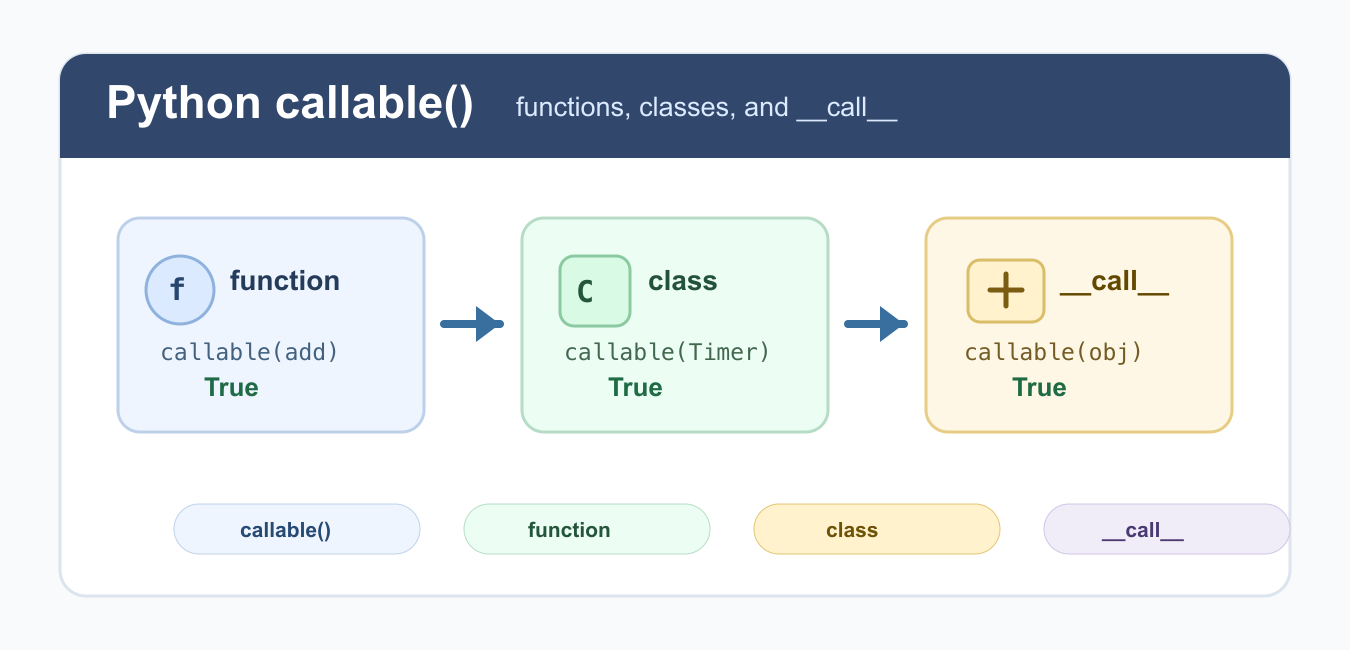
Quick answer: callable(obj) checks whether Python considers an object invokable with call syntax. Functions, classes, methods, and instances with __call__ usually return True, but the result does not validate arguments, return types, safety, or business behavior.
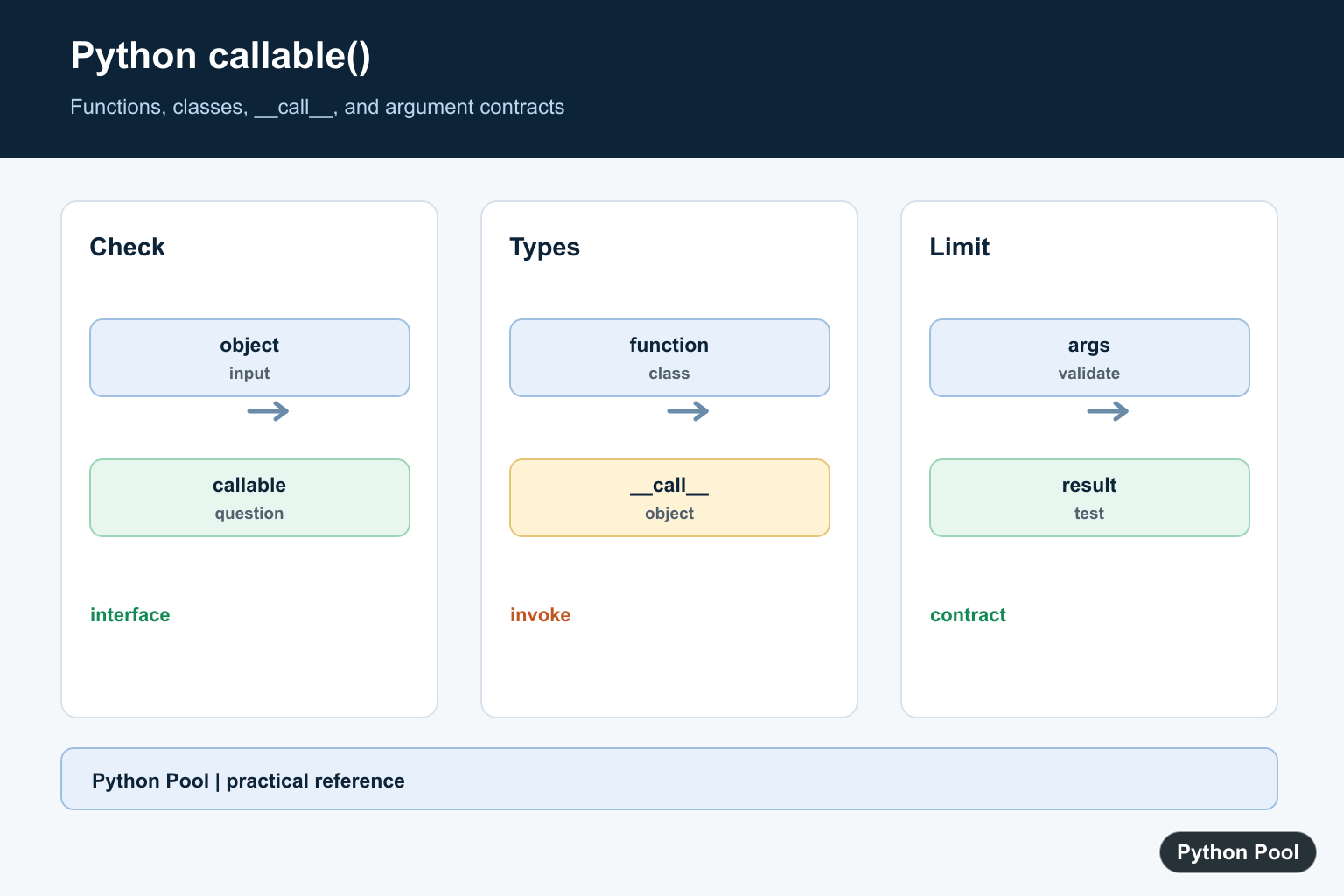
callable() is a built-in Python function that checks whether an object can be called with parentheses. Functions, classes, methods, lambdas, built-ins, and objects that define __call__() usually return True. Plain data objects such as integers, strings, lists, tuples, and dictionaries usually return False.
The result is useful before running callbacks, plugin hooks, validators, decorators, or user-supplied functions. A True result means Python sees the object as callable, but it does not guarantee that your arguments are correct. Calling the object can still raise an error if you pass the wrong number or type of arguments. The official Python callable() documentation describes this exact built-in behavior.
Think of callable() as a quick interface check. It answers the question, “can this object be invoked?” It does not answer whether the object is safe, whether it returns the expected type, or whether it performs the action you intended. Those checks still belong in your tests and error handling.
Check Functions, Classes, and Values
Regular functions are callable. Classes are also callable because calling a class creates an instance. Most ordinary values are not callable, even when their names look like they might represent actions.
def greet(name):
    return f"Hello, {name}"


class Greeter:
    pass


print(callable(greet))
print(callable(Greeter))
print(callable(42))
This is why callable() is often used as a quick guard before code tries to execute a variable like a function. It separates function-like objects from regular data before the risky call happens. It also makes debugging easier when a variable was accidentally reassigned from a function to a value.
Make an Object Callable With __call__
An instance becomes callable when its class defines __call__(). This special method lets an object store state and still behave like a function. The Python data model documents it under object.__call__.
class Multiplier:
    def __init__(self, factor):
        self.factor = factor

    def __call__(self, value):
        return value * self.factor


double = Multiplier(2)

print(callable(double))
print(double(8))
This pattern is useful for configurable callbacks. The object can keep settings in attributes, while callers use the simple object(value) syntax. It is common in validators, scoring functions, retry policies, and lightweight strategy objects.
Instances Are Not Always Callable
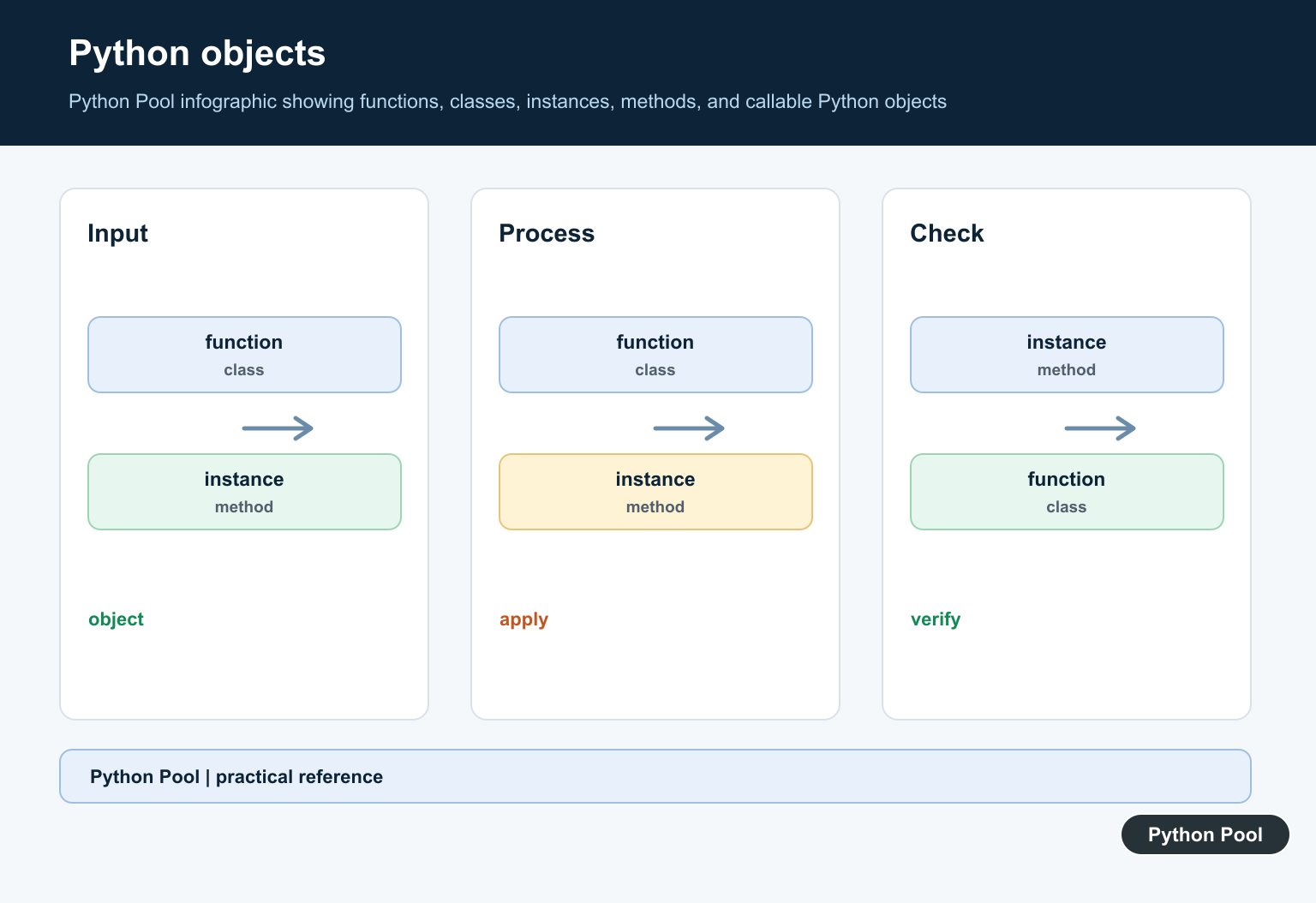
A class object is callable, but an instance of that class is not automatically callable. The instance needs a __call__() method. Without it, the instance is just a normal object with attributes and methods.
class User:
    def __init__(self, name):
        self.name = name


user = User("Ada")

print(callable(User))
print(callable(user))
This distinction explains many beginner errors. User can be called to build a new object, but user cannot be called unless the class provides callable behavior. If you meant to access data on the object, use an attribute or method instead of adding parentheses to the object itself.
Use callable() Before Running a Callback
When a function accepts another function as an argument, validate it before calling. This gives a clearer error message than letting a random TypeError happen deeper in the code.
def run_callback(callback, value):
    if not callable(callback):
        raise TypeError("callback must be callable")
    return callback(value)


def square(number):
    return number * number


print(run_callback(square, 5))
This guard is especially helpful in reusable utilities, decorators, event handlers, command registries, and small frameworks. If you are deciding whether a function should print or hand a value back to the caller, the print vs return guide covers that related design choice.
Fix Object Is Not Callable Errors
If callable() returns False and you still use parentheses, Python raises TypeError. The most common causes are overwriting a function name with a value, calling a list like a function, or calling a NumPy array like a function.
items = [1, 2, 3]

try:
    items()
except TypeError as error:
    print(error)
For detailed troubleshooting, see the fixed guides for TypeError: ‘list’ object is not callable and ‘numpy.ndarray’ object is not callable. Both errors are cases where parentheses were used on an object that Python cannot call.
callable() vs inspect Checks
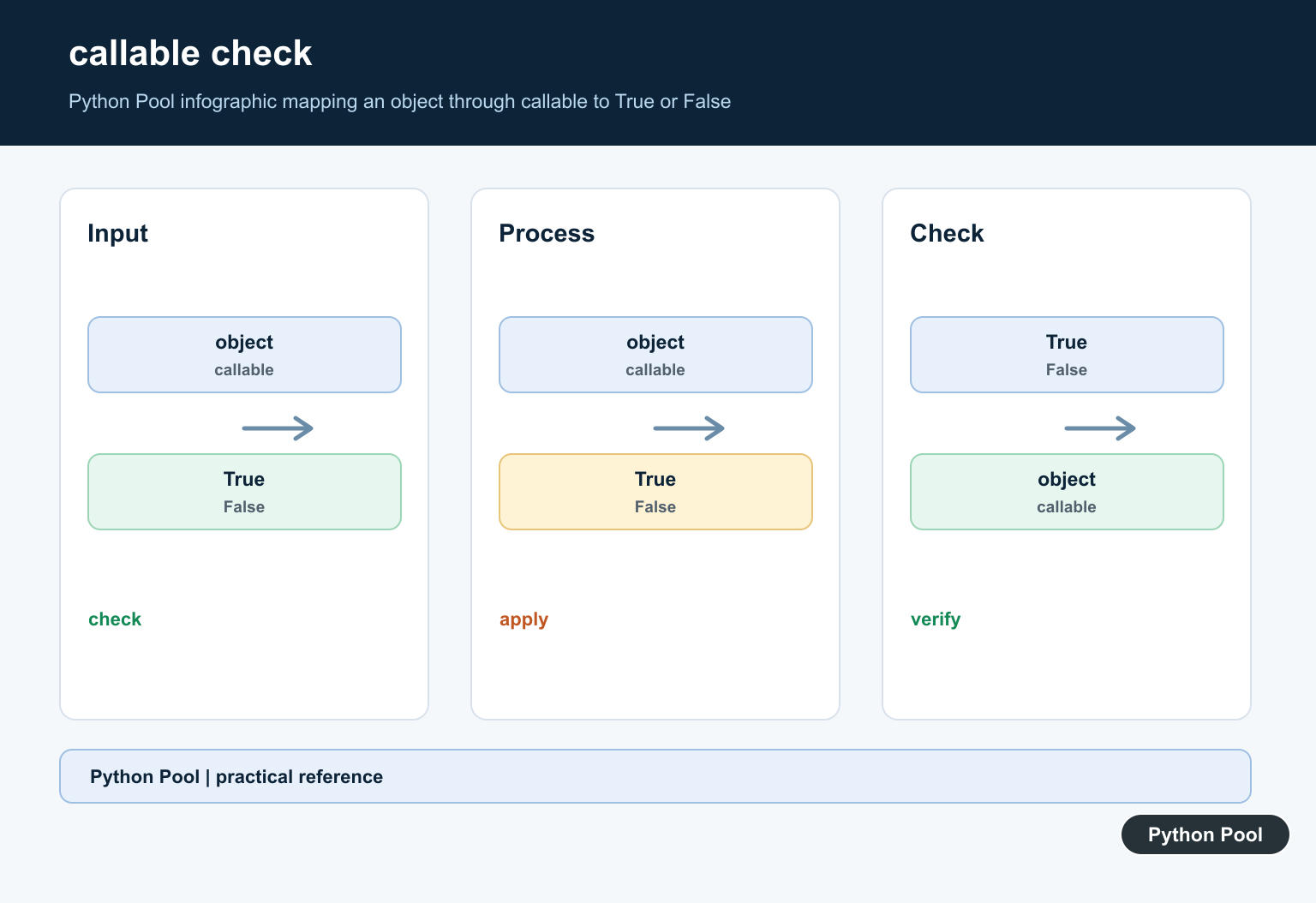
callable() answers a broad question: can this object be called? The inspect module answers narrower questions, such as whether something is a plain Python function. A callable instance can return True from callable() while returning False from inspect.isfunction().
import inspect


class AddOne:
    def __call__(self, value):
        return value + 1


add_one = AddOne()

print(callable(add_one))
print(inspect.isfunction(add_one))
print(hasattr(add_one, "__call__"))
Use inspect.isfunction only when you specifically need to identify function objects. Use callable() when functions, classes, methods, lambdas, built-ins, and callable instances are all acceptable.
Best Practice
Use callable() at API boundaries where a parameter is expected to behave like a function. Do not use it as a replacement for actually handling call errors, because valid callables can still reject bad arguments. For custom classes, define __call__() only when the object naturally represents an action. If you are learning special methods, the same idea appears in comparison methods such as Python __lt__(). For more class fundamentals, the official Python classes tutorial is a useful reference.
In everyday code, the cleanest pattern is to name callable parameters clearly, validate them once, and then call them in one obvious place. That keeps error messages readable and prevents data values from being mistaken for functions.
Check The Invocation Interface
callable is useful at a callback, plugin, validator, or hook boundary where the object may be supplied at runtime. It is a quick interface check before attempting a call.
Remember Classes Are Callable
Calling a class normally creates an instance, so classes return True. A class being callable does not mean the object you receive from it has the same contract as a function.
Understand __call__
A class can define __call__ to make its instances invokable. Keep the argument and return-value contract documented, and use a small wrapper when the callable needs validation or state management.
Do Not Overtrust True
callable does not check the number or type of arguments, whether a call has side effects, whether it is safe, or whether it returns the value your application needs. Tests and explicit protocols still matter.
Handle Errors At The Boundary
For untrusted or plugin-provided objects, combine callable with allowlists, signature checks where appropriate, timeouts or isolation, and error handling. A callable object can still raise during invocation.
Python’s callable documentation defines the built-in and its limits. Related references include dynamic objects, attribute inspection, and callback tests.
For related dynamic interfaces, compare object attributes, attribute inspection, and callback tests when validating plugin hooks.
Frequently Asked Questions
What does callable return?
callable(obj) returns True when Python considers the object invokable with call syntax, and False otherwise.
Are classes callable in Python?
Yes. Calling a class normally constructs an instance, so classes are callable objects.
Does callable check function arguments?
No. A True result does not guarantee that the object accepts a particular number, type, or shape of arguments.
How do I make an object callable?
Define __call__ on its class, then implement the argument and return-value contract your code expects.