
Quick answer: A set comprehension uses braces with an expression, for clause, and optional filter to create a set of unique hashable results. It is concise for simple transformations, but a normal loop is clearer when validation, multiple steps, or error handling are involved.
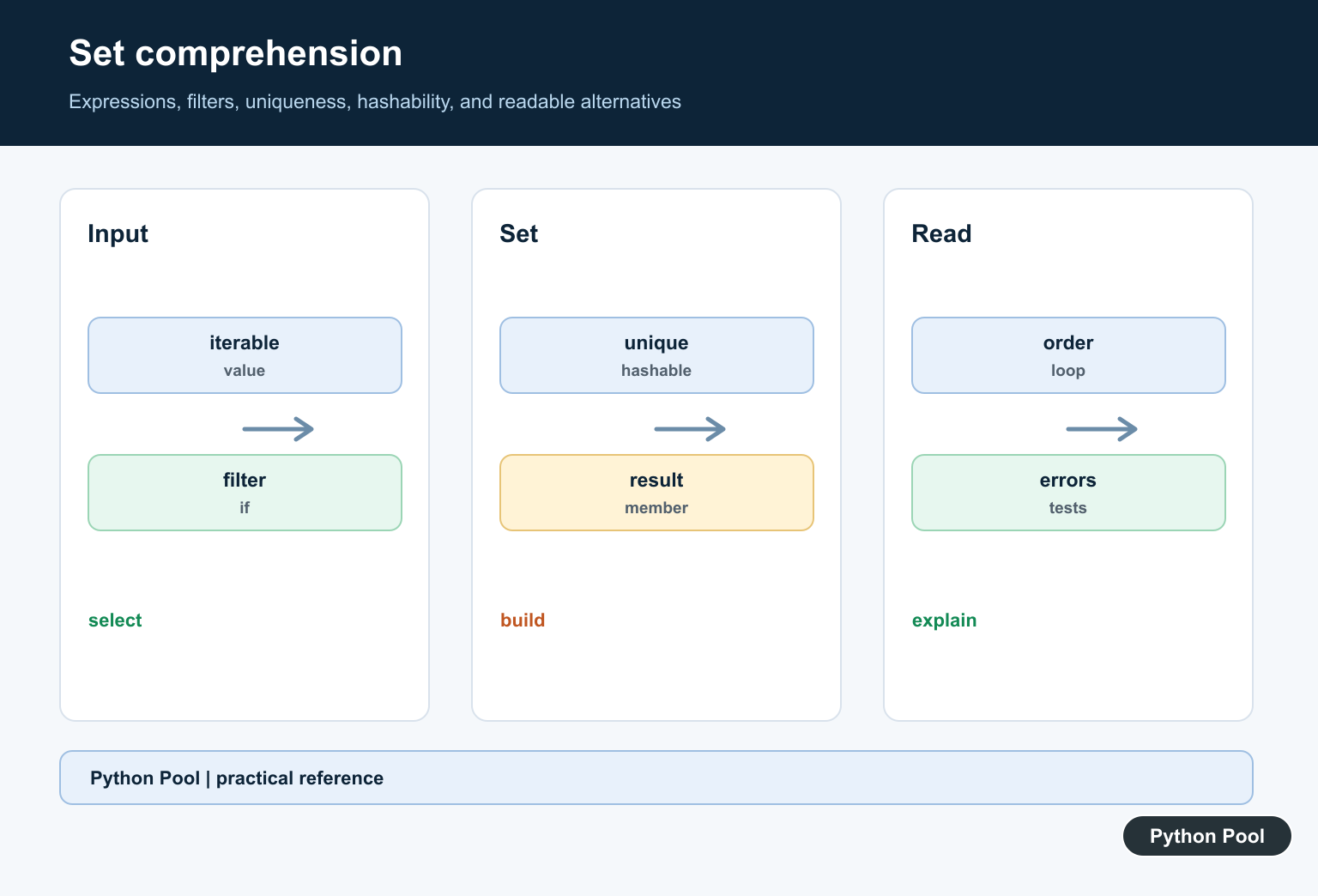
Python set comprehension is a concise way to build a set from an iterable. It looks similar to list comprehension, but it uses curly braces and returns a set, so duplicate values are removed automatically. Use it when you want unique results from a transformation or filter.
If order and duplicate values matter, use a list instead. The Python list comprehension if/else guide explains the corresponding list syntax for filters, two-way transformations, and combined conditions.
The general pattern is {expression for item in iterable if condition}. The condition is optional. Python's reference documentation for list, set, and dictionary displays defines this syntax, and the Python tutorial on sets explains the uniqueness behavior. The main tradeoff is simple: set comprehension is compact and removes duplicates, but it should not be used when output order is the most important requirement.
Basic Set Comprehension Syntax
A set comprehension evaluates an expression for each item in an iterable. The result is a set, not a list, so the display order is not something your program should depend on.
numbers = range(6)

squares = {number * number for number in numbers}

print(squares)
This creates a set of square values. If two input values produce the same output, the set keeps only one copy. That automatic deduplication is the main reason to choose a set comprehension over a list comprehension.
Use Conditions in Set Comprehension
Add an if clause when you only want some values from the input. The condition is evaluated before the expression is added to the set.
even_squares = {
    number * number
    for number in range(10)
    if number % 2 == 0
}

print(even_squares)
This keeps only even numbers before squaring them. A condition can check membership, string content, numeric ranges, or any other expression that returns True or False. Conditions are especially useful when the source data contains placeholders, blanks, or values outside the range you want to keep.
Remove Duplicates While Transforming Values
Set comprehension is useful when you need to normalize values and remove duplicates at the same time. For strings, combine strip() and lower() with a filter.
names = [" Ada ", "ada", "Lin", "LIN", ""]

clean_names = {
    name.strip().lower()
    for name in names
    if name.strip()
}

print(clean_names)
This example keeps one normalized version of each name. For more on lowercase cleanup, see Python lowercase string handling.
Set Comprehension With Math Expressions
The expression part can contain calculations or function calls. This is useful for building derived numeric sets without writing a separate loop.
distances = [-3, -2, -1, 0, 1, 2, 3]

absolute_values = {abs(value) for value in distances}

print(absolute_values)
The output contains unique absolute values because -3 and 3 both become 3. This behavior is different from a list, which would keep both transformed entries. It is also useful when you only care whether a result exists, not how many times it appeared.
Nested Set Comprehension
A set comprehension can use more than one for clause. This is helpful for combinations, coordinates, or flattening small nested inputs.
rows = [1, 2]
columns = ["A", "B", "C"]

cells = {f"{column}{row}" for row in rows for column in columns}

print(cells)
Keep nested comprehensions short. If the expression becomes hard to scan, a normal loop is easier to maintain. For nested mapping structures, see nested dictionaries in Python.
Set Comprehension vs List Comprehension
Use list comprehension when order and duplicates matter. Use set comprehension when uniqueness matters more than order. The syntax differs only by brackets: square brackets make a list, and curly braces make a set.
values = [1, 1, 2, 2, 3]

as_list = [value * 2 for value in values]
as_set = {value * 2 for value in values}

print(as_list)
print(as_set)
The list keeps repeated values, while the set removes duplicates. If you are moving between list and set representations, the guide to convert a list to a set in Python covers the direct conversion.
Common Mistakes
The most common mistake is expecting a set comprehension to keep insertion order like a list. A set is designed for uniqueness and membership tests. Another mistake is using unhashable values such as lists or dictionaries as set items. If you need unique dictionaries, track a hashable key instead.
Also avoid confusing a set comprehension with a dictionary comprehension. Both use curly braces. A dictionary comprehension has a key-value expression such as {key: value for item in items}. A set comprehension has only one output expression. For dictionary-related memory topics, see Python dictionary size.
Where Set Comprehension Helps
Set comprehension is useful for tags, normalized usernames, unique IDs, file extensions, and membership checks. It is also a good companion to list union work when you need unique values from several collections; see Python union of lists for that pattern. For generator-like syntax around tuples, PythonPool also has a guide to tuple comprehension.
Use a normal loop when the transformation needs several steps, logging, exception handling, or comments. Comprehensions are best when the expression is short enough to understand at a glance. Readability matters more than compressing every loop into one line.
Conclusion
Use Python set comprehension when you want to transform or filter values and keep only unique results. The syntax is compact, but the result is still a set: order is not the main feature, and every item must be hashable. For ordered output or duplicate-preserving output, use a list comprehension instead.
Read The Syntax
The expression is evaluated for each selected item, and the resulting value is inserted into the set. An if clause filters input items before the expression result is added.
Expect Uniqueness
Repeated results collapse automatically because a set stores each hashable value once. This is useful for deduplication, but it also means counts and source order are discarded.
Do Not Promise Set Order
Set iteration order is not a stable presentation contract. If the consumer needs deterministic display or serialization, sort a compatible result or use an order-preserving list-based approach.
Handle Hashability
The values produced by the expression must be hashable. Convert nested data deliberately when the domain defines a safe key, or choose a list when the result must contain mutable or unhashable objects.
Choose A Loop For Complex Work
Use a loop when several statements, logging, exceptions, normalization, or side effects are needed. Making the logic explicit improves reviewability and lets tests identify which step failed.
Test Duplicates And Filters
Test an empty input, repeated values, filtered values, transformed collisions, unhashable results, and a comparison with an explicit loop. Assert membership and the intended type rather than an accidental order.
The official Python set and comprehension tutorial explains the syntax. Related Python Pool references include lists and tests.
For related collection patterns, compare list comprehensions, set behavior, and membership tests when writing a set comprehension.
Frequently Asked Questions
What is Python set comprehension syntax?
Use braces with an expression and for clause, optionally followed by an if condition, such as {value * 2 for value in values if value > 0}.
Does set comprehension preserve order?
A set is designed for membership and uniqueness, not a stable display order; do not rely on its iteration order for an API result.
Can a set comprehension contain lists?
The resulting values must be hashable because set members must be hashable; convert nested data deliberately or use a list when order and mutability matter.
When is a loop clearer than set comprehension?
Use a loop when validation, multiple steps, error handling, or side effects make the compact expression difficult to read and test.