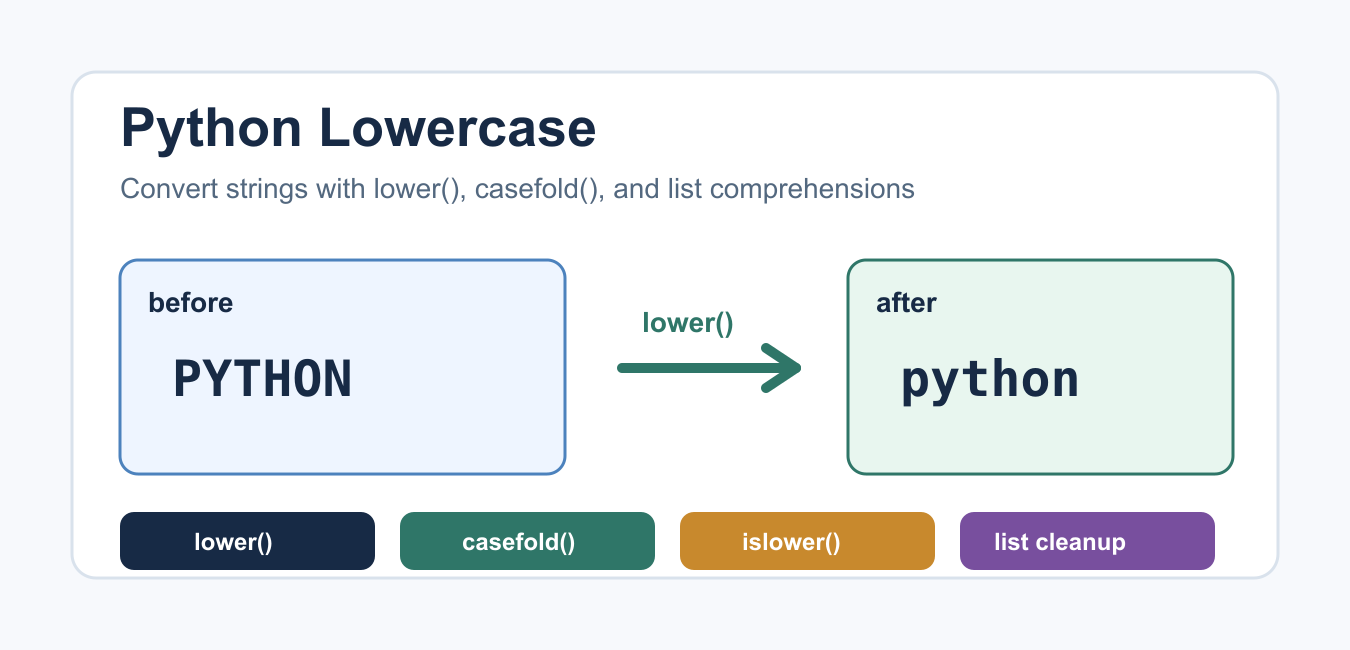
Python lowercase handling usually starts with str.lower(), but a reliable text workflow separates conversion, comparison, validation, and whitespace cleanup. lower() returns a new string with lowercase mappings. casefold() is a stronger option for case-insensitive matching, while islower() answers a different question: whether all cased characters are lowercase. Choosing the method from the job prevents subtle bugs in search, identifiers, and user input.
Quick answer
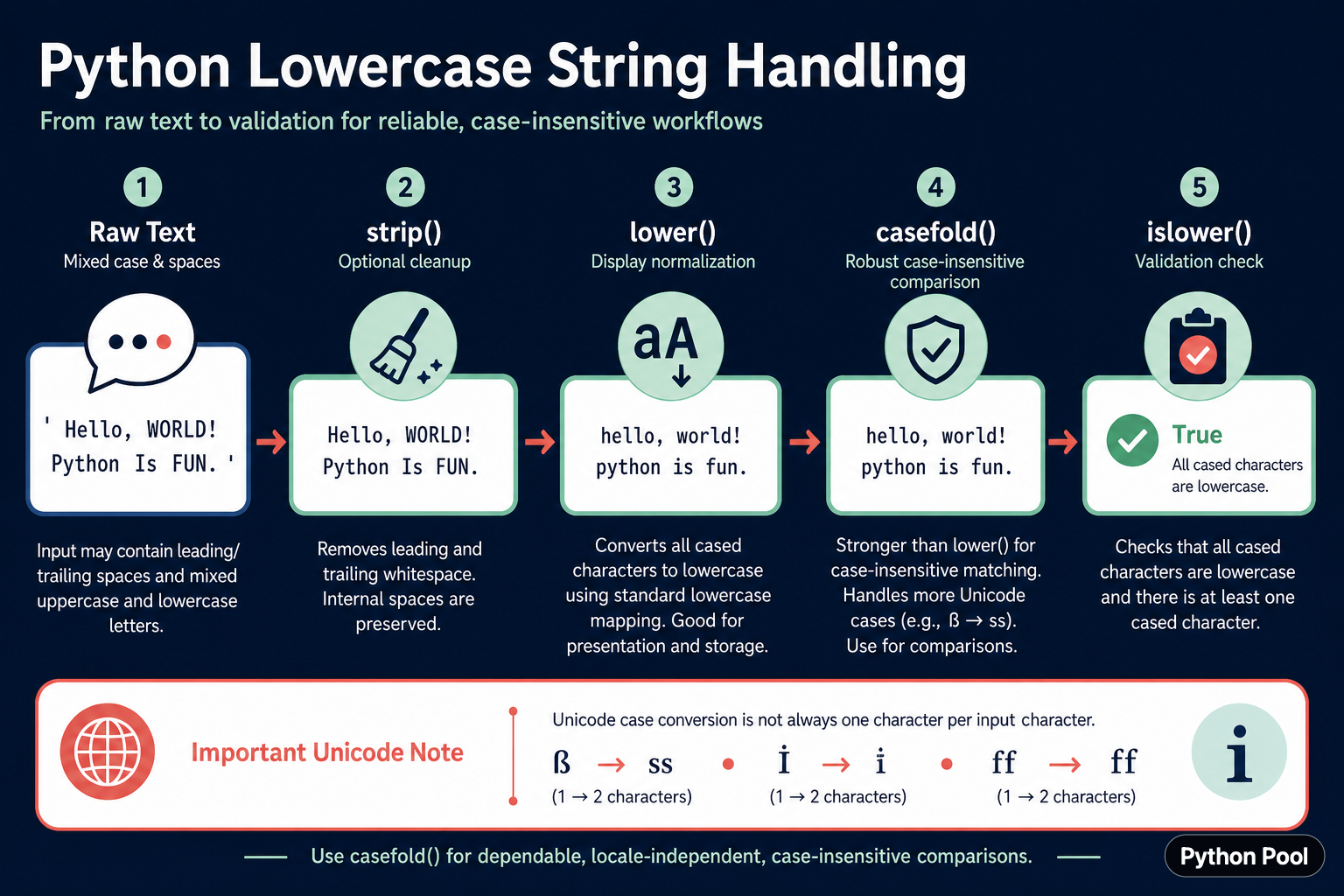
Call text.lower() to create a lowercase display or storage value. Use text.casefold() when two Unicode strings should compare without regard to case. Use text.strip().lower() when leading and trailing whitespace is not meaningful. Use text.islower() only to validate case, not to normalize a string. Python strings are immutable, so each method returns a new value.
The official Python string documentation describes the lower and case-related methods. Case conversion is Unicode-aware, and the output is not guaranteed to have the same number of code points as the input. Keep the original value when it is needed for display or auditing.
Convert text with lower()
The simplest lowercase operation is a method call. It leaves the original string untouched, which makes it safe to create a normalized copy for a comparison or label. Assign the result when the lowercase value is needed later.
message = "Python Pool"
lowercase_message = message.lower()

print(lowercase_message)
print(message)
print(message == lowercase_message)
Numbers, punctuation, and whitespace are not removed by lower(). The method changes cased characters according to Unicode rules and returns the other characters in the result. If the field also needs trimming, splitting, or punctuation removal, perform those transformations as separate, documented steps.
Trim before lowercasing when appropriate
Input from a form, command line, or CSV often contains accidental spaces at the edges. If those spaces are not part of the field, call strip() before lower(). Keep the original input if you need to show the user exactly what they entered or record it for debugging.
raw_username = "  Ada_Lovelace  "
normalized_username = raw_username.strip().lower()

print(repr(raw_username))
print(normalized_username)
Do not strip every field automatically. A password, a fixed-width code, or a document title may treat spaces as meaningful. Normalization should follow the contract of the field, not a generic habit applied everywhere.
Use casefold() for matching
lower() is useful for many English-language comparisons, but casefold() is intended for caseless matching across Unicode text. Apply it to both sides of a comparison. Keep the casefolded value as an internal key and use the original text for display.
def same_text(left, right):
    return left.casefold() == right.casefold()

print(same_text("Python", "PYTHON"))
print(same_text("Straße", "STRASSE"))
Casefolding is not a complete security policy for usernames or account identifiers. For security-sensitive data, also define Unicode normalization, allowed characters, collision handling, and whether identifiers should be stored in a canonical form.
Check with islower()
islower() returns True when the string contains at least one cased character and all cased characters are lowercase. Digits and punctuation do not count as cased characters. Empty strings and strings without cased characters return False.
samples = ["python", "python 3!", "Python", "12345", "", "café"]

for sample in samples:
    print(repr(sample), sample.islower())
Use this method when the application needs a validation rule such as “the label must contain lowercase letters.” If the rule is instead “make the label lowercase,” call lower() and compare or store its result.
Normalize a list without mutating it
A list comprehension creates a new list of lowercase values and preserves the original list. This is useful when the original labels are needed for a user-facing report while normalized labels are used for filtering or lookup.
labels = ["NumPy", "Pandas", "Matplotlib"]
normalized_labels = [label.strip().lower() for label in labels]

print(normalized_labels)
print(labels)
If a list can contain None or non-string values, validate the type before calling a string method. Converting every value with str() may hide a data error by turning a missing value into the literal text "None".
Build a normalized lookup key
For a dictionary or set, store a normalized key separately from the display value. This makes the matching policy explicit and prevents repeated conversions throughout the program. Keep collision behavior visible if two inputs normalize to the same key.
records = ["Ada", "ada", "Grace"]
lookup = {}

for record in records:
    key = record.casefold()
    lookup.setdefault(key, []).append(record)

print(lookup)
The result groups values that compare the same under casefolding, but it does not decide whether those values should be treated as one account, one tag, or separate user entries. That policy belongs in the data model.
Handle Unicode expansion
Case conversion can expand one input code point into multiple output code points. This matters when code assumes that lowercasing preserves indexes, fixed widths, or byte counts. Use string operations on the converted result rather than copying positions from the original without checking.
text = "İ"
lowercase_text = text.lower()

print(repr(text))
print(repr(lowercase_text))
print(len(text))
print(len(lowercase_text))
For user-interface limits, decide whether the limit is measured in code points, grapheme clusters, encoded bytes, or display columns. Those are different measurements. Lowercasing is correct even when it changes the length.
Common mistakes
- Expecting
lower()to mutate the original string. - Using
islower()when the real task is conversion. - Using uppercase or lowercase display text as the only security rule for identifiers.
- Stripping spaces from fields where spaces carry meaning.
- Calling string methods on missing or non-string values without validation.
The practical rule is to preserve the input, derive a documented normalized value, and choose casefold() for robust matching. That small separation improves search keys, form handling, and tests without forcing the visible text to change.
Choose a normalization boundary
Normalize as close as possible to the boundary where text enters the comparison system, then keep the original value for output. Doing this once avoids slightly different lowercase rules in different functions. It also makes tests easier because the helper has one clear contract.
When a normalized key is persisted, record the rule that produced it. A future change from lower() to casefold() can merge values that were previously distinct, so migrations and collision checks may be necessary for stored identifiers.
For Unicode-aware case changes, compare Python uppercase conversion and casefold matching. Read python uppercase and python casefold for the related workflow.
Frequently Asked Questions
Frequently Asked Questions
How do I convert a string to lowercase in Python?
Call text.lower(); it returns a new string with lowercase mappings and does not mutate the original string.
What is the difference between lower() and casefold()?
lower() is a normal lowercase conversion, while casefold() is intended for stronger Unicode-aware case-insensitive comparisons.
How do I check whether a string is lowercase?
Call text.islower(); it is true when there is at least one cased character and all cased characters are lowercase.
Should I strip whitespace before lowercasing?
Only when leading and trailing spaces are not meaningful for that field; use text.strip().lower() for that explicit rule.