Quick answer: Use math.factorial for a production factorial of a non-negative integer. Factorial has the base case 0! = 1 and grows quickly; an iterative implementation can teach the recurrence without the recursion-depth and call-stack costs of a recursive version.
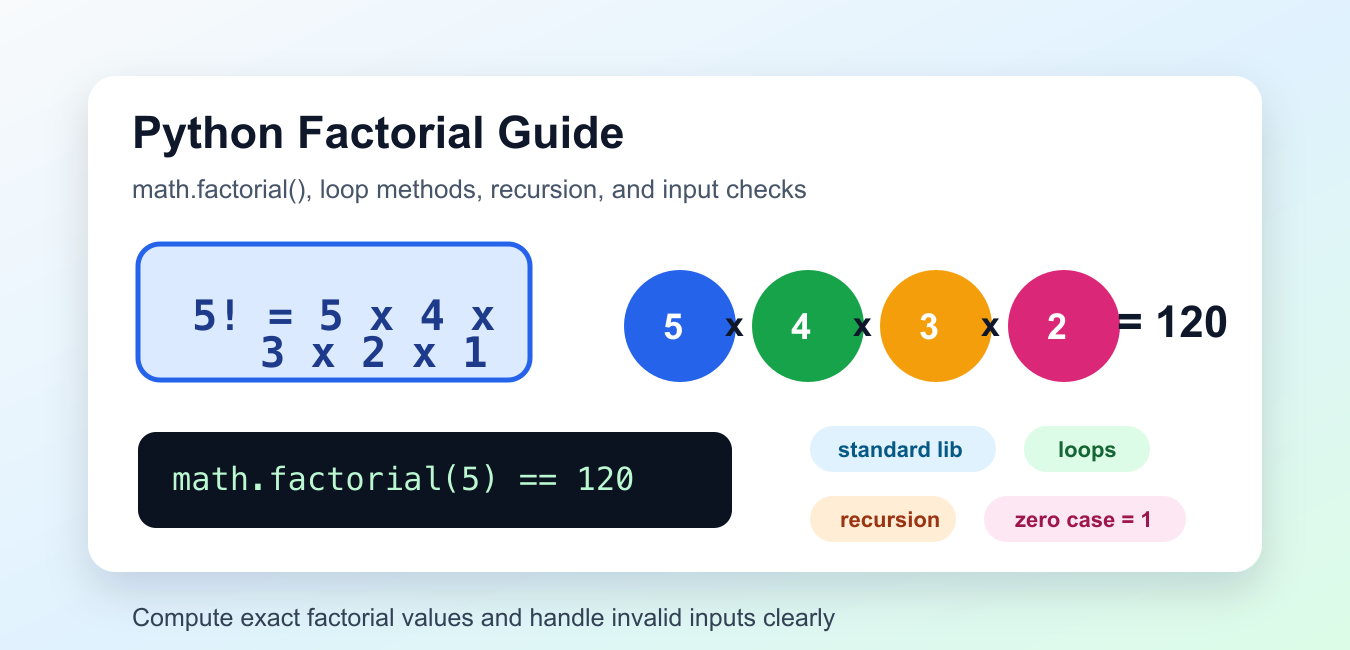
A Python factorial calculation multiplies every positive integer from 1 through a chosen number. In math notation, 5! means 5 * 4 * 3 * 2 * 1, which equals 120. The special case is 0!, which is defined as 1. Factorials form the direct combinations formula; Calculate Binomial Coefficients in Python compares that formula with math.comb() and multiplicative methods.
The best everyday tool is math.factorial() from the standard library. The official Python math.factorial documentation defines its behavior for non-negative integers.
Factorials appear in permutations, combinations, probability, series expansions, and beginner recursion exercises. They also grow very quickly. A result that looks small in notation can contain many digits once the input gets larger, so choose a clear method and validate input before doing the calculation.
For production code, prefer math.factorial(). Use a loop when you want to teach the multiplication process or add custom validation. Use recursion only for small teaching examples, because recursive factorial code can hit Python’s recursion limit for larger inputs.
Use math.factorial()
math.factorial() returns the exact factorial for a non-negative integer. It is concise, fast, and easier to read than a hand-written implementation.
import math

print(math.factorial(0))
print(math.factorial(5))
print(math.factorial(10))
The output is 1, 120, and 3628800. This covers the zero case and two positive examples.
Use this form when you simply need the answer. It communicates intent directly and leaves validation details to a standard-library function that other Python developers already know.
Handle Invalid Input
Factorials are defined for non-negative integers. math.factorial() raises an error for negative numbers and for non-integer values.
import math

for value in [4, 0, -3]:
    try:
        print(value, math.factorial(value))
    except ValueError:
        print(value, "is not valid")
This pattern keeps the main calculation simple while giving a controlled message for bad input. In user-facing code, place the error handling near the input boundary so the message can explain what went wrong.
If input arrives as text, convert it with int() before calling math.factorial(). Reject blank strings, decimals, and negative values according to the rules of your application.
Calculate Factorial With A for Loop
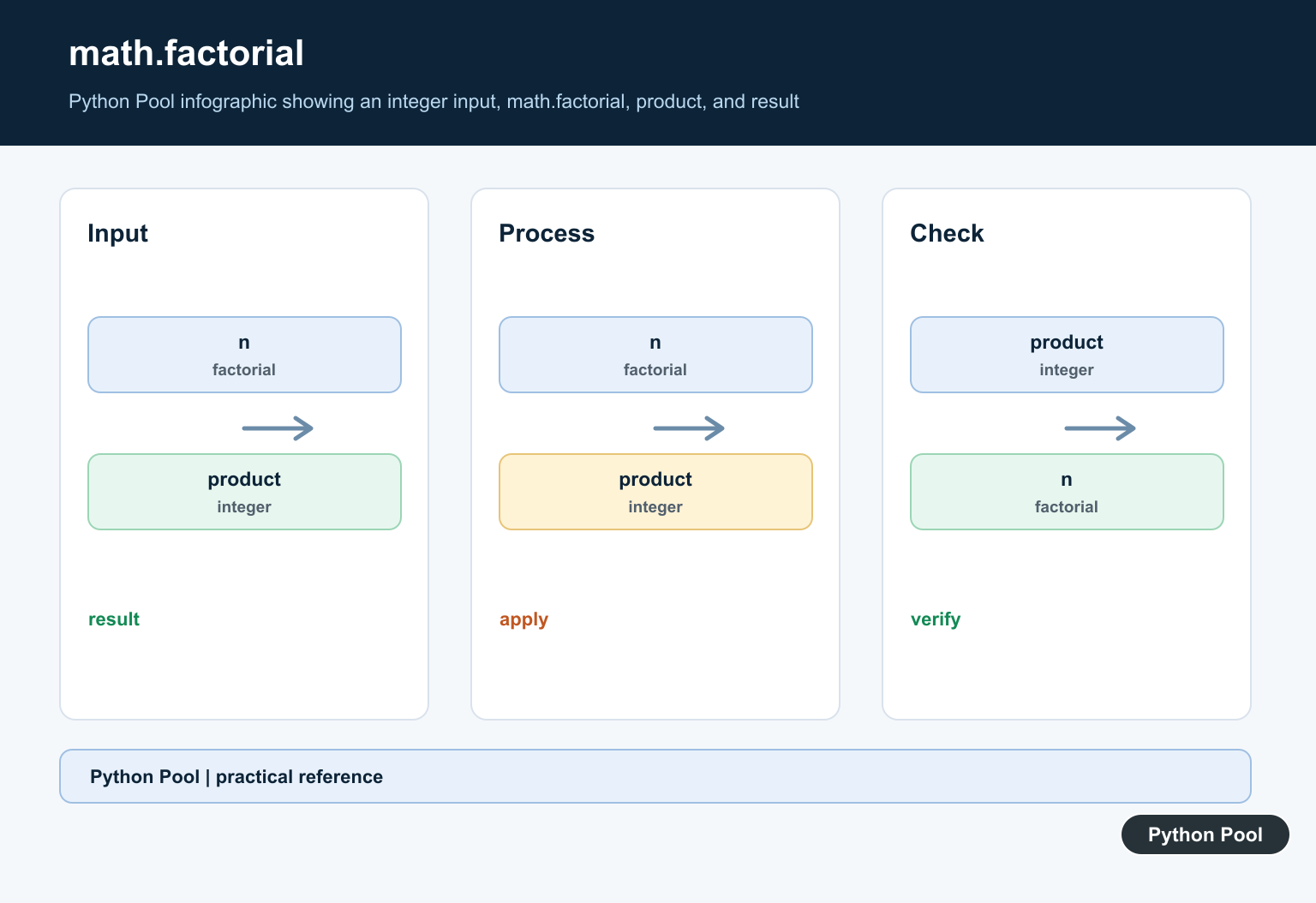
A loop shows the multiplication process step by step. Start from 1, then multiply by each integer from 2 through the target number.
def factorial_loop(n):
    if n < 0:
        raise ValueError("n must be non-negative")

    result = 1
    for factor in range(2, n + 1):
        result *= factor
    return result

print(factorial_loop(6))
The loop returns 720 for 6!. It also returns 1 for 0 and 1, because the range has no extra factors in those cases.
This version is useful when you need a custom error policy, logging, or a teaching example. For a normal calculation, math.factorial() is still the cleaner default.
Calculate Factorial With A while Loop
A while loop works too. It can be useful when the count changes as part of the loop state, but it needs careful stopping logic.
def factorial_while(n):
    if n < 0:
        raise ValueError("n must be non-negative")

    result = 1
    current = n
    while current > 1:
        result *= current
        current -= 1
    return result

print(factorial_while(7))
This prints 5040. The loop multiplies by 7, then 6, and continues down to 2.
Choose a for loop when the range is straightforward. Choose a while loop only when its state-based style makes the surrounding algorithm clearer.
Use Recursion For A Small Example
A recursive factorial mirrors the mathematical definition: n! equals n * (n - 1)!, with 0! and 1! as base cases. For another recursion example with explicit base and recursive cases, work through Tower of Hanoi in Python: Recursive Solution.
def factorial_recursive(n):
    if n < 0:
        raise ValueError("n must be non-negative")
    if n in (0, 1):
        return 1
    return n * factorial_recursive(n - 1)

print(factorial_recursive(5))
This returns 120. The base case is essential; without it, the function would keep calling itself until Python stops it with a recursion error.
Recursion is a good learning tool here, but it is not the strongest practical choice for factorials. Python does not optimize tail recursion, and deep recursive calls add overhead.
Count Digits In A Large Factorial
Python integers can grow beyond fixed machine sizes, so large factorials are exact. Sometimes the length of the result is more useful than printing the whole number.
import math

value = math.factorial(50)
digits = len(str(value))

print(digits)
print(str(value)[:12])
This counts the digits in 50! and prints only the first few characters. That keeps output readable while still proving that the calculation succeeded.
When factorials are part of larger formulas, look for functions that avoid creating unnecessary intermediate values. For example, math.comb() is usually better than manually combining several factorial calls for binomial coefficients.
Which Method Should You Use?
Use math.factorial() for direct factorial calculations. It is part of the standard library, returns exact integers, and handles the important input rules. Use a loop when the lesson or surrounding logic needs each multiplication step to be visible. Use recursion only when demonstrating recursive thinking with small inputs. Factorial and Fibonacci are both classic recursion exercises, but Fibonacci Series in Python: Loops, Recursion, and Generators also shows iteration and generator-based alternatives.
Always decide how invalid input should be handled before the call. Negative numbers are not allowed, and non-integer data should be rejected or converted explicitly. Avoid hiding these checks deep inside unrelated code, because clear input rules make factorial examples easier to test and maintain.
Good tests should include 0!, 1!, a small known value such as 5! = 120, and a negative input case. Those examples catch the most common mistakes: forgetting the zero case, starting the loop at the wrong number, or returning a misleading result for invalid input.
Use math.factorial
The standard-library function states the intent clearly and validates that the input is a non-negative integer. It is preferable to reimplementing the ordinary operation in application code.
Understand The Base Case
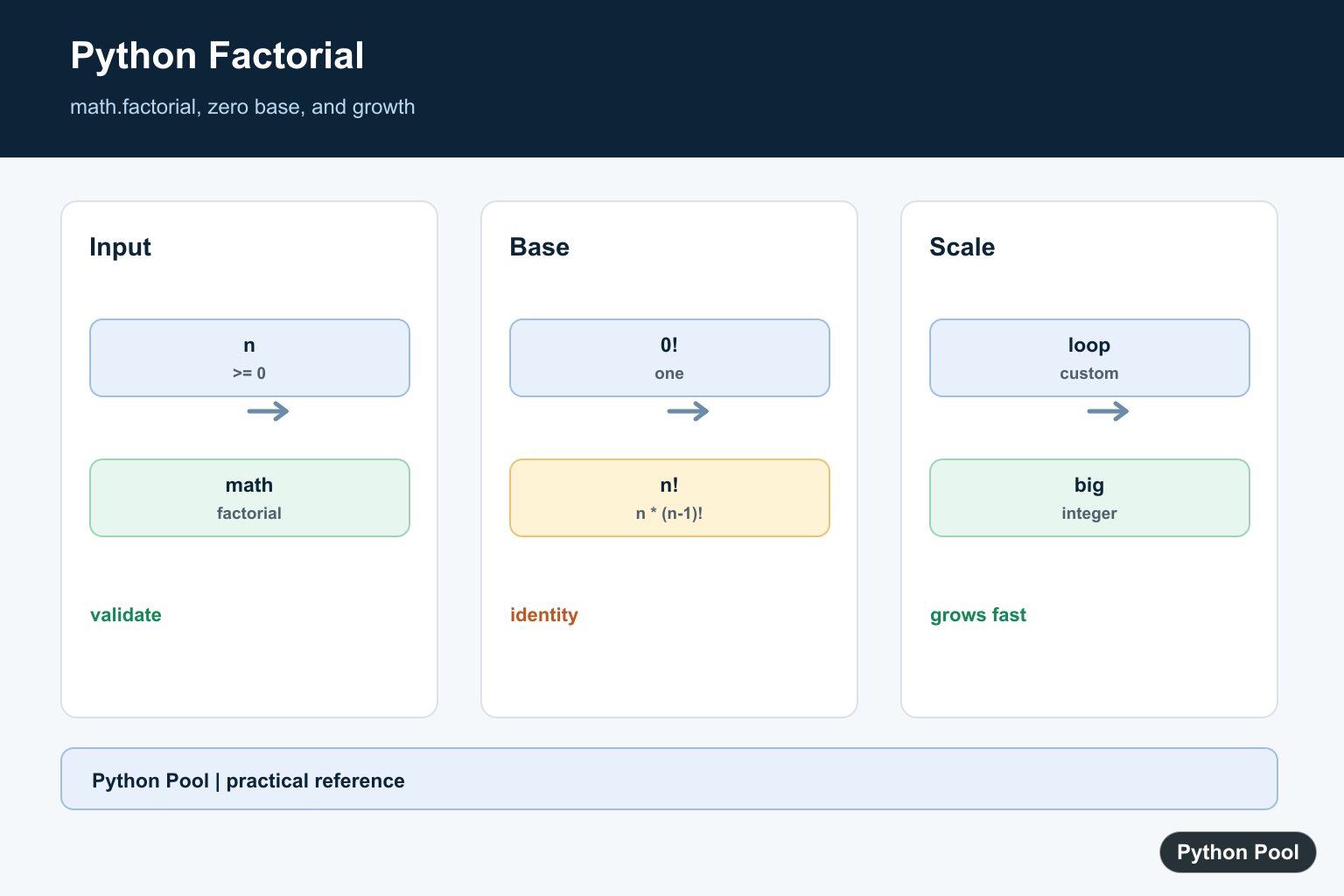
0! equals 1, the multiplicative identity. This base case makes the recurrence n! = n times (n-1)! consistent and allows loops to start with a product of one.
Validate The Domain
Reject negative values and non-integral values explicitly. A float that happens to represent an integer may still indicate a boundary or data-model problem that should be handled before calculation.
Prefer Iteration For Custom Logic
A loop avoids recursion depth and repeated function-call overhead. It also gives a natural place to check a maximum input, instrument progress, or use a custom numeric type.
Test Growth And Edge Cases
Test zero, one, a known small value, negative input, and the largest input your application permits. Factorials grow rapidly, so choose an integer, decimal, or modular representation appropriate to the result.
Python’s math.factorial() documentation defines the supported domain. Related references include products, memory considerations, and validation tests.
For related arithmetic patterns, compare products, factorization, and validation tests when implementing factorials.
Frequently Asked Questions
How do I calculate factorial in Python?
Use math.factorial for a non-negative integer or write an explicit loop when learning or adding a custom policy.
What is 0 factorial?
0! is 1, the multiplicative identity and the base case that makes factorial formulas consistent.
Can factorial accept negative numbers?
No. Factorial is defined for non-negative integers, so reject negative or non-integer input explicitly.
Should I use recursion for factorial?
Recursion can illustrate the definition, but an iterative approach avoids recursion depth and call-stack overhead.